This forum is a read-only archive. Posting, replying and signing in are disabled.

xGov-119: Zorkin - Social Login for Self-Custodial Account Authentication with ZK-SNARKs

altaro

This is the official discussion thread for xGov-119: Zorkin - Social Login for Self-Custodial Account Authentication with ZK-SNARKs

Id: 119
Period: 3
Title: Zorkin - Social Login for Self-Custodial Account Authentication with ZK-SNARKs
Author: Winton Nathan-Roberts (@mangoplane)
Company Name: Helium Labs
Category: dApps
Focus Area: User Onboarding
Open Source: Yes
Amount Requested: 100000
Status: Final

Abstract

Zorkin aims to implement a ZK-SNARK based OpenIDConnect authentication solution that runs natively on Algorand, allowing Social Login like Facebook to authenticate access to an application specific self-custodial Algorand Account.

A fiat on-ramp will be integrated into the solution to enable regulatory-compliant blockchain asset purchases using major payment methods such as credit card.

Team

  • Winton Nathan-Roberts as Research, Design & Software Engineering lead

  • Skilled independent contractors for auxiliary tasks spanning software engineering, legal consultation, and financial services

Contractor involvement in core system design and implementation will be minimal and subject to rigorous validation checks.

Experience with Algorand

Winton Nathan-Roberts is a Machine Learning PhD dropout with over 4 years of industry experience in Software Engineering working for various Startups & Blue Chip companies like Wargaming.

Over the last two years, he has been working largely in silence on an Algorand-based Web3 gaming venture. His current focus is on enhancing user onboarding for Web3 dApps and games, with a specific emphasis on regulatory-compliant authentication and fiat on-ramping. Helium Labs on GitHub represents some of this work, with many of its repositories private.

Present Proposal

Zorkin aims to implement a ZK-SNARK based OpenIDConnect (OIDC) authentication solution, allowing Social Login like Facebook to authenticate access to an application specific self-custodial Algorand Account. A variant has been implemented by Mysten Labs for their Sui blockchain called ZK-Login, which is only usable with Sui. Zorkin will attempt to improve upon ZK-Login, if possible. Some of Algorand’s user experience (UX) challenges, like the need for explicit consent for asset Opt-In, will be mitigated by possibly leveraging ARC-56 whose development is proposed by XGov-117.

Multiple system designs are being explored, with one variant and its MVP implementation detailed at this Github repository. However, the final deliverables will differ, as development is expected to lead to an enhanced design and implementation.

Zorkin will be integrated with a 3rd Party Fiat On-Ramp to allow users to buy approved crypto assets using major payment methods like credit card, taking care of relevant compliance. A Fiat On-Ramp such as MoonPay will be considered for integration.

Deliverables

The deliverables of this proposal are the success criteria, against which the proposal can be considered delivered on should they be met, and are enumerated below.

ZorkinInfra is defined as a ZK-SNARK based OpenIDConnect authentication solution that authenticates access to a Self-Custodial Algorand Account, that’s local to a specific tenant. A tenant is an application interface to ZorkinInfra, through which users can authenticate access with ZorkinInfra to self-custodial Algorand accounts that are local to the tenant. PaymentInfra is defined as payment infrastructure that allows billing of tenants for their usage of ZorkinInfra to cover related operating expenses (e.g. cloud hosting costs) and a pre-determined profit margin. The Dashboard is an area where customers can configure their tenants, and manage their billing via PaymentInfra. LegalConsult refers to consulting with a relevant legal professional to ensure the deliverables comply with relevant laws, and to assist in drafting necessary legal documents such as terms of service.

In chronological order, the deliverables are:

  1. Development of ZorkinInfra

  2. Development of Dashboard

  3. Development of PaymentInfra

  4. Testnet Deployment of ZorkinInfra, with a tenant configurable via Dashboard and billed via PaymentInfra

  5. Integration of at least one 3rd Party Fiat On-Ramp

  6. Initiation and completion of LegalConsult

  7. Refinements of ZorkinInfra, Dashboard & PaymentInfra against feedback on their testnet deployments & legal consultation (LegalConsult)

  8. Mainnet Deployment of ZorkinInfra, with a tenant configurable via Dashboard and billed via PaymentInfra

The delivery timeline is deliberately open-ended to prioritize legal compliance and consumer safety. The deliverables will be available for public access only in jurisdictions where they fully adhere to local laws. The deliverables will be adjusted against feedback from legal consultation to ensure legal feasibility. These services will be offered as long as they are financially viable and legally permissible, with a planned legal sunsetting and exit strategy to be devised and communicated to consumers through the terms of service.

Minimum-Viable Product Demo

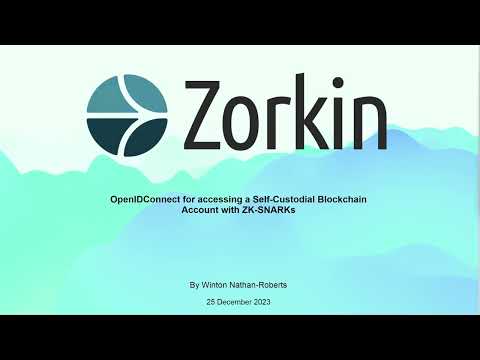
The following video showcases an early-stage design of Zorkin, featuring a demo of the Minimum Viable Product for this variant. Please be aware that the described variant is in its early stages; the final deliverables may differ significantly as the design will be refined throughout development.
Benefits for the community

If implemented, developers in supported countries can provide users with a ZK-SNARK based OpenIdConnect authentication solution to access an application-specific self-custodial Algorand account linked to their OAuth credentials. The integrated 3rd party Fiat On-Ramp will enable users to buy approved crypto assets using major payment methods, including credit cards. Some of Algorand’s UX challenges, like the need for explicit consent for asset Opt-In, will be mitigated by possibly leveraging ARC-56. Estimates of operating expenses like cloud hosting suggest it may have competitive pricing to competitors in the space.

Additional information

Open Source Clarification

The proposal’s metadata suggests it will be Open Source, but this applies only to solution components chosen at our discretion such as certain frontend application clients. Each open-source component will be subject to a separate license with respective terms and conditions that must be adhered to.

Ownership of Deliverables & Intellectual Property

The deliverables and related intellectual property (IP) will be fully owned by Winton Nathan-Roberts, who reserves the right to do anything with the property as permitted by law. To the best of our knowledge, the current IP isn’t conflicting with any patents. The intellectual property and deliverables might undergo ownership transfers, leading to possible rebranding or integration with other companies or products. For instance, Zorkin could be renamed and associated with a different product the author is affiliated with under similar ownership changes. Zorkin, described by the proposal, is a commercial endeavour with the aim to profit.

Self-Custodial Definition

The proposal’s Self-Custody aspect means that Zorkin or its affiliates do not hold users’ sensitive account access keys, such as private keys, whose possession would allow the holder access to the users’ account. Account access is restricted to the user, their OAuth account provider, and potentially frontend application clients.

Disclaimers

To the fullest extent permitted by law, this proposal and Zorkin are subject to the following legal disclaimers:

  • NO WARRANTIES: We offer no warranties or guarantees, explicit or implied.

  • NO LIABILITY: We are not liable for any damages from using or inability to use this content.

  • INDEPENDENCE: We do not necessarily have a direct affiliation with any party mentioned or implied besides Zorkin.

  • INDEMNIFICATION: You must defend and indemnify us against all claims and damages from your use of the content.

  • NOT PRODUCTION READY: The content may have vulnerabilities and is not for production use.

  • USE AT YOUR OWN RISK: You are solely responsible for using the content and ensuring its legal compliance.

  • UNVERIFIED CLAIMS: Claims in the content are not independently verified; do your own research before relying on them.

  • IMPORTANT NOTICE: This document, including all disclaimers, should not be considered as legal or investment advice. The information provided is for general informational purposes only.

Due to the research heavy nature of the proposal, all claims are subject to change.

Link to the full proposal on GitHub:

Please see the disclaimers and additional information in the proposal for context and clarification around the terms such as “Open Source” (which applies only to components chosen at our discretion).


edited
altaro

I believe we have until the 6th of February to make updates to our proposals :smiley:

edited
altaro

So why do we even need another social login method? Here’s why I think it’s worth pursuing, subject to proposal disclaimers:

  • Current estimates indicate pricing will likely be cheaper than competitors such as Web3Auth, especially for applications where few users transact, such as Free-To-Play games where only 2-5% of users make purchases. A pricing model being considered is one that charges for authorized session creation as the billable usage metric. Session creation can be deferred to the first transaction and is often includable in the session-authorizing group transaction, providing sybil-resistance
  • To mitigate vendor lock-in risk
  • By being Algorand first, many Algorand specific UX issues can be addressed in a single cohesive solution. For instance, we could streamline Asset Opt-In if the Minimum Balance Requirement (MBR) is covered and potentially enable cross-chain asset interoperability
  • To attract developers to Algorand

Note, pricing is variable based on the Algo/USD exchange rate. Algorand has expressed that it will adjust fees to keep them relatively low.

edited
altaro

Most countries are possible in theory, as evidenced by comparison with similar services like Magic Link. However legal advice is required to give definite answers.

edited
GhostOfMcAfee

I really like this idea. However, I worry if this may be duplicative of things already planned by the Algorand Foundation.

During a recent interview with John Woods (CTO Algorand Foundation) mentioned that AF was developing a product like ZKLogin that would be out “very soon.” (see this link, relevant discussion starts at around the 55 min mark in case time stamp doesn’t work).

Are you familiar with this planned product? If so, can you describe how what you propose is different?

Also, while I can appreciate the need for a flexible delivery timeline, can you put a rough approximation on things?

joe-p

I believe what John was referring to was the research we have been doing with FIDO. First for authentication with websites (ie. login with wallet) and then txn approval. @altaro’s proposal is very different from what we’ve been researching as far as I know. Even if that wasn’t the case, something like ZK-based login is incredibly complex and different implementations will have different tradeoffs and UX so it’s always good to have more options, especially with “bleeding edge” stuff like this.

altaro
↩ in reply to GhostOfMcAfee

Thanks for the question. Algorand Foundation (AF) is developing a FIDO2-based auth mechanism that’s significantly different to Zorkin’s OIDC based-solution. As @joe-p outlines, AF’s solution currently only supports user authentication. It’s unclear the extent to which AF will enhance the user experience, such as including an integrated Fiat on-ramp which Zorkin intends to do.

Below I compare the self-custodial FIDO2 authorization mechanism I’m familiar with to Zorkin. Although AF might use a different method, all FIDO2 mechanisms I’ve seen are similar, primarily leveraging the challenge-signing phase of the FIDO2 auth ceremony. Since both methods are still in development, the details provided below may differ to their final forms. Unintentional inaccuracies may be present.

Zorkin based Transaction Authorization:

  • Zorkin enables OIDC-based authentication through social login providers (e.g., Google) to gain access to a linked application-specific Algorand account, leveraging the privacy-preserving nature of ZK-SNARKs to keep sensitive access keys within the frontend

  • A user must authenticate with the same mechanism they normally use with their OIDC provider such as multi-factor authentication (MFA), Passkeys, FIDO2 & password. Often the experience is one-click using session information from cookie storage

  • Zorkin will provide a recovery mechanism should the interfacing application (e.g. website) become inaccessible. The OAuth account itself can be recovered via any recovery mechanism the user has with their provider

  • It’s compatible with any OIDC provider that allows customization of at least one OAuth claim in the initial request, including Firebase, Google, Github & more

FIDO2 based Transaction Authorization:

  • FIDO2 can be used to prove access to a FIDO2 credential stored on an authenticator device to authorize transactions from a linked Algorand account, inheriting FIDO2’s properties like passwordless & phishing resistance

  • Unlike OIDC, which offers a complete authentication solution, FIDO2 lacks essential account management features. For instance, it does not provide a recovery option for lost authenticators, session revocation, or the ability to update authentication factors, such as adding multi-factor authentication (MFA). Additionally, even with OIDC based authorization methods, managing an associated Algorand account requires extra logic

From now on, this method will be referred to as “FIDO2.”

Some Similarities:

  • Both methods are self-custodial means of transaction authorization, in the sense accounts are accessible to interfacing frontend clients. OIDC based methods also provide access to OAuth providers, inherent in its centralized nature

Some Differences:

  • FIDO2 has weaker browser and mobile authenticator support compared to the well-established OIDC flow, which supports a broader range of authentication factors like Magic Link, Password & Username, FIDO2, and more

  • Applications can seamlessly integrate Zorkin with their existing OIDC auth solution, provided it’s compatible. In contrast, FIDO2 would require retrofitting to existing user profiles through some linking process

  • FIDO2, lacking comprehensive features such as account recovery that OIDC offers, is not a complete authentication solution by itself. Zorkin aims to provide many of these additional account management features

In conclusion, they have distinct advantages and disadvantages. Depending on IP ownership, FIDO2 auth might be added to Zorkin as an alternative option. A developer may wish to offer social login, which people are familiar with, alongside FIDO2 via Zorkin.

edited
altaro

I intend to make a few updates to my proposal. Apparently we have until the 6th of February to do so.

Algomania

This is interesting, I will be honest I am not a coder so whenever i see ZK-SNARKS i think privacy and transactions , I think Zcash & shielded TXs but I understand there would be MANY different types of applications you could use ZK-SNARKS for. Sorry if this is off -topic Might be a dumb question sorry but I was curious if this would make it possible to create shielded TXs in future or does Algorand already have the ability to do this in its core code. Maybe im thinking about the most popular use case for ZK-SNARKS i would think the addition off this will give algorand an edge over other chains.

altaro

Thanks for your interest in Zorkin. For this proposal, the scope is being limited to authentication & transaction authorization. I will consider privacy extensions in the future, possibly as a separate XGov proposal.

ZK-SNARKs have a wide range of applications outside private transactions. Effectively they can be used to prove a fact to a verifier with a proof generated off-chain that consumes private input not seen by the verifier, using the prover. Example applications include off-chain transaction verification (e.g. zkSync), private transactions (e.g. zCash), and using OIDC authentication/authorization on-chain without exposing the sensitive JWT access token involved on-chain (e.g. Zorkin).

altaro

Hey, just letting you know that I updated the proposal. The updated proposal can be viewed at xGov119’s PR on Github.

The latest commit, bbd49ad97a25e536b099bc0d742d0e190170b7df, is at the head of this update.

The main changes are in the clarity of explanation, and a couple clarifying terms.

altaro

Update: The proposal has been committed with a status of final.

edited
altaro

The proposal you’ll be voting on is whatever appears in the voting session after recently being snapshotted and merged. The scope of that proposal is self-contained, and doesn’t include whatever is said outside the proposal.

I’m currently attempting to revise my prototype to use a superior method, as permitted by the proposal. Note the proposal allows refinement.

By the start of voting I’m hoping to have a revised method, with a video demo, although this isn’t guaranteed.

edited
altaro

The proposal explains in plain English to expect the delivered method to be significantly different to the current prototype, as it naturally evolves over the course of development.

From delivery, expect a paid service that’s available only in supported countries, with these outcomes: access to a self-custodial Algorand account using OAuth/OIDC, presence of ZK-SNARKs, partial reduction of UX friction associated with Algorand (such as explicit asset opt-in), and integration of a fiat on-ramp. The definition of self-custodial is in the proposal. The specific system design & implementation that achieves these outcomes is flexible & in my control, with the proposal presenting a working prototype of one approach!

edited
altaro

In the proposal, “Helium Labs” is a placeholder for a company I’m about to create. I’ll specify the registered company before voting commences, which the proposal will reference.

altaro

Hello everyone,

Exciting update: I have applied to register “VERSEWARE PTY LTD” (not yet a registered company) as a Proprietary Limited Company and have secured verseware.io as its domain. The name is currently undergoing manual review. It’s important to emphasize that the registration is still pending and could be rejected. I’ll keep you updated on its progress.

The name “Verseware” is a blend of ‘Metaverse’ and ‘Software’, and I have confirmed the absence of conflicting trademarks to the best of my knowledge.

Additionally, I have not yet documented an alternative variant as previously mentioned. I will provide an update on this as soon as possible, though I cannot specify a timeframe and I’m in no rush.

Cheers,
Winton

edited
Algomania

Ill be honest the private transaction feature will be incredible later on mixed in with xgov-108 if this goes ahead since this has offline signing aswell. Fully airgapped. What a great combo … this ill be honest a private transaction feature will bring an entirely new perspective on this coin and ppl will stop calling it a government coin or cbdc and it will bring entire new users onboard. Privacy is a hot topic in this era of suppression and cancellation culture

altaro
↩ in reply to altaro

VERSEWARE PTY LTD is now a registered Australian Proprietary Limited company, which legally represents Zorkin in trade and commerce. The entity will also represent most (if not all) business activities I conduct in this space.

In the proposal, “Helium Labs” is a placeholder for VERSEWARE PTY LTD.

I may rename the company sometime in the future, but it’s honestly fine. The name sounds good, and I’ve thought about existing trademarks and don’t see any cause for concern.

altaro
↩ in reply to Algomania

I agree privacy is important. While I’m open to considering privacy-enhancing features in the future, I cannot make any promises as previously mentioned. The current focus is on the core experience per the proposal.

Private transactions often face legal restrictions due to their potential for facilitating crimes (e.g. Tornado Cash). Privacy features we implement, if any, will be legal and ethical.

Having thought about it, chances are I won’t add private transactions of any kind, however other types of privacy-enhancing features will be considered for inclusion.


Notes:

  1. My understanding is certain types of private transaction, such as using a single record-keeping custodian or engaging in non-monetary exchanges, may be legally permissible. Further due diligence is essential.
  2. This post is not intended as legal or investment advice. Please conduct your own research.
edited
Algomania

Thanks .

just an FYI ZEC is sold in every exchange without any issue maybe the exchange has certain rules you must abide by and i agree if the exchange says mst be unsheilded then thats what you must do but between 2 private parties why cant you make a shielded TX ., by the way most exchanges i have seen in Aus sell monero if the exchange doesnt allow shielded it will stipulate , and its only an option if the wallet provider decided to implement it. Some countries require this privacy from their tyranical goverments, oThat is why the standard transaction is non zk-snarks you have to decide wether you want to make this transaction or not , z-cash has been approved by some government entity which is basically the same it has shielded and non shielded unlike monero where it is the standard and you must transact privately

altaro

I have a bunch of updates regarding xGov119 (Zorkin). It is difficult to speak in absolutes since AF’s WebAuthn solution is still a work in progress. I welcome corrections for any unintended inaccuracies in my interpretation.

:magnifying_glass_tilted_left: AF Webauthn vs. Zorkin: A Clarification

I want to clarify once again the significant differences between the Webauthn approach that AF is developing and Zorkin. Let me explain.

My understanding is that AF is developing a Webauthn authentication method without an OAuth provider, initially focusing on authentication and then transaction authorization. Below, I compare this to Zorkin.

Webauthn for OAuth Authentication

OAuth2, utilized by Zorkin, can use Webauthn as an authentication factor if offered by the OAuth provider. This inherits the provider’s setup, such as passkeys and Web2 account recovery options (for example, see Google Webauthn).

After OIDC authentication, a user can authorize transactions from a linked Algorand account, with access proven via a ZK-SNARK proof through Zorkin.

Zorkin’s Additional Efforts

Zorkin will provide additional features such as simplified Asset Opt-In and a Fiat On-Ramp. I’m fairly certain AF won’t go this far, focusing solely on auth.

Integrating Zorkin Seamlessly

A business can integrate Zorkin seamlessly, enabling existing users to access a linked Algorand account, assuming they use a supported OAuth provider.

Conversely, WebAuthn alone would require explicit linking to existing user profiles and, without passkeys, ties the authentication factor to a specific device. It’s unclear if AF’s solution will include passkeys.


In short, Zorkin can use a number of OIDC authentication methods, including Webauthn, depending on what is supported by the chosen OAuth provider. With the fiat on-ramp and other features, it will provide a nearly frictionless Algorand onboarding experience.

edited
altaro

:scroll: Open-Source Licensing with the Apache License v2 (APLv2)

I have decided to make all source code for xGov119 software deliverables available under APLv2 to the fullest extent legally possible, if the proposal passes this xGov session. This does not mean the service will be free to use; charges will still apply for usage.

Should the proposal not be approved, I retain full discretion over its future. In such a scenario, I cannot commit to releasing the product or making it open source.

edited
altaro

:chequered_flag: Approaching the Finish Line

Finally, the proposal is close to achieving 90% of votes needed to pass. In these final moments, your support is crucial to help it succeed. I will devote all my energy to fully realizing its potential, if it passes.

The funding will primarily cover my salary for several months of intense R&D work and any incidental expenses I may incur along the way, such as a hypothetical registration fee or external freelance tasks, like creating a marketing website.


For more details, see the proposal on GitHub with its video demo. GovernorHat on Twitter ranked xGov119 with a select few in the S-tier after thoroughly reviewing them all.

edited
altaro

I would like to clarify a few things I’ve said so far in case I have miscommunicated them unknowingly. Please understand the following:

Clarification on APLv2 licensing

By saying the source code is licensed under APLv2 where legally possible, I mean in respect of any license terms I must oblige by such as copy-left licenses, and such. Anything that may legally compromise me will be respected first and foremost. Read about APLv2 online to understand how that license works.

Clarification on Self-Custodial meaning

By self-custodial, I mean user assets are not actively managed and the sensitive user access keys are not in direct control of Zorkin (i.e. assets won’t be in my custody). However depending on how it’s implemented, parts of the implementation will require innate trust in a 3rd party to not act maliciously. It is almost unavoidable, even in most respectable self-custodial wallets I won’t name.

Examples of how trust is required include compromised client code integrity (e.g. a frontend or app is updated to use a hidden malicious version), or more specifically in Zorkin’s current design having the Chainlink SC be updatable to allow updating OAuth provider JWK signing links should they change.

I will do everything I can to ensure the trust is minimized and security is maximized at every opportunity. For example having client-code integrity verification by having a webapp build to a single file whose hash can be verified in the client, DNSSEC/DNSLINK, open-source code, and consideration of a DAO for community voted upgrades to infrastructure with immutable versioning.

These are examples of small design choices that may be made during development should this project be funded. This is to be expected as the proposal is R&D intensive and not fully complete, which is why I was liberal with disclaimers and vagueness in the proposal.

Deliverables

Following on from the last section, since it’s R&D intensive, please understand the final concrete design will of course be different to some degree. There are numerous small design choices that are yet to be made, as I continue to refine and iterate. But rest assured the high level gist, “Self-Custodial social login to authorize transactions with ZK-SNARKs”, will be delivered by EOY if passed. The way that is achieved and presented will inevitably evolve during development. Where “self-custodial” is the definition given, as clarified above.

I look forward to the outcome. If you have any questions please let me know and I’d be happy to answer.

edited
altaro

I mistakenly believed I had signed the contract by completing the Google Docs form. However, I now realize a Docusign digital signature is also required, which will be delivered separately. Sorry for any confusion. I’ll keep you updated.

I’m reviewing the contract again to ensure I haven’t accidentally overlooked or misunderstood any crucial details. For instance, I may need to do more than write articles to fulfill the promotion part of the “purposes” as defined in the contract. I’ll inform you if I decide to modify my plans, such as my promotional strategy, to satisfy that requirement.

As explained earlier (see the proposal), given that this is an R&D-intensive project that is non-trivial, expect things to change within some reasonable tolerance. For example, I may code something one day and write an article (or make a public Git commit), and then iteratively refine it later after discovering a better way to do something for the betterment of the project.

Disclaimer:
As always, nothing I say is intended to be legal or financial advice. I’m not a lawyer or financial professional. While I believe my layman interpretations of the contract are accurate, please seek professional guidance if you have the same contract.

edited
altaro

Business Entity

I recently registered the Australian company Inter Auth Systems Pty Ltd last night. This company signed the contract and assumes full legal ownership and responsibility for the proposal and intended business. What I meant in saying “I may rename the company sometime in the future” above, is that I may change the company and that’s what I’ve done.

Please disregard the above business entity I have previously mentioned. As explained, Helium Labs in the proposal is a placeholder, and it is actually my Github organization, which I’m going to rename.

edited
altaro
↩ in reply to altaro

I am currently receiving legal advice regarding the open-sourcing of the solution. Once I have received the necessary guidance, I will prepare a statement addressing the matter. I will share the statement as soon as it is ready.

edited
vidhyanand
↩ in reply to altaro

Yo only need to create an article after deliverables are completed. The main purpose of the article is for the community to try out your product and also to know the benefits the product may offer.

So the article should be less of a tecnical thing.

altaro

Zorkin: Beta Release & Design Document Expectations

Hi Everyone,

I have an update regarding Zorkin, which I’ve been working on.

I’m nearing a beta release of the product, which will hopefully be ready for testing by Friday. It should have all the core features to be approved for the xGov grant, except for legal consultation and the on-ramp integration.

If you’d like to sign up for the beta release, please register here: Beta Release Signup.

I’ve made several refinements to Zorkin’s architecture since the first version of the design document. These changes are publicly documented here: Zorkin GitHub Repository.

I want to make it clear that the repository, along with any related public musings, is not a roadmap of expected features. Most of the features listed there won’t appear in the xGov release. It’s a place to record my design thoughts as they develop, particularly in a public space to guard against patents.

Zorkin is research-intensive, as it’s a full-on product and startup that hasn’t been done before. This means we can’t realistically predefine all the features upfront. Instead, we’re delivering the promised big picture, which is what I’ve focused on. That’s why I emphasized that the design documents are subject to change and shouldn’t be considered a roadmap of features that will definitely appear in the release.

The big picture will be delivered as described in the actual grant proposal, which specifies a list of high-level deliverables to expect if all goes well. You can view it here: Grant Proposal Document. It’s nearly done, and I’ve made several refinements over time. Some specific approaches, like the initial architecture described in the early design document, likely won’t be followed as they’ve been revised.

For example, I have decided it’s best not to verify RSA signatures within the circuit and instead do it on-chain. I’m currently adding modular exponentiation as a new opcode to Algorand, which will hopefully be available in AVM 11. You can see more details here: Algorand Issue #6139. This innovation was only recently conceived, which means the old design will not be followed.

If you have any questions, please feel free to ask.

Kind regards,
Winton

edited
altaro

Announcing the Release of Beta v1

I’m excited to announce that beta v1 is available today. Unfortunately, due to time constraints, not all features could be included. These features will be added in subsequent beta releases. Please see the email sent to participants below:


Hi everyone,

We are excited to announce that the Zorkin Beta v1 Testing Program is now open to all who signed up via our Google form. This closed beta is designed to minimize cloud resource usage due to the prover’s compute-intensive nature and will remain available until further notice.

What’s Included in Beta v1:

  • Demo Frontend on the Testnet: Experience the functionality firsthand with our demo frontend.
  • Early Access to the Zorkin SDK: Provide your valuable feedback as you explore the SDK.
  • Open-Source Components: The demo frontend and Zorkin SDK are open-source, allowing you to view and contribute to the code. While most of the backend infrastructure remains closed-source, the prover-server and MIMC hasher are available for your review.

We will continue to add new features in waves leading up to the production release. Looking ahead, Beta v2 will introduce a dashboard for provisioning Zorkin instances and a billing system.

Next Steps:

  • Try the Testnet Demo: Access the demo by signing in with the same Google account you used to register. Please note that email addresses not associated with a Google account cannot access the program due to our Google sign-in authorization method. If you’re using a non-Google email, please fill out the form again using a Google email address.

  • View Source Code: We welcome your feedback on the demo source and the Zorkin SDK source.

A follow-up survey will be sent later for you to provide your feedback on Beta v1.

Thank you for your participation and support. We look forward to your feedback and collaboration as we work towards the production release of Zorkin.

Best regards,

Winton Nathan-Roberts

CTO of Inter Auth Systems Pty Ltd

Disclaimers:
Please be aware that the beta program is provided “as is” without any warranties or liabilities. Features present in the beta, and any claims made, are not guaranteed to appear in the final release, as our work is research-intensive and subject to change. Any misrepresentation is unintended.

edited
altaro

Beta v1 Testing Completed – Thank You & Upcoming Feedback Survey


Hi everyone,

Thank you for testing the Beta v1 release. The testing phase has now concluded, and we have gathered valuable insights from your feedback. We will be sending out a survey soon to collect additional input from all participants.

Please note that the prover server has been disabled, so authorization attempts will no longer be successful.

Kind regards,
Winton

altaro

Announcing Beta V2: New Features Now Available for Testing


Hi everyone,

Beta V2 is available for testing.

  • Beta V2 is the second stage of Zorkin’s Beta Testing program.

  • This stage introduces new features that closely resemble the production release, including splitting proof generation into two parts for speed gains, a dashboard to set up Zorkin instances, and the ability to manage your Zorkin subscription via Stripe. Additionally, various bug fixes have been made based on feedback from Beta V1.

If you’re interested in participating, you can follow the instructions here to create your own client and use it on your website to authorize your users.

Alternatively, you can test the new version without creating your own client by using the dashboard at Zorkin’s Demo Frontend.

Please note that only users registered for the beta program can access the dashboard. It will remain live until further notice. The focus of testing should primarily be on usability issues, bugs, and suggestions for improvement. Questions are welcome, and I appreciate your interest and assistance with testing.

Kind regards,
Winton

Disclaimer:
Please be aware that the beta program is provided “as is” without any warranties or liabilities. Features present in the beta, and any claims made, are not guaranteed to appear in the final release, as our work is research-intensive and subject to change. Any misrepresentation is unintended.