This forum is a read-only archive. Posting, replying and signing in are disabled.

Evolving Algorand Governance

shaih

As we announced last week, the Algorand Foundation intends to bring to a vote in Governance Period G3 (June 2022 voting session), a proposal to evolve governance away from the current focus on just rewarding passive Algo holders.

Starting in G4 (the 3rd quarter of 2022), we intend to grant extra “governance seats” and rewards that favor active participants in the Algorand ecosystem, starting with DeFi participants (and later expanding to other constituencies such as NFT creators, developers, node runners, etc.).

We need feedback from the wider Algorand community as we develop the exact rules that will govern these governance seats and their associated rewards. The feedback that we get will be incorporated into the proposals that will be brought to a governance vote in the June 1st 2022 voting session. From there, changes and modifications to these rules will be brought for vote by the governors before taking effect.

Please use this forum to discuss and give us feedback regarding specific rules. We ask for your guidance on the fundamental questions of who should be considered an “active participant” for the purpose of governance, how to decide if a specific Algorand account belongs to that set, and how many governance seats (and rewards) they should get.

Specifically, for the G4 (Q3 2022) governance period, we intend to have two forms of governance seats: passive Algo holders as we do now, and DeFi participants. Some technical questions that we need to resolve include:

  • How do we identify accounts that participate in DeFi, and how many governance seats they should get?

  • How to reconcile changing participation levels over time? For example, how much weight should be given to a vote that happens sometime in the middle of a governance period, vs. how much to use for calculating rewards at the end of the period.

  • Should we have just a single governance rewards pool that is distributed among all governors, or should each segment have its own rewards pool? (E.g., 50% of the rewards go to DeFi participants and the other 50% to passive Algo holders.)

Below are plausible rules, these are meant as examples to promote discussion, NOT as the final rules that we will use.

  • Algo holders who commit to holding their Algos in their account for [three months], would get [one] governance seat for every Algo they commit.

    We are asking for feedback here, and the parameters are up for discussion. For example, should we modify the three-month period? Should we ditch the commitment altogether and move to a low-watermark system instead? Etc.

  • DeFi projects that average at least [$10M TVL] as listed in DefiLlama would be tasked with providing the Algorand Foundation with a list of active accounts and their balances. These accounts will get [three] governance seats for every Algo-equivalent that they hold (using daily average).

    • Each project will give the Foundation a list just prior to opening each voting session, and another list at the end of the governance period. The voting power of each account will be determined by the former list, and the rewards will be determined by [the minimum] of all these lists.

    Again, the above is just an example, quantities above like the $10M TVL and three seats are of course up for discussion.


michel

Hi all, this is Michel from C3 Protocol and Rand Labs (AlgoExplorer + MyAlgo).

I wanted to leave a brief note on my opinion as to why this discussion is extremely important.

I believe that the current Algorand Governance tokenomics are materially handicapping the DeFi ecosystem of Algorand. This tokenomics are cannibalizing Algorand’s TVL by creating an extremely high risk free interest rate (9-10% APY) from which the DeFi alternative needs to compete with.

9% might not seam too much, but when taking into account the risk free nature of it (i.e. no smart contract risk, hot wallet risk, etc…) it is a huge floor on a Sharpe ratio basis (Return/Risk ratio). Thus, if institutions where to choose between allocation $ millions into Algorand DeFi, 9% APY with no risk is an extremely better alternative to say 25% APY with smart contract risk and custody risk. Also, remember that the smart contract risk in Algorand is even bigger than other EVM alternatives given how nascent TEAL still is and whales know this.

Therefore, all the Algorand holders are getting inflated to the tune of 280 million new circulating Algos per year to the expense of nothing good but rather direct cannibalization of DeFi and TVL which has been empirically demonstrated to be a leading indicator of price appreciation.

It is for these simple reasons that I believe Algorand Governance should be either shot down all together or drastically modified to change from the current negative incentives cannibalizing Algorand DeFi to positive incentives purely towards DeFi adoption of Algorand. I believe that done right, Governance rewards allocated to DeFi in a fair way can boost the ecosystem to a place where it can compete with other top 5 blockchains. This will be exponentially more effective as many whales and institutional investors won’t want to take the smart contract risk meaning that the APY will be further concentrated into the hands of retail degens who have strong word of mouth from which network effects benefit the most (in comparison to whales/institutions).

Crypto users are constantly seeking APY and it has become the defacto way of acquiring users for blockchains. Therefore, I believe spending 280millon Algos annually towards making users from other ecosystem come and test Algorand’s DeFi and tools by directing those rewards towards boosting APY’s is a much better use of funds and inflation than the current situation.

Happy to hear more thoughts on this.

lopezm

I find ICP governance to be very practical for both the foundation and the holders.

majicman42

I agree that a 9% relatively risk free return is very difficult for DeFi projects to compete with. However, making drastic changes to the existing infrastructure or doing away with governance itself is something that large exchanges, who hold a lions share of the Algos currently in governance participation, are unlikely to support since they have business models set in place that revolve around the current setup. Along with the community, AF will need to work with these exchanges to find a common ground on pushing forward a proposal that reduces the incentives for simply holding Algo but maybe in a staggered approach.
Maybe something like this:
3 different tiers of governance. 1st tier is your standard 3 month commitment, similar to the status quo except that this tier would be capped at a 3% interest rate (or something comparable to the official Fed rate) with a 1.25 seat bonus for DeFi activity. 2nd tier is a 6 month commitment w/ a DeFi activity bonus of counting 2 seats for every Algo committed. Proposing a middle ground tier between the current 3 month commitment and the xGov year long commitment since that is a pretty significant time gap. 3rd tier would be the xGov year long commitment that overwhelmingly passed last round, only users who have actively engaged in the last few Governance votes (we need official Algorand Governance Participation NFT’s please…) are eligible for this tier. These xGovernors get a DeFi activity bonus of 3 seats for every Algo committed, are able to formulate, evaluate and propose measures to be put to vote, and also share a percentage of the fee revenue generated through the protocol transactions. Quarterly votes on new measures would still apply.

Algo_Cleanup

One concern is the lack of support among dapps for cold storage Currently very difficult to participate in defi if there is no ledger support.

Michel and the foundation make great points for rewarding with compensation and extra votes for those that participate in the defi space.

Two interesting scenarios come to mind.

  1. Rewarding a defi wallet based on the assets held, but this raises the question will the wallet that minted goBTC be treated the same as the one that swapped for goBTC on tinyman?

  2. Rewarding a defi wallet based on the value of the defi assets, but this raises the question of an individual holding lots of LP tokens, clearly participating in defi, but the value may have significantly dropped over the governance period.

Just a few of my initial thoughts.

HashMapsData2Value

+1 to Michel’s comments. I do believe that the exact return might change once we have exhausted the Foundation’s reserves and we start dipping into the FeeSink from the transaction fees, but in the meanwhile DeFi is being affected.

One thing that hasn’t been mentioned here is running a participation node. Accounts that are engaged in consensus are listed as “Online”.

Let me preface this by saying that I do NOT believe that participation node runners should receive rewards for running a node. Silvio has argued this before and it comes down to the fact that the cost is simply too low, the “work” (and hardware required) doesn’t really scale with the Algos staked. We’d be at risk of centralization. (I DO however believe Relay nodes should be rewarded, since running one is very costly. Preferably they should compete with each other to the point that nodes are barely breaking even.)

But I do think if you run a participation node so your account is online while you engage in governance, you should have more of a say. Maybe it should 2x your voting power, or something. This would be a good way to encourage participating in consensus, decentralizing Algorand.

(As always, we need to be careful to do this in such a way that whales dont just split their holdings over many smaller accounts.)

edited
defidaddy

Governance should always exist as a form of shareholder vote just as regular stocks hold votes. If your holding shares between certain periods, you are eligible.

Now, I agree this isn’t worth much but that is why we have xgov which already passed the vote… this needs to be expanded upon to bring more value to the blockchain as a whole. We do this just like everyone else… staking, and what that means is you must run a participation node. With concerns around defi participation I would concede the longer lock up periods but it is absolutely vital that we start securing and decentralizing the network. We can worry about relay nodes later. They are already paid until a certain date. At some point maybe we make relay nodes another layer of governance with lockups and slashing to incentivize good node running similar to running a validator on ethereum.

So here is what I would like to do as a participant.

  • Have my whole stack backing a participation node. This would be a layer of governance.
  • Participate in governance voting. Same rules as stocks. Small reward.
  • Use something like algofi to do governance so real coins are locked up and receive wrapped tokens to use in defi. Ideally a non permanent loss pool.

I would do all this and be happy with all parts summing up to ~10% apr which anyone can do. This brings much more value than just doing defi rewards or just doing governance. If everyone did this it should count towards TVL and everyone is happy.

Abondoning governance and just handing out money in the form of government subsidies is distasteful and I would avoid at all costs. It only gets messier from here.

Gov22

Created this new account, and leaving this comment just as a suggestion : Algo should really take a step back and think about how coherent their brand is… I almost missed the last vote because I never received a notification in my app… plus the app logo changed… plus the app drastically changed ( to pera )… I had thought my account was hacked… No direct communication in advance… No notification… No option to “vote with (majority)” so you don’t lose rewards…

I didn’t even know these forums existed until someone on reddit is linking to them - if you want feedback from the algo community - why can’t I leave this reply right inside the pera app? why didn’t I get a notification that the foundation wants feedback from governors? why was no “Welcome to algorand” email or text or splash page in pera or so on ever happen? Why don’t I know about most of your ecosystem, and why have you put so little emphasis on me ever being welcomed/invited/informed of any of it?

Im constantly told “you have to dyor” and “you have to contribute” and “you have to get informed, get involved” - as if it’s solely my fault that algo feels so fractured in so many ways… Meanwhile, entire counties, entire states, are protesting, rioting even - because someone couldn’t vote - because they didn’t update their drivers license for the last 20 years - and that HAS to be racist…

Anyway - “we are very new” seems to be the overall crypto theme - so many of these issues were never yours to solve in a day - but you really should put more effort into solidifying the “brand” and doing more to get your core community involved further, included better, and informed more meaningfully…

LuisERodriguez
↩ in reply to shaih

I am wondering why the governance dapp/smart contract could not read all the smart contracts a user may have opted in to .

. This way, all Algo tokens a governor or xGov holds should count towards governance .

. For any ASAs held, the foundation or through a vote itself, create a whitelist of other tokens that can count towards governance ?

Edit#1: Also note that the high APY is only high due to the number of participating tokens is not high enough. If we automatically count all tokens a user holds in a wallet or locked up in smart contracts then users can collect rewards for both governance and participating in DEFI/games etc, this should solve he issue.

I assume there will be different tier of rewards for xGovs ( time commitment required) versus just voting.

Thanks,
Luis E. Rodriguez
https://www.linkedin.com/in/luis-e-rodriguez-b8969922/

edited
nollied

i would be weary of giving too much power to the rich. although any dampening of wealth opens exploits to sybil accounts. to combat this, identity/KYC systems can be employed, but with the sacrifice of permissionless-ness. it’s a delicate balance.

a measure of breadth and depth of governance contribution is important. if you only vote on one item with 10,000 algos soft-staked, you are probably less valuable as a governer than someone who voted on 50 items, yet only soft-staked 100 algos. this of course assumes their depth level is reasonable – ie. they were diligent.

one way to measure this is to hold a peer-to-peer review of importance. the coordinape tool comes to mind, although it can be done in a plethora of ways. these reviews are notoriously hard to get right. beware.

ah yes… allocation of resources for public goods. i’m an active member in the gitcoin DAO and this is a problem we have dedicated workstreams to solve (like for example, the fraud detection and defense workstream that i am a leader in).

we are collectively building the 2.0 version of gitcoin grants where we are adopting a more modular approach for funding allocation. the goal is to provide all of the tools and processes needed to conduct resource allocation (based on the consensus of the community) without sacrificing legitimacy.

i would love to facilitate a collaboration between algorand and our fraud detection and defense workstream within gitcoin for fraud resilient governance fund allocations. this could be amazing!

this is called 1 dollar 1 vote (1d1v) and means that the rich potentially have unfairly amplified voices over the poor majority. we use quadratic funding, although it’s ripe with exploits so it should be proceeded with caution.

edited
defi

I agree DeFi participation should be the strong factor in governance classification. If the goal is to improve DeFi participation then communication improvements are a must, i.e. an announcement of new tokens or dApps in Pera wallet or an ad on Vestige would be a start.

Greater award will be based on the amount of Algorand held in an ecosystem wallet as well as the extent of dApp use/support. Not everyone has the creativity to design a NFT, coding experience or resources needed to run a node. These skills, should not be a requirement for taking part in governance.

Rewards should, of course, be based on the amount of Algorand held as well as the length of time one is willing to commit their tokens. However, if a minimum commitment is being considered, care must be taken so as not to ostracize those with less resources.

algouk
↩ in reply to Gov22

I missed the last vote.
For security all my crypto is done on a another computer which is normally switched off and disconnected.
Are mobile apps and the security of my phone sufficient for crypto?
The only way for me to keep up now is by subscribing to the Twitter account.

I was aware of the forum, but I thought it was just for technical issues and devs.

algouk

How are passive Algo holders rewarded?
Apart from a possible increase of value of the token over time?

I’m committing my Algo every three months and trying to vote on governance.
Should most Algo holders even vote?
As we probably don’t fully understand what we voting for.

Am I in a minority or a silent majority?

KennyG

Some really great ideas moving forward. I would first just advise to take as much time as needed before rushing out a change to Governance. It’s should be important to remember some of the qualities that Silvio has been pointing out, most importantly, inclusiveness. Creating Tiers may challenge this important aspect of the Algorand we have all come to love.

I think there can be a much simpler way to move Governance toward DeFi platforms without making initial massive changes. Why not run all Governance through DeFi platforms. It is essentially being done now. Stake Algo on your platform of choice for Governance, and then borrow to participate in DeFi. I believe if given more time this would have eventually happened.

Now, platforms should have some parameters. First, participating platforms should support cold wallets. Second, platforms participating in Governance must have PUBLIC auctions for liquidations.

I think this would be an acceptable next step in the evolution of the current Governance system that has been identified as the largest and most successful.

Great discussion. Thanks

nollied

agreed. these things take time and are brittle.

D3G

I will start by saying that this is a damn great post and I’m glad someone started this. I am sick of staking and governance systems. The majority of exchanges (these leaches) using the funds of others to participate in every single staking/governance and for this to stop, we need to get rid of this airdrops mentality… Nothing it’s free on this world, and as it was designed Algorand, it doesn’t need to attract billions of tokens staked for security. Algorand needs to attract investors, retailers, etc. through defi dapps, not through a fkn governance system with free Algo airdropped for nothing basically.

cooleydw494

I think this is a great post and very well thought out. I’d point out that governance rewards will continue to decrease and that perhaps some changes could be made via proposals rather than a dismantling from the top down (although exchanges and Algorand Inc will decide right?).

I don’t dislike the governance program and I think that some goals may not be the same for everyone, but to be honest I’m not knowledgeable enough to have an opinion on this. This sounds like a good idea, but Algorand governance also seems to have benefits to me. It does at the very least seem that the TVL argument is correct but I can’t synthesize that into a particularly strong opinion.

In any case, just some thoughts. I appreciate the post and think this is an important discussion as somebody who wants Algorand to achieve the success it deserves.

metigue

Hello all.

If the question is how do we reward active participation in the Algorand ecosystem to foster growth then I strongly disagree with rewarding participation in currently popular defi platforms with more than $10m TVL

This would only lead to pooling of funds on these already established platforms and make it harder for new projects to break into the space. Why would anyone try a new DeFi platform when they would lose their extra governance votes? It kills the potential for innovation and cements the status quo.

We need to reward all active participation equally or not at all - The problem is we can’t just count the smart contracts someone has value locked away in because not all smart contracts could be considered “active” participation.

I believe the solution to this lies in the auditing of smart contracts - If we included a simple standard flag in TEAL for “This account is actively participating with X amount” that could be added to contracts either by developers but only enabled after a short approval process or only added by approved auditors. This would be better than having a minimum TVL requirement because any project could potentially benefit and it would be easy to widen the scope of “active participation”

D3G

I rather see the governance rewards and voting power, distributed among all defi projects running on Algo based on their TVL/Ape - Value/Algo contribution, than airdropped for free in a gov. After all, the projects, devs, active users should be rewarded, not exchanges for participating with ur share, neither the lazy VC whales which votes are always pushed in their favor. I really hate these systems designed to grab a penny for nothing. If the only utility of a token, it’s to get u more tokens, than that token it’s useless…

KennyG
↩ in reply to michel

So, it’s hard to disagree with most of your comments. I don’t think you can just dissolve the current Governance system. This would be very risky in that most current retail investors are growing weary of the ever-changing Algorand ecosystem. I for one would be frustrated with an immediate change that drastic. It’s already hard to go long in this current environment due to the constant changes. Slowly evolve the current system.

cooleydw494
↩ in reply to cooleydw494

I’d also point out that even if there are valid concerns and what seem to be obvious solutions to seemingly obvious perceived problems, that the people behind governance have put a lot of thought and care into it for their own reasons and goals.

Silvio Micali speaks about the difficulty of creating the right incentives for a system to function well and discourage bad actors. Certainly we’ve seen our fair share of bad actors already intention-wise, but it’s worth asking the question of whether TVL is everyone’s primary goal, and if prioritizing it would be detrimental to other goals.

As I’ve said I’m far from a genius on these topics, but for those of you that are, at the very least remember to respect the hard work and serious thought put into this system in the first place by some brilliant minds. The OP was not particularly disrespectful but a few comments seem a little pointed.

jaclarke

Hi, this is John from Algofi (lending, AMM, NanoSwap). I’d like to briefly offer some thoughts on the Foundation’s proposal to evolve governance.

As a leading L1, Algorand is competing with Ethereum and other alternative L1s. Specifically, Algorand is competing for dApp users / TVL and their developers. Now, Algorand has a strong case that its technology is superior. (1) PPOS is a novel consensus algorithm that will enable Algorand to solve the blockchain trilemma, making the chain scalable, secure, and decentralized. (2) AVM is intuitive and safer to build on. (3) Algorand has never had downtime (unlike some other chains). (4) Algorand’s developer documentation is robust. So, as a developer, if you think these properties are important for your application, you should build on Algorand. But, as we’ve seen, the market is not so efficient and it isn’t just a matter of technology. Large incentive programs can tilt the scales in favor of a given chain if executed well.

Indeed, in the last year, L1s have taken advantage of their treasuries, propped up by marketing and network effects, to deploy large user / developer incentive programs:

  • Terra’s Anchor Protocol pays users roughly 20% to lend UST, their asset backed stablecoins (this costs the chain ~$2bn annually after staking rewards)
  • Avalanche has committed nearly $500mn to DeFi and multiverse applications through their Avalanche Rush and Avalanche Multiverse programs
  • Fantom announced a 370mm FTM incentive program that pays out to developers directly as a function of TVL
  • NEAR launched an $800mm grants program to fund ecosystem development with a focus on DeFi. NEAR has also launched a UST competitor, USN
  • Elron launched a $1.3bn incentive program to support the growth of its native DEX, Maiar

These programs have greatly benefited their DeFi ecosystems with native token price appreciation more than paying for them. As Michel said, incentive programs help grow TVL which is empirically correlated with token FDV. Intuitively, it makes sense that larger, flourishing dApp ecosystems help their native token appreciate (all things equal). Then the more valuable token can be deployed into other verticals like the ones Shai noted (NFTs, node runners, etc.). It’s critical for the Foundation to take advantage of these early days of DeFi to get users / TVL, developers, and build network effects for Algorand. We need to compete at both the technological and ecosystem development level, not one or the other. The best framework in which to do this today would be to modify Algorand Foundation governance to support DeFi.

I’ll come back with some thoughts on a potential compensation structure and implementation to measure DeFi usage.

Overall, I’m very excited to see the Foundation taking the steps I believe are necessary for Algorand to compete and, ultimately, win the lion’s share of DeFi users and developers. I invite any follow ups, comments, or critiques of my position.

Links:
https://medium.com/avalancheavax/avalanche-foundation-announces-180m-defi-incentive-program-d320fdfafff7
https://www.coindesk.com/tech/2021/10/25/near-protocol-offers-800m-in-grants-in-bid-for-defi-mindshare/

LinxFit

I think you need to be careful with this. Trying to tie governance with other projects can cause issues with market volatility. Also I think being in actual governance such as Algorand’s governance isn’t “passive”. You still have to join, you still have to make a decision else you are dropped. There is something that has to happen to also the position is still liquid the person is actively locking the token.

While I understand 1 algo=1vote makes sense and is the easiest to follow. As for time, I think that(time) is the best standard as it rewards the patient and not the ones looking for right now yield. There is a reason token locking and slashing has been implemented in so many protocols, those willing to take the risk are typically willing to contribute.

I think there are several issues and they need to be laid bare in many systems and talked about:

1Q. Does staking an L0/L1 token really help the core ecosystem? Especially if that core ecosystem is limited by scarcity (Limit of total available tokens and limited to unlocked/unstaked tokens)?
1A. From a L1 perspective you would want that token to be used a lot and traded around a lot. Basically your L1 token would be worth the usefulness of your ecosystem. Locking it away in a staking mechanism while may temporarily increase it’s value. That would be lost if lets say a lot of people just stopped staking and started spending.

2Q. Does TVL really mean have value? What would 10M TVL mean if it never moved or if it only moved during a market crash, like we are experiencing now?
2A. Probably not. That TVL is still locked to the wallet that deposited it so it isn’t going to get used unless it is some sort of AMM. I think being able to move volumes cheaply or provide a unique use case would be better to incentivize over pure $ amount. An example of this is lending collateral. Large TVLs because people are dropping their LPs into the protocol and then borrowing more to get more until they reach a certain point where inevitably a liquidation cascade happens.

3Q. Would it be better to lock a token for a certain amount of time, 2w, 1m, 3m, 6m, 1y, 2y, 4y? Maybe cause slashing?
3A. I think people willing to take a risk is a good thing. Locking for a certain amount of time does provide some stability to the protocol. I think you could possibly build a liquid locked staking mechanism allowing your position to still be liquid. Then falling outside the rules of locking causes you to get slashed.

I think there are a lot of possibilities. As for just owning the coin to gain staking isn’t healthy for the ecosystem. I think offering input into gov similar to now, building new/innovative dapps, time holding/active staking, and producing governance proposals would be a more healthy mechanism. I think you could follow all of the above on chain.

MarkEllison0

I agree the risk-free rate of return for governance is too high and it is smothering Algorand DeFi. Just look at the numbers, currently there is $2.6 billion locked up in governance and just $186 million locked up in DeFi.

I think this is very important and needs to be addressed, however, I think this can get very complicated very quickly.

I would propose a simple solution. Instead of needing to worry about governance seats and how to award those, for which participants, and how to track it, how about we cut the governance rewards in half and divert the cut funds to a new program focused specifically on rewarding DeFi users, NFT artists, developers, etc, similar to Aeneas. This accomplishes the goal of keeping governance simple, reducing the governance reward to make DeFi more competitive, and having a new source of funds to incentivize users of the ecosystem. The parameters of this new fund could even be voted on each governance period.

I believe this is the best of both worlds and keeps everyone happy. I understand the desire to change governance fundamentally to be more inclusive, but I think relying on community built solutions like Gard, Algofi Vault, and Folks Liquid Governance might just be easier to run with for those who want double exposure.

edited
KennyG
↩ in reply to jaclarke

I’m glad you posted. Algofi is an amazing product. Some insight into how Algofi’s Vault is doing would be interesting. Maybe Governance could be done through collateralized vaults, and participants rewarded in the platforms token. Governance Vaults could be standardized modules for any platform designed by the Foundation?

Esg

Can governors just get paid from transaction fees and
partial from rewards reserve maybe burn part of reserve higher price per algo less rewards needed to keep govenors happy…more defi transactions may= more rewards.

Riley

There is currently no such thing as a passive Algo holder. Everyone participating in governance has Algo price exposure and therefore market risk and the governance program is no different than a staking pool where one earns a reward for locking up their exposure for a 3 month period of time. The fact that this isn’t currently considered a part of the Algorand TVL is an administrative issue and not a real problem to solve because everyone participating in governance is exposed. There is also a great upward price benefit to people permanently locking up Algos for an extended period of time.

We should not be creating a dynamic between Algo governance participants and other forms of Defi. We should expand governance rewards and increase the hold time significantly so we have extreme upward pressure on the price AND SIGNIFICANTLY increase the incentives provided to the rest of the ecosystem to drive increased utilization on Tinyman, Algofi, Pactfi, Humble, Yieldly, Folks Finance and etc.

We also shouldn’t just assume that all the capital sitting in Algorand governance will just flow to the rest of the ecosystem if the program changes. The capital may permanently leave Algorand because there are people there who have been hurt by the hack in our ecosystem and from the collapse of some tokens prices in our ecosystem. Don’t just assume they won’t leave Algorand.

In summary, we don’t need to create an us vs them mentally in Algorand. The Defi utilization problem, the TVL problem and governance are three separate issues that can be resolved without anyone losing. Algos are not scare resources at this time and we need to make them scarce.

HolisticNicole

So, I was asked by Staci W to post some of my thoughts here that I originally posted on a Twitter thread that Michel posted there. When Staci says jump… Ha.
For reference: This Thread

I’m looking forward to an honest and open discussion on this. I’ll be very honest, my gut reaction to this is to be pissed off. Kind of viscerally, I feel like this is a betrayal to the promises and guarantees that Algorand made with it’s widely promoted Governance pathway to 2030. These guarantees are what brought a huge number of people into the algo ecosystem to begin with. As Michel stated, very low risk with huge up-side potential, & a chance to be tangibly involved with a project so promising IS one of those once-in-a-lifetime opportunities that everyone wants to find.

I feel like Governance participation at an individual level is important, if the goal is to have a truly decentralized blockchain. If Algorand still feels that way as well, they have to make it worth people’s time and attention. No one wants Monster Exchange controlling Algorand, but you can’t make it a waste of time for everyone just to try to keep them out of the playground. Governors, by and large, want to help. We want to participate. We want to engage. But many of us are investors, not necessarily blockchain experts or NFT creators. I don’t really think one is more important than the other - just different. If Algorand really is for everybody, let’s make sure we act like it. This draft proposal doesn’t feel like that.

On that note, Governance is brand new. We’re coming up on our 3rd vote this quarter, and 2 out of 3 have been delayed, w/ the proposals changed to introduce sweeping changes to governance, virtually straight out of the gate. After so much promotion that Algorand had the gold standard of governance, shouldn’t we be giving both the governance model AND the ecosystem some real time to function as it was envisioned before so dramatically revamping it? I think it makes Algorand look unstable to do such abrupt u-turns so quickly out of the gate.

Further, the hypothesis that defi platforms could give The Foundation wallet addresses participating on their platforms and their respective balances in return for 3 seats in gov for each algo-equivalent those wallets hold is very concerning to me. Independent companies sharing customers’ engaged wallet addresses and active balances, so that their trading or liquidity is rewarded in exchange for influence? That just sounds shady when I type it.

This is also insinuated in places/posts to be a way to thwart whales & exchanges… do we not remember DENA? These exchanges/whales can and do participate - which is good - but I feel like any kind of argument that this adjustment to the way governance operates will deter them is dangerous and false. I worry that doing this could actually have the opposite effect, and allow whales and exchanges to fully take over governance if they get something akin to triple the seats at the table for each algo, because they “participate in the ecosystem”.

Additionally, tying governance to node running will introduce other complications. Personally, I live in an extremely rural location. No cell service, only satellite internet with slow speeds, high latency, and very, very low data caps. Running a node is not an option for me (as cool as that would be), and a huge chunk of the world population is in a similar situation. For that reason, I’m not opposed to incentives for node runners, just tying it to governance. Just food for thought.

I understand the arguments to stimulate innovation, growth & participation in the ecosystem. Those are obviously critical issues that need to be addressed, and they should definitely, unequivocally be a main focus. However, I don’t think blowing up a plan before allowing it to even try to work & reneging on the vision that was so enthusiastically sold to early supporters is the right way to do that.

I also don’t agree that 9-10% is outrageously high, or that the roughly 4% inflation is so cataclysmic to the price action. I mean, we’re all looking around at fiat right now, right? As a historically traditional investor, even I-Bonds are over 9% now. While the risk:reward ratio is obviously relevant, I think in this case it’s kind of a cop-out. It’s the very thing that was used to spur interest in the 1st place. It feels a bit rug-pull-ish, to be honest.

Lastly, here are my questions. (Warning: Crypto newbie opinions incoming.) Last quarter we voted to start an xDAO. I fully support this. Is there a way to make the actual xDAO a full fledged platform that we could physically deposit our tokens to and lock, similarly to some defi platforms? Could our governance payouts have to ‘vest’ in some way that is actually invested and involved in the ecosystem via this platform before they unlock and we can have full access to them? If not, and these things could only be done through defi platforms, what do we do about forcing people to make their investments vulnerable to security breaches, hacks, etc.? What about hard locks, extended durations of commitment, etc.? I feel like there are solutions that will benefit everybody here… we just have to be creative enough to find them

I’ll step off my soapbox now… I’m looking forward to reading others’ thoughts, though. Cheers!

edited
markmc
↩ in reply to KennyG

+1 for “Why not run all Governance through DeFi platforms?”

Today, for a Governor to earn their reward, they must be active, i.e., vote.

Why not expand the eligibility criteria so that a Governor must vote AND participate in DeFi (or hold NFTs / ASAs)?

What if a Governor could only vote tokens that were held in DeFi?

What if every ASA got a vote? Or 10x vote?

myshkin

This seems like a drastic move just to chase last year’s Defillama success stories. I think it will create perverse incentives and make the reward and governance structures unnecessarily complicated and cumbersome. Eventually, all governance proposals will devolve into a scrum for remaining Foundation cash, ruled by the few with the deepest pockets and loudest voices. Please do not go this route.

defidaddy

@myshkin
I’ve feel similarly but I was thinking it made sense to incentivize participation nodes. Silvio and other smart people here think otherwise. It doesn’t make sense to me because validators on eth are / will be rewarded about 5% + whatever fees are associated. Why shouldn’t we reward validators?

If we broke down governance into tiers of participation it could be voting, extended lock up periods, and node running (participation/ relay). That could maybe account for 5-7% APR then some of the dapps implement a way to lock up your real Algo while doing the above, and give you wrapped tokens which can be put in pools…. Maybe that’s another 3%. So we get the best of both worlds and still get a good rate.

Strictly giving the majority share of rewards to participants is a weird way to run a blockchain and is short sighted.

If we want to incentive defi the foundation can launch a stable coin program or fund more devs etc. which is not what is being discussed here.

permarugbear
  1. Fix issues with hardware wallets so DeFi can be safer, no Algonaut that treasures ALGO will use ALGO DeFi without better risk management.

  2. Foundation needs to actively promote to crypto community and not to the general public that knows nothing about crypto. Marketing needs to be targeted, with finite resources adoption needs to be now not 10 years down the line. It’s a noble act to educate the general public and university but remember this is a dog fight. There are L1s popping up every day which claims to be better and adoption NOW is key.

  3. Work with whales (early investors) not to dump tokens - yes, believe or not price action is important. No investor wishes to hold an asset that is risky and has negative absolute returns. Any savvy investors looking at the ALGO chart knows to stay away. If the Foundation are the ones behind selling large amounts of ALGO, they need to think about cutting costs because literally no APY is going to compensate for 90+% drawdown against ETH.

Until those issues are solved changing the current structure is kicking the ball down the line and should be rejected. The Foundation is deflecting the lack of adoption and basically saying its because the APY is too high without comparing to other APY in the crypto market. Yes, 7% is high for traditional investments but believe it or not, crypto is still a risky asset with 50% drawdown (especially for ALGO) time and time again. The Foundation should really do its job and grow demand not by changing the current incentive structure and benefits of token holders but by managing the Foundation and Inc better.

The brutal truth is that Silvio and the tech team has laid the foundation for the team to build on, if there is a lack of adoption it is because current management - don’t try to blame it on anything else.

Hire better economic advisors, change the marketing team from old dinosaurs to ones with crypto experience. Anyone in the Foundation who hasn’t figured the above themselves should also think about going back to traditional brick and mortar business because this is a high growth industry. Other L1 understand it is cut throat competition and has already rolled out killer apps with high APY to attract users. ALGO now voting this ridiculous change taking 6 months to implement and another 6 months for adoption will spell the death of the chain.

Iluvmnts

Tiered rewards have merit…Exchanges need to be kicked out of governance however possible, if defi provides that path than so be it, their long term interests are not aligned with the success of Algorand. Perhaps the long term rewards and Algo distribution schedule could be reworked. Are we at the crux or some crucial moment in time in the race to being a major L1 with the MC to back it up? We had better figure this out soon with all the light the World Cup will bring and potential lookiloos exploring the system. But I support reworking the system to require greater participation and however possible to get the exchanges out of deciding it’s future

defidaddy
↩ in reply to permarugbear

@permarugbear
Yep. This is just noise. Drone racing, expensive yacht clubs, chess tournaments, Times Square, dumping 14 million in Algo (for the environment, so fucking dumb btw), most of the non dev salaries…. Dumping against the new adoption. The only thing good, because it involved adoption, was this FIFA deal.

permarugbear

@defidaddy

and here they are trying to change the incentive structure for current tokenholders, tbh they just need they need to do a better job and stop the dumping. even if they increase the APY to 100% but your token dumps 50% it still makes no sense holding ALGO. fix the fundamental problem of supply and demand, its just maths and I m sure Silvio can figure it out.

artifically pushing people to DeFi is not going to improve the situation if the Foundation and whales keep dumping. build some demand not by just increasing APY but actually doing some real marketing with immediate effect.

FIFA is a good start and even if they dump tokens to sponsor it, it still makes perfect sense. But SailGP, Woman Soccer what is the KPI for measuring the $ spent? Do they even have one?

Turning lights off at Times Square created literally 2 days of discussion then tailed off. How much did that cost and did the number of wallet grow exponentially? So where is the effect of throwing millions on these “advertising” apart from the team taking photos and Algonauts discussing it internally? The media basically moved on to other news, money wasted to satisfy and to prove Algorand is doing marketing. Crazy whoever thought about this concept and the people that approved funding for it.

edited
LogioTek

The Foundation should maintain a Qualifying DeFi List and corresponding smart-contract addresses for each governance period. Qualifying DeFi projects that launch during the period should be updated on the list and their participation should be rewarded at the end of each period.

It’s extremely important to have a path to get multiple seats or increased weights for every type of Algorand user:

  1. passive governance staker: should be able get multiple seats or increased weight if they commit their ALGOs for longer periods of time (1 seat for 1 period, 2 seats for 2 period, 3 seats for 4 periods) - these participants take ALGOs out of circulation and should be rewarded for longer commitments

  2. node operators with sufficient uptime during the period: participation: +1 seat, relay: + 2 seats

Vote weight should be time prorated for voters that casted votes but then disqualified themselves before the period officially ended.

For DeFi participation you could integrate balances over time (i.e. every 24 hours) locked into approved smart-contracts, the balances (i.e. valued in ALGOs based on average price derived from qualified DeFi LPs). You could use a formula something like: (seats/weight) = PerDeFiSum(PerDeFiIntegral((balance sample), (time period)) / ((starting balance) * (period duration))) / (total sum of balances participating in DeFi), this also helps steer people toward legitimate DeFi LPs and staking because if you were for example in LP that got rugged (higher level degen), your balance drastically decreased and you lost your weighting/seats. Yea it gets complicated but if you want to encourage participation you need some rigid rules that are harder to bend.

There are multiple ways to go about it: You could have a single governance rewards pool but each user claims a different weighted share of the pool based on their level of participation OR you could leave the existing 280M/year pool for governance AND allocate additional funding for the ecosystem rewards with least amount of disruption to existing model - yes it would cost more BUT it’s least-intrusive AND it can be stopped when ecosystem matures enough so it’s temporary. The 2 rewards systems would be mutually exclusive and a way to get both with the same ALGOs would be to use governance by proxy in dApps like AlgoFi, Folks Finance, GARD, etc. thus accomplishing the same thing: pushing users to participate.

If possible, I will edit more things as they come to mind later.

I understand what the Foundation is trying to do and agree that increased rewards should be given to users that participate deeper in the ecosystem BUT at the same time a change like this needs to be thought-through really hard and ironed out because it could really back-fire as it would basically reduce expected APY for passive whales that’s why it’s important to give them a path to full expected APY in exchange for longer commitment. If they don’t like the proposal they wouldn’t allow it to be passed at best OR at worst they would liquidate parts/all of their ALGO stake if they can’t get APY they counted on culminating in ALGO price crash.

edited
LuisERodriguez
↩ in reply to Riley

I agree with this, I am happy to have small portion of my capital participate in DEFI, but I have lost funds several times on DEFI apps. So if rewards from Governance are too low, I would probably just sit on my Algos and only risk a small amount on the new DEFI apps. We should not assume Algos not participating in governance will immediately participate in DEFI. I think the solution is too allow for Governance to count all Algos regardless of what contract they are opted in to, and to whitelist certain ASAs as well. 1 Algo 1 vote without it having to be locked in a Governance contract.

joseph.leelloyd
↩ in reply to Riley

I think I get the idea of what you’re saying, but how does the upward pressure, as you put it, increase the incentives provided to the ecosystem and drive increased utilization of DeFi apps? Are you saying that increased hold time in governance will have upward pressure on price and FOMO will increase demand for DeFi apps?

fifth.race

Thank you for carefully considering this issue. One thing that concerns me personally as someone who would like to participate as an xGov is the difficulty of classifying defi usage and regular gov participation. For instance, during gov1 and 2 I used a ledger backed account to participate and needed to keep some algo back in order to interact with defi. That’s two distinct accounts that I think should be considered for my personal participation in the xGov program. I have been involved with yieldly, tinyman, algofi, pact.fi, gomint and others from day one, but I use separate accounts on each especially during the inception in order to test and become comfortable with the platform.

I think there should be a way for a user with multiple accounts to “claim” ownership of a group of accounts for consideration.

joseph.leelloyd

So its almost like we need a way to go to a portal and connect wallet or account under each category of Defi, and then it can verify that wallet or account for the activity related to that category. Works for one wallet or account, works for multiple. Integrate with Governance, DEXs, Pera Wallet, My Algo, NFT marketplaces, .algo Domains, Github, discord, twitter, etc. We could even integrate with this forum(add connect wallet to track and reward participation like reddit karma points).

rbu

here’s what I’m thinking … no need to draw it out in a long response.

Provide DeFi protocols with $10M+ in TVL with 50% of the governance rewards, split pro rata, to distribute as they see fit. No need to complicate this with seats and tiers etc…

More importantly, I would propose an allocation of the governance rewards be provided to DeFi protocols, that meet certain criteria, for the sake of paying for rolling audits. Perhaps the Algorand team could also be considered an auditor so that these protocols would just pay back the foundation (but not obligated to use the foundation’s team).

Security should be focus #1 today!

evolutionary-coder

As regards to Governance a couple of ideas which come to mind could be :

(A) Reward based on Contribution

The best would be to have different reward tiers for governance, e.g.

Node Operators, dApps developers, DeFi = receive X Algo rewards

Ambassadors, Evangelists = receive Y algo rewards

Passive Stake Hodlers = receive Z Algo rewards

So like this it is an inclusive system, rewarding every participant. The reward will be based on the level of contribution.

(B) Governors vote on Projects

To include governance further and allowing governors to have a say in the Algorand ecosystem, the foundation can also publish a set of projects which requested funding and governors can vote on these.

Kentmug

Sorry but i dont like this idea AT ALL. Who says that participating in Defi should be the ‘blessed’ activity. This is GOVERNANCE we are promoting here…THAT IS ALL. If an activity such as a certain Defi platform cant garner attention on its own then that is its problem. Bestowing some great benefit to a random utility breeds all sorts of corrupted systems and will only lead to another corrupted way of doing business where a few ‘chosen’ businesses get an unfair advantage…and dont get it twisted…all these dapps are BUSINESSES. Their stock is simply in the form of their own tokens (cover your ears regulators). It is up to governance to guide the algo PIPES not pick winners and losers. Fellow algonaughts KEEP GOVERNANCE PURE.

Kentmug
↩ in reply to fifth.race

Or we just abandon this silly convoluted idea of ‘participtation’. You should only be rewarded for GOVERNANCE. If you govern properly people will find the infrastuture attractive to build on and winners win on their own merit.

evolutionary-coder

Blockchain philosophy is all about incentive alignment. So if we get it right for Algorand governance, i.e. all parties are fairly incentivised, that will be a big win for Algorand both as a technology platform but also as a powerful community model for incentive sharing.

evolutionary-coder
↩ in reply to Kentmug

I partly agree regards the fact that dApps need to survive, thrive, evolve or die on their own use case, but if there are no dApps on the Algorand protocol then the protocol is useless. Also business people taking risks of building dApps on Algorand need to be helped, in a structured way. Then they need to stand on their own 2 feet or die. Other protocols offer grants and incentives to developers and entrepreneurs to take the risk and build on their protocol. If Algorand does not help these builders they would build on other protocols. Web3 is the future but it is risky, so any help dApps developers can get is important to kick-start and popularise the protocol. The protocol and dApps success cannot be seen in a decoupled way but the success of one feeds the other. So we must see how we can have the best incentive alignment strategy for all parties involved, whether they are node operators, passive stakers, dApp developers, ambassadors, etc, obviously with the proper checks and balances.

No-Cash-7970
↩ in reply to Kentmug

Agreed. The incentives for participating in DeFi and participating in governance are dangerously misaligned. Participation in DeFi, as it is now, is mostly about yield-chasing, not about governing Algorand. On the other hand participating in governance is almost entirely about governing Algorand, and the governance reward system is supposed to incentivize for that purpose.

Also, who says that participating in DeFi is active participation? Much of DeFi participation is staking with some platform, just like so-called “passive” Algorand governance.

thezec

While I think that rewarding DeFi participants is important, I also would say that one thing that makes governance great is the fact that it is absolutely risk free. I would never trust all my Algos to be committed in DeFi as every DeFi project is still in its infancy and exploits could happen. Nor should a blockchain that wants to be decentralized makes its user having to trust a third party in order to participate - a point that Silvio makes every time he speaks publicly. What I think is a better solution is NOT a reward for DeFi users, but making harder requirements to participate in Governance or decrease rewards - or both.

What I’ve been thinking lately is that with the addition of xGov it could be implemented a system with 2 separate reward pools. 1 lesser pool for Governors who only have to vote and who have the same requirements as of right now, and 1 pooll with xGov. For xGov the only requirements would be to run a node - either a participation, an archive or a relay node. This way nearly everyone who wants to commit to the protocol could set up a node, and node runners would be rewarded. I also would strongly advise the Foundation to develop installers to make it easier for everyone to get a node up and running. That way everyone gains - the users who are involved get better rewards, the network grows more decentralized, the individuals who like the low effort - high security rewards still get some.

I don’t think that rewarding DeFi users is the Foundation job - this has already be done with the Aeneas programm. At the end of the day DeFi projects must find a way to entice users, and the only thing that the Foundation can do to help is making it a little less enticing to simply commit to governance, while still rewarding users who actively help the network grow.

umr

I support the idea of rewarding the users of dApps. To be a good governor, one must also be familiar with the Algorand ecosystems such as dApps.

  1. Passive governor: 1 seat
  2. Governor that participates in one of the approved dApps: 2 seats
  3. Governor that participates through dApp, e.g. Algofi Vault, Gard: 3 seats.
    3 seats for this option because there is more risk involved. Also this will increase the TVL dramatically.

We need to figure out a way to exclude the centralized exchange wallets from the governance. Only the exchange benefits, not the Algo holder.

edited
RonanLJH

Hello there. Thank you for the interesting feed. For background, I am a Algo user. I am mostly using Algofi and Lofty, also Folks Finance to a lesser extend. I am participating in the liquid governance of both Algofi and Folks. Developing DeFi and the ecosystem in general is a key step for Algorand development. Right now Algorand promote participation in three ways : participation rewards (to be discontinued very soon), governance rewards and Aenas rewards.

With the suppression of participation rewards, gov rewards are what is the closest to company dividends. In that regards, if we look at algo holders as shareholders, I believe that we should stick to the scheme 1 committed algo = 1 vote = 1 reward. To my knowledge, most of PoS blockchains work like that (via a delegation system, for intsance) and it is not preventing the development of the DeFi.

Allowing algos in DeFi to be committed is a great idea. Algofi (vAlgo) and Folks Finance (gAlgo) offer products that solve this issue. Imposing one standard directly at the level of the protocol seems to be going in the wrong direction to me.

That being said having some particular accounts play a particular role in the governance system seems also natural. Going back to the shareholder/company analogy, there are also corporate executives (in our case the Algo foundation) and non-executive directors. Those non-executive director are not directly link to the management but they are often consulted on some issues, have a voting power and receive a sitting fee.

From my understanding, this is what the xGov proposition is about even though the exact implementation is still unclear to me. Could it be possible to automatically allow to DeFi protocols a certain number of xGov seats (or another kind of special governor seat) ?

Determining which protocols have access to it is of course difficult. There should be of course some minimal requirements, for instance that the team has had some kind of doxxing, that it respects some good practice (open source), being on mainnet since n numbers of months and so on.

Then the seats could be attributed based on a percentage of the TVL rather than a hard cap but there should also be away to avoid very small protocol to get dust.

If this works correctly this could later be generalized to other ppl (developers, node runners, creators and so on).

Massimo
↩ in reply to michel

Thanks Michel! A few numbers: 10.5% was the APY in Q1, 7.5% is the APY now, 4.5% would be APY if all users not yet in DeFi were Govs. We can direct some governor incentives straight to DeFi without killing Governance, which is our path to Decentralization, and without squeezing Governor hodlers.

A very basic example: even just devoting 1/10 of 280M Gov rewards to DeFi Govs means approximately +30% APY to current Defi Govs, and +10% APY even if they triple. We can discuss here to come to a solution which is fair to everyone.

D3G
↩ in reply to permarugbear

+1 ser, what I’ve seen in the last year was foundation spending massively on worthless partnerships, grants, parties and so on. It was like these were promoted just so we can pomp a few pennies so the whales unload even more, and everyone can track easier this correlation by looking at the charts. Imo the foundation job should be to incentives the built and migration of dapps to Algorand, for this they need to engage with crypto communities more actively and stop the dumb promotions as carbon negative to attract devs and investors. A part of these 280m allocated yearly for gov can be sacrificed for defi dapps. Let’s not forget that Algo is advertised as a Futurefi blockchain and not just as the greenest gov chain. I personally, I considered useless this passive income with the depreciation of Algo 70% over a year, and when you’re seeing even VCs as Scarammuci promoting Algo as a blue chip but on the other hand saying that his holding only 100m from 250m in couple a months, than we have a serious problem around.

Yes Fifa it’s a corrupt system in some ways, but it’s the biggest partnership I’ve seen in 2 years pulled by Algorand and I do hope it’s not just another worthless sponsorship and some usecases will pop up from this one. The impact of this news and the hype it’s in charts and mc, lame if you’re asking me, and it only shows u that what happened in 21 wen Algo pomped without no news, was VCs and early backers game to get their AV faster in a bull run, and it also shows the level of confidence in Algo from investors.

Decipher, Miami, 500m fund announced by Borderless Capital and Co, and still nothing pooped on chain from these, what’s telling u? So, maybe the Foundation should change their approached audience if they really want to achieve dapps and users adoption. Otherwise, we will keep empty the treasury bag by promoting green horses on the walls for whales exits.

edited
permarugbear

Like Silvio said, all you need is to be good at one thing so the team should focus on 1 fundamental issue to tackle. If it is DeFi then they need to know it requires retail, then focus on retail marketing and promotion but not with the current dinosaur marketing team.

Bottom line, stop spending on promotion from CBDC to Institutions to The World Economic Forum etc. It hasn’t worked and they need to draw the line, asking tokenholders to kiss their reward goodbye is just deflecting the underlying issue. Focus on a topic like DeFi and really work on it because every other L1 has and Algorand is already 12 months behind.

D3G

I think Foundation and everyone else, should realize eventually that “the tech doesn’t sells itself”

Gary1

The “Defi” protocols shouldn’t get more support from the Foundation until they are actually decentralized.

pmd

Hi all,

I’ve been an ALGO holder and DeFi user for a year. I’m a strong believer in the tech. I also strongly believe that the governance incentives in place completely miss the point.

From a general standpoint, what are we trying to achieve?
We want to create an incentive structure that incentivises ALGO holders to help the ecosystem flourish.

What can it mean? Voting on decisions, participating in DeFi, running a node, creating NFTs…

Where should the focus be?
The main objective is to grow the DeFi TVL since is an obvious correlation between TVL and token price.

The focus should not be on incentivising voting, running a node, or creating NFTs since there are no real problems there. At the moment, the only problem to solve is DeFi TVL.

Should governance be rewarded?
In my opinion, governance should not be rewarded. The reward is the possibility to give an opinion.

What should be the guiding principle for DeFi incentives?
As much as possible, we should rely on the main DeFi players to create the correct incentive structure to grow their TVL. As always, competition will make wonders!

My proposal

  • We replace entirely the current governance incentives with DeFi incentives.
  • All trusted and big enough (I like the 10mio threshold) DeFi platforms receive incentives correlated to their TVL. They choose entirely how they allocate them to their users.
  • These platforms allow users to participate in governance (it’s already the case).
  • Since governance is not incentivised anymore, we can simplify the rules around voting. No need for a 3 months balance commitment, we can simply have a rule that prevents users from voting multiple times, such as: you must maintain you balance after the vote for it to be taken into account.
permarugbear
↩ in reply to D3G

basically if the tech sells itself then why do you even need the marketing team in the first place. not that the current marketing team has done anything significant for the last 3 years until yesterday.

just_a_guy72

Unpopular opinion - but I think someone should say it

I think the foundations proposal to evolve governance is a good one, as we do need a more equitable way to reward active participants in the Algorand ecosystem as compared to passive holders, but I think the focus is too narrow in scope. DeFi and NFTs are two use cases for blockchain that have caused multiple coins/tokens (layer1s and defi projects) to gain significant value in the last 18-24 months, but the use cases have downfalls that Algorand has successfully, thus far, avoided.

We should be focused on attracting the “right” users as opposed to the retail mainstream users who hop from protocol to protocol looking for the highest yield (this is an over-simplification but helps underscore my point). High yields are unsustainable, and when the liquidity programs, governance programs, staking programs, etc run out, you have an outflow of users and capital to the next “hot” layer 1. DeFi is not a long term sustainable model at this point in crypto’s evolution as most users are focused on yield farming and alpha generation as opposed to the financial inclusion and efficiency principals that it touts. This coming from an active DeFi user on multiple Layer 1’s, and as someone who has moved capital from protocol to protocol to capitalize on the highest rewarding liquidity program.

If we want true long-term value to be attributed to the Algorand ecosystem (and thus the ALGO token), it is my opinion that Algorand needs to differentiate itself as an institutionally friendly blockchain and do more to support entrepreneurs and projects that are building new use cases as opposed to use cases that were introduced on Ethereum (NFTs, DeFi, etc) and then copied to other layer 1s. Even though crypto is in a “cool down” period at this exact point in time, institutional interest and adoption has never been higher. People are starting to see past the “crypto = Bitcoin” narrative, more and more intelligent entrepreneurs are starting to build in the space, and more institutions are starting to dip their toes into investing. We are at a critical turning point that will allow layer 1s to differentiate the value add they provide to the broader ecosystem and Algorand has the ability to lead the way due to its ease of use and exceptional tech stack.

Instead I think the foundation should focus on rewarding (i) entrepreneurs and innovators who are challenging the status quo of projects built in the crypto ecosystem, (ii) Active developers who contribute to open source protocols/new use cases, (iii) non-crypto oriented institutions (read: not exchanges) who are focusing on building in the decentralized ecosystem, and (iv) community participants who actively help the brand of the Algorand ecosystem through contribution efforts (almost in a DAO type model). Rewarding DeFi holders and NFT creators, while important, should not be the main focus as we will become susceptible to the same hype cycles that are ongoing within the other layer ones (look at Terra - what use is there for UST besides anchor protocol). These are temporary cycles of prosperity; not necessarily leading to long term accretive value.

Instead lets focus on building an institutional brand around Algorand, focus on promoting entrepreneurs who are exploring new use cases that can benefit from a decentralized model and diversify the participants and capital allocation within the Algorand ecosystem, and focus on getting more participation from current, actively involved community members through workstreams/projects that can be rewarded with ALGO.

The NFT hype train and DeFi hype train are great for short term value addition, but do not equate to long term user attrition, developer attractiveness, or institutional adoption. In my opinion, those will be the key fundamental value drivers that will create ecosystem value.

This is where I would put a bunch of rocket emojis

Conscious

I’ve written a long proposal viewable and formatted better here:

edited
KennyG
↩ in reply to Riley

Great comment! How can we include Governance in TVL? My suggestion was to run Governance through DeFi platform vaults. Then holders can participate in DeFi if they chose and the Dapp registers the TVL.

JonP

I’d love to see some progress evolving governance.

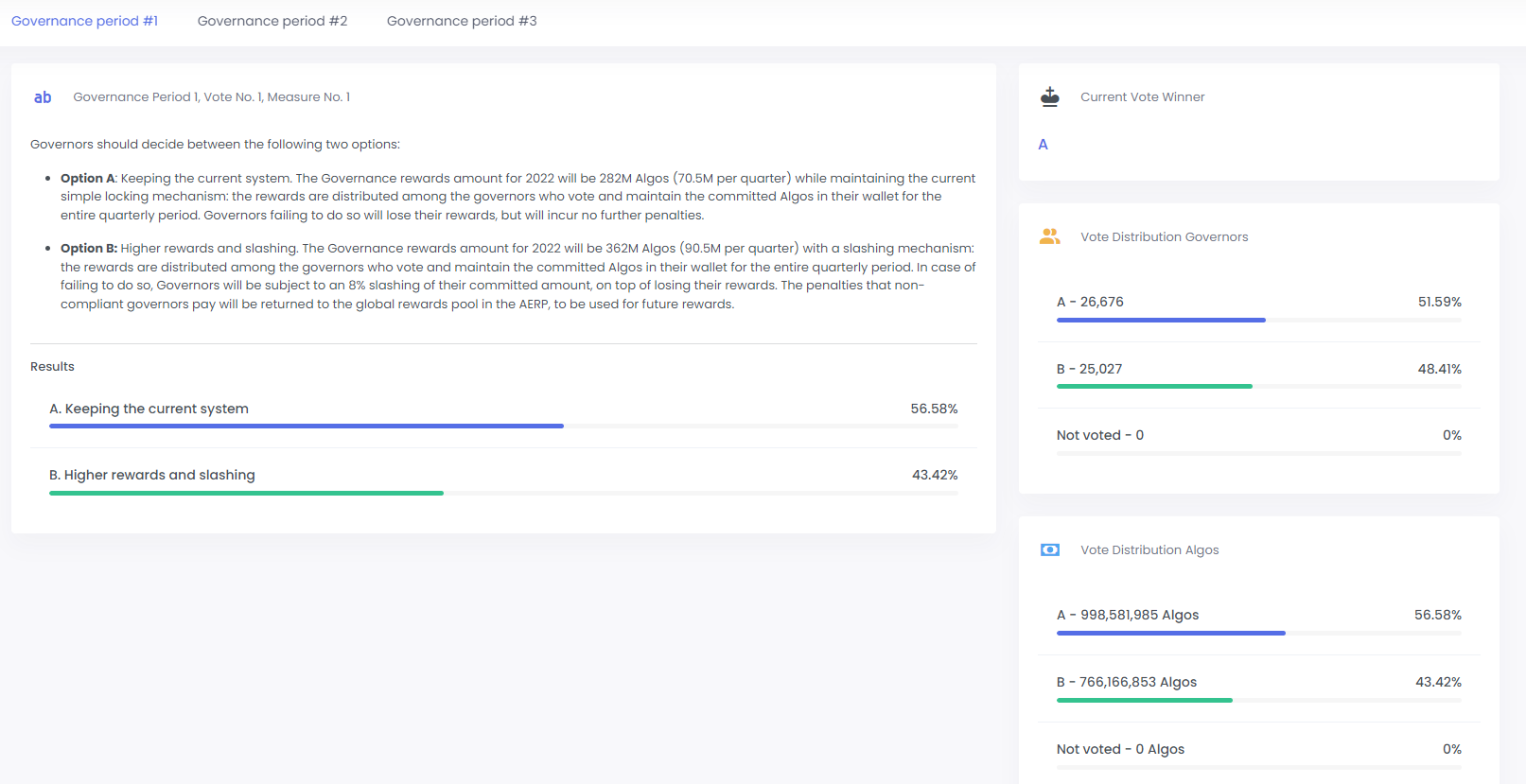
Firstly the foundation is spending 70,500,000 Algo to ask 57,221 Governors an A or B question, that’s on average 1,232 Algo per Governor, it would literally be cheaper to pay a human to go to their house and ask them in person, it feels like a very inefficient system for that reason.

Secondly I agree that having a risk free rate of 7-10% drowns out the possibility of defi competing. What I’d love to see is a system where you can be both a governor AND use your tokens for defi simultaneously.

Thridly a suggestion I’d like to make is giving people 0.001 “Gov tokens” each time they make a transaction. That way the people who use the network can be the ones who vote on what happens to it and no locking is required.

Good luck with working on it :slight_smile:

oysterpack

High Level Design Proposal

Design Goals:

  • Link Governance rewards distribution to DeFi KPI metrics
  • Empower and incentivize DeFi projects to innovate, grow, and add value to the Algorand ecosystem

New $GovALGO Reward Token

Two tokens are used for Governance seats with different weights: $ALGO and $GovAlgo. For example,

  • 1 $ALGO = 1 vote
  • 1 $GovALGO = 10 votes

$GovALGO is modeled as a loyalty reward token, e.g., airline miles rewards that can be redeemed. In this case, $GovALGO is redeemed for votes and Governance rewards.

High Level Design

  • DeFi projects reward participation using $GovALGO.
  • Governors can commit $ALGO and/or $GovAlgo to Governance
  • When $GovAlgo is committed to Governance, then it is returned back to the pool.
  • Governance commitment is a hard commitment enforced by smart contracts. Governors can withdraw with the following penalties: All $GovAlgo rewards are lost. A 10% $ALGO exit fee is applied and added to the Governance reward pool.

Benefits

  • No change is required to the reward pool size. DeFi projects are free to innovate and integrate with Governance, e.g., AlgoFi vaults, Folks Finance liquid staking, AlgoGard vaults.
  • This process aligns Governance rewards and voting power with the level of DeFi activity. Active and engaged defi Governors will be rewarded with greater voting power and with a greater share of the Governance rewards.

DeFi Project Roles and Responsibilities

  • Projects must apply to be accepted into the $GovALGO program. They must be approved by Governors with a 2/3 majority vote.
  • Each approved project is allocated a base budget. The project’s budget will be aligned with KPI metrics: TVL, on-chain value, accounts, transaction activity, etc. In turn, projects may delegate to their project Governors how to best make use of the $GovALGO budget to promote growth.
  • Proposals may be submitted to expel projects from the Governance rewards program. A 2/3 majority vote will be required to expel projects.
  • Projects are required to be fully transparent. Standardized reports on KPI metrics and $GovALGO distribution must be published quarterly.

Final Thoughts

The proposed high-level design is simply that. It is a starting point to model a solution. There are many details and specifics that require more thought and a deeper dive. The devil is always in the details.

KennyG
↩ in reply to just_a_guy72

Why can’t we do both? In my opinion, the Foundation has mostly been focused on institutional investment. I would say in the last 9-6mo they started focusing on Retail. Why? Retail investors do more that just hype the best yielding L1. They bring awareness, which brings innovation, growth and most importantly talent. Hivemind may be a good example, and what are the focused on? Gaming. I understand your long term point of view, but maybe we are in a race to capture innovative talent. Its not coming from institutions. Talent is leaving institutions to come into a retail driven space.

pmd
↩ in reply to michel

Fully agree with @michel.

@Massimo

A very basic example: even just devoting 1/10 of 280M Gov rewards to DeFi Govs means approximately +30% APY to current Defi Govs, and +10% APY even if they triple. We can discuss here to come to a solution which is fair to everyone.

I really don’t think it’s the right way to think about this issue. The point is not to be “fair to everyone”. It’s to allocate our resources where they will have the most impact.

The fact that we currently incentivise governance should not be taken into account. We should not be driven by inertia.

Governance is an interesting concept and one we should keep. The question is: should it be rewarded?

My conviction is that rewarding governance is useless and that we should allocate 100% of governance rewards towards DeFi.

AlgoTrillion

Hello everyone,

This may echo some existing comments but these are my thoughts on the general governance questions.

Governors should be primarily motivated by the role of governance, not attractive low risk returns.

If they are participating in governance primarily for financial return then how much serious consideration will they give to voting and proposals, as opposed to not voting, voting with the foundation or the simple majority. This is not effective or nurturing of robust governance.

Additionally, I was concerned by the potential consequences of having xGov status that is basically “pay to play”, the more ALGO I commit the more weight I have to control the narrative by setting voting topics. This structure does not honour the principles of decentralised governance and particularly the ethos of Algorand’s model.

For these above reasons, I think that governance should be:

  • A longer commitment (1yr)
  • A fixed ALGO commitment per governor
  • Penalties for breaking governance
  • Fixed annual reward which represents attractive compensation for the job

This will dramatically reduce the number of people interested in governance but my expectation is there will still be a very healthy number of people, myself included, who would like to maintain the status of governor and actually do the job of governance.

Under the above model, the current resources allocated toward governance rewards (280M/yr) would be largely intact to be deployed in other ways. I believe there should be a number of areas:

Node operators – we should be incentivising the continued decentralisation of the Algorand network so resources should be allocated to reward node operators. Perhaps weighting rewards to new nodes coming online and then tapering off so the cost of setting up a node can be recouped over a realistic time period.

De-Fi participation – Growing TVL through active De-Fi participation is hard to argue with and the bulk of the existing governance rewards should be routed in this direction to reward the most committed De-Fi users. However, I have a few caveats.

Firstly, who decides which De-Fi platforms will be allowed to participate in this because having these rewards will act as “king maker” in what should be a free market dynamic.

Secondly, having these rewards to offer will increase the success and therefore the profitability of these De-Fi platforms which are privately owned enterprises. What commitments will they need to agree to in order to participate, for example, providing grants that give back to the community development or ensuring added security through insurance provision, bug bounty schemes, treasury accruals etc. - this shouldn’t be a free lunch for the De-Fi platforms.

Finally, resources should be retained to promote these rewards outside of the ALGO community. My impression, at least early on, with the Aeneas program is that it has mainly shifted the existing users around as they look to mop up the available rewards. Any new long term reward scheme has to make attracting new money its first priority and that means investing in proper promotion to other chains and off chain.

Passive ALGO holders – if an elegant solution can be found which offers a sufficient APR that bears comparison to other chains then rewards for passive holding of ALGO should be returned. If there are not sufficient resources to provide an attractive APR then we should not do something that can be used as stick to beat us with.

edited
LuisERodriguez
↩ in reply to myshkin

Agreed on this. Participation on DEFI should not be forced. But governance should not override incentives to participate on DEFI. So the solution should be to count all ALGOs in governance including ALGOs held in other smart contracts, or ASAs.

ARO

I have used AlgoMint, Algofi, TinyMan, etc., and I have helped out with beta testing some projects. I’ve also been involved with governance since the beginning, and I’ve been an Algo holder far longer than that. That having been said, I am concerned about what is being proposed.

First of all, what is governance supposed to actually be? The governance page states “Earn rewards for your participation in the decision making.” Not, “Earn rewards for participation in DeFi.” So I think that we are possibly fundamentally straying from the purpose of governance with what has been proposed, and instead we are developing another Aeneas Program that is blended with voting.

I think that before we can address your question, we first need to clearly explicate what the ultimate goals of the governance program actually are. Do you just want to get as many votes as possible? Why do you want voters who are active DeFi participants? Personally, I would rather have a smaller number of thoughtful voters who are active on boards such as this determining the future of Algorand, versus 100,000 users pressured into DeFi and clicking “A” or “B” just to receive payment. If the reason is simply ecosystem health, then maybe we have to question the fundamental idea of locking Algo for voting, versus an active incentive program. Again, without clearly seeing a list of all of the major goals of governance listed in one spot, I have a hard time saying what I think is the best course of action.

I strongly urge the foundation to pause the drive towards these changes, and instead have a thoughtful, honest conversation with the community that doesn’t just ask for rules, but actually lays out clearly stated goals of governance and challenges that we now face. Then, we should have a serious conversation about how to best achieve those goals, and whether governance is even the appropriate mechanism for achieving some of the objectives.

michel
↩ in reply to pmd

I agree with @pmd, the discussion should focus on how inflation should be allocated into what can generate the most impact towards Algorand adoption. Any solution where not a single Algo is going towards inactive, non-value add stake is a much better one to the current system.

TJay_Sez

Hello everyone, I’ve never been a part of any governance before so this is a really cool experience and I’m no big bag holder by any means but I plan on being one day! That being said, I think it’s awesome that I was even eligible to be a part of this. I will say a lot of the stuff I’m reading here is EXTREMEMLY insightful and I can tell these are things that have been weighing on every one of you. So far I have to say I agree with the ideas that are trying to get AWAY from anything involving rewards to zero-value add stake. Adoption is key and if we can implement the ultimate hedge against inflation while also incentivizing active participation in the ecosystem; that’s what I’m likely to be supporting.

nsalgo

As someone who falls in the middle I feel we need to come to beneficial compromise. I came for the staking rewards and ventured into DEFI, but not risking my entire bag to hacks and rug pulls. I do both at a responsible level. We need holders and risk takers to make this work.

GoalDarn

While I agree that the current Governance rewards structure doesn’t incentivize active participation beyond voting, I don’t like the idea of DeFI participation being linked to rewards (‘official’ rewards—of course you can still get yield).

I do like the idea of incentivizing active participation in Algorand, but I don’t think focusing on those who add liquidity to DeFI is the answer. I think it could have unintended consequences and lead to neglect in other areas, and might lead to a very unnatural DeFI ecosystem where instead of cause (adoption) leading to effect (healthy DeFI/TVL metrics), one tries to mimic the effect and hopes it somehow brings about the cause. I would have no problem taking some significant Governance rewards away from Governors (that’s me too!) in order to aggressively advertise specific dApps to parts of the public, or to help assist in developing useful dApps to begin with so there exists something to market, but choosing “any DeFI with over $X TVL” as “the winner” doesn’t resonate with me.

Also, there is still no motivation for people to run consensus nodes beyond pure altruism, which seems important, so is there a way to add that requirement to Governance on top of the locking and voting requirement?

HolisticNicole
↩ in reply to AlgoTrillion

Excellent points. I especially like your ideas regarding governance model adjustments. I don’t feel like these adjustments are massive breaks in the overall spirit or idea of Algorand, but they adjust current function to address flaws in the system as it operates right now. This is a concept that I believe could be worked with. Thanks for posting this!

HolisticNicole
↩ in reply to ARO

This. This is the center of this issue. Your entire post is 100% spot on. We aren’t discussing just altering governance with this proposal. We are discussing a fundamental break with the core objectives of governance. This is serious, and I think it warrants much more thought than 2 weeks, last minute, as a substitute to whatever they had planned for a vote prior to this.

Kudos on such an excellent, well articulated post.

TJay_Sez

I agree 100%. Governance is important for trust in this space and the only way forward (that benefits holders) is a REAL discussion on weather the original intent of governance in the first place is even still in sight here. We need not focus on how high of pressure we can put on the defi space to bolster our price. We need faith, security, trust, and true governance by and for the community if Algorand is going to be the stated currency it was intended to be.

jmob

I agree with Michel but I have some reservations. Yes, it’s hard for defi to compete with no risk holding through governance. However, I am in governance because defi has so many problems. Mainly, they get hacked a lot. I’ve invested a lot of money in Algorand and to think that an error in a smart contract could wipe me out is just unacceptable,

Frankly, it’s a big ask when you consider the poor price action algorand has delivered thus far. It’s a catch22. People, are in fact holding and not taking risks.

What I want to see and what I want to feel is certainty.

If you want people to participate in defi, you have to foster a space that can be trusted. Stop verifying ASA’s that are rug pulls. KYC should be mandatory for verification. Until that happens there is no way in hell I would ever participate.

That being said, I love Algorand.

oysterpack
↩ in reply to HolisticNicole

I think folks are missing the big picture.

What is the mission?

The mission is to maximize ecosystem growth and decentralization.


Thus, the question boils down to: Should more $ALGO be allocated to Governance rewards or DeFi rewards? The question is then: What creates more value for Algorand? What is more aligned with the overall mission? DeFi economic activity creates significantly more economic value. Thus, financial incentives should be significantly greater for DeFi vs Governance.

Simple Solution: Less Goverance Rewards and More Aeneas Rewards

Let’s lower Governance rewards by 75% and moving those funds to the Aeneas Liquidity Program … and call it a day. As a positive side effect, this reduces the wasted rewards that are sent to centralized exchanges.

Note: this has nothing to do with xGov. We should proceed with xGov as planned.

majicman42
↩ in reply to jaclarke

John, just wanted to say that I really love using Algofi, such a great platform. Have you guys considered incentivizing ACATs In transfers to Algofi from other chains with additional rewards or a one time bonus payout depending on the amount and time period (eg. 3 months) for the funds transfer? I think this would be a great use of some of the Governance rewards pool if it was used to bring more people into the Algorand ecosystem.

javier0rosas
↩ in reply to michel

@michel could not have said it any better. Deploying governance rewards through DeFi to reward developers and true believers who are willing to take smart contract risk for high APYs (also known as degens) is the right move. This will increase TVL and incentivize more developers to come into the ecosystem, creating a self-reinforcing network effect and hopefully causing more demand for $ALGO, which has been underperforming over the past 6 months relative to the Altcoin benchmark.

For some context, here is a graph of ALGO-PERP vs ALTCOIN-PERP over the past 6 months.

Clearly, $ALGO has been underperforming the benchmark and this is unnacceptable given our superior-tech and novel consensus mechanism. Web3 developers should be flocking our ecosystem like crazy, but they are not (partly because Algorand is not EVM compatible), but partly due to the lack of governance & stablecoin incentives that other blockchains like Terra are hammering down on.

HolisticNicole
↩ in reply to oysterpack

Yes. But I don’t believe sacrificing governance is a good idea, and if we transfer the algo distribution to effectively just pick winners and losers, are we really creating more decentralization, or less? Honestly, I think the answer (at least in part) is that governance needs to be given more to do, and have more “stroke” over decisions and direction. Maybe ultimately this will happen, but right now I think it’s largely unimportant… which is really too bad. I think instead of tying governance PARTICIPATION to DeFi, maybe we should look at tying the REWARDS to DeFi. Rewards issued through a defi platform smart contract, staked or providing liquidity and locked for a pre-determined amount of time (6 months? 12? I mean, maybe even longer! I’d lock my rewards for 2 years.) before they can be claimed. That gives you 280 million coins/per year that are REQUIRED to participate in DeFi, without altering anything else - including the vision or roadmap of governance. It would also prevent taking rewards and immediately dumping them - especially by exchanges.

Totally. And I think something needs to be done about this issue. I don’t think anyone is under the illusion that exchanges are going to vote with the best interest of Algorand in mind. For the love… Coinbase won’t even display $algo on a Top Movers list or post news/announcements (ZERO mention of the FIFA deal, which had to be one of the biggest announcements in crypto of late). Is there some way that Exchanges could be made ineligible altogether? Ultimately, they’re really a big part of our problem in a lot of ways.

fig

First off, excited to see folks jumping in here.

Algorand is in need of greater discussion surrounding governance and more visibility among the wider Web3 ecosystem - this is a great first start.

Passion is important but I would caution against a complete redesign of token economics. This change can be messy and complex, including arduous smart-contract work.

While the original sentiment is well-intended @michel a high reward on Governance is a great way to onboard new users to the network. It is similar to the other L1 incentive programs outlined by @jaclarke

I do agree however it may throttle and deter use across Algo-native DeFi protocols. Exploring a solution seems beneficial. Let’s look at some data to inform our decisions:

A whale, as defined by the top 0.5% of all accounts, participates at lower levels in DeFi.

95.5% of whales have not swapped on DEXes. Please see the distribution below:

You can take a look at the in-depth analysis here: Flipside Crypto - Algo Whale Swaps

Second, let’s look at rewards distributed via Governance for Period #2: Flipside Crypto - Governance Period 2 Payouts - Daily (unable to include embed because user level :confused:)

Looks like the average reward is 10-50 ALGOs, with 10,571 wallets receiving this amount.

Have we thought about 25% of total governance rewards being distributed to DeFi protocols? Based on past rewards this would be around 12,000,000 ALGOS. 50% would be 2x this number.

Returning to the OP - my fear is an approach like this seems very game-able:

It is reminiscent of “airdrop farming” - where users enter during a certain block to receive 3x rewards and withdrawal soon after the snapshot or time of capture.

This however, is doable, and Flipside Crypto can help with this if you decide to pursue it:

If you want to look into this list as mentioned above, we have the data that could be used to identify wallets that have engaged in DeFi activity.

A guiding question around DeFi participation & risk-reward: Does an extra 5% from staking incentivize one of these whales enough to participate in DeFi and take on smart-contract risk?

Excited to continue this important discussion.

edited
Massimo
↩ in reply to majicman42

Thanks for the great discussion on this first day. Answering to @majicman42 because you may appear off track, but I think you are not. The main purpose of this discussion is getting as much as possible what @majicman42 is already doing: users talking directly to developers and entrepreneurs to find ways to bring more and more users to Algorand.

We are a decentralized ecosystem and this is what we all want. This is also why we have a Decentralized Governance, that needs to be more and more decentralized. As long as the Foundation has a role, we commit to help. We all agree here that we want Governors that are ready to bring value to Algorand, and reward them consistently, this was the spirit since the very first Silvio’s blog. Fortunately things have evolved since then and we see from this debate that we have different choices, even if I find that attention to DeFi is largely shared. Finding the right balance is the purpose of the initial questions we posted, and for sure @javier0rosas, we want to see the green line back to the right place.

For those who asked about xGovs, we have been working on that as well and will bring them soon to the discussion.

oysterpack
↩ in reply to HolisticNicole

You gave me an idea … I still favor reallocating rewards from the Governance bucket over to the Aeneas bucket, but I would change Governance to liquid staking (like Folks Finance but zero fees taken). ALGO liquid Governance provides the following benefits:

  1. It enables the Governance $ALGO to be counted towards TVL
  2. It unlocks the staked ALGO value for DeFi
ARO
↩ in reply to ARO

If @Massimo, @shaih, or anyone else at the foundation has a document that already clearly lists these somewhere within it, please just provide a link and I’ll read through it. Thanks!

oysterpack

Folks Finance explains it well: Algo liquid governance.

Folks Finance charges a fee for the service - 5% of the Governance rewards goes to the Folks FInance treasury. The Algorand Foundation version of Algo liquid governance would function the same way minus the fee.

D3G
↩ in reply to ARO

It doesn’t happen the same thing now with the gov, 100k apes voting for A or B :face_with_raised_eyebrow:. And imo, the all point of decentralization it’s not to have just a hand of ppl to decide for everyone.

Rambutan
  1. increase lock up period for governance to yearly basis instead of quarterly. Make governers run nodes or participate or do something besides just lock up tokens to get rewarded. - but whatever you ask them to do, you need to provide full tutorial videos on how to do it, step by step and I mean step by step. Like teaching a monkey. Assume users don’t know how to shut down a computer. This level of tutorial is needed if you going to make governers do whatever they have to do.

  2. all liquidity providers on tinyman should get additional rewards. - have different tiers. Someone who has been providing liquidity for 4 months should be rewarded more than someone who has provided liquidity for 1 week. (Impermanent loss is a real issue so rewards for LPs is ideal).

Reward each LP address proportionate to their LP tokens.

Focus on making 1 main defi platform successful to the masses - tinyman is best, easiest to use, safe, secure, solid - we don’t need 5 different defi platforms - this will just lead to fragmentation. Encourage users and LPs to hop on tinyman.

Make tinyman the go to DEX of Algorand for users, institutions, banks etc.

edited
ARO
↩ in reply to D3G

I have concerns about the current system too because I don’t like pressuring people to vote. I would like to think that the vast majority of current governors actually do care, but I’m sure there is a percentage who put virtually no thought into the vote and simply click to get the rewards. I fully support making voting as accessible as possible for people who want to do so.

dmclancy

@shaih , how has the Foundation studied other forms of stakeholder governance that leverage dual-class voting structures (ex. founder shares in the US, super voting shares in France, voting shares in Brazil) and the impact on rights to future earnings? Is there something to read about the major influences on the xGov proposal?

My primary concern with further stratifying direct economic incentives to vote is that it would further entrench larger players and that the administration will become increasingly complex. Both could be centralizing forces.

I agree with the DeFi builders in the ecosystem (@michel) that they should not be forced to compete with the Foundation on yield.

edited
GoalDarn
↩ in reply to ARO

Strongly agree with that.

Algo_Cleanup

I just had a general thought. Algorand is the future of finance. A major aspect of that future is decentralized finance. That is why I fully support the foundation’s initiative to reward those that help forge the path into this future.

Conscious

Made a twitter thread which may be easier for some than the google doc if you’re on mobile.

YSF

I think @ARO hit the nail on the head.

What is Governance supposed to be? What is its purpose?

I feel like Algorand has gotten too ideological too quickly, without consideration of the practical implications.

Communism is a great ideal if we were to look at it on paper. However, in reality, it didn’t work out even once.

Just what is the purpose of Governance? To create more coin inflation? Because currently, that is literally the only thing it achieves.

A few people in the thread mentioned how they were attracted by Algorand’s governance system and don’t want it to be changed. I want you to ask yourselves honestly, do you really care about voting either A or B on a single topic that has not been fleshed out at all so as to be completely meaningless, AND your vote doesn’t ultimately matter anyway because exchanges and the foundation together hold a vast majority of the Algos in governance, and exchanges by default always vote with the foundation…

There are so many things wrong with the way governance works today, so much so that it’s just a complete waste of time for everyone involved. And with the way governance is currently designed, important, specific implementation details would never get put up for vote, nor should it ever get put up for vote either.

The entire governance system as it is, is a huge nothing burger, only creating useless coin inflation while suppressing the other parts of the ecosystem.

The ideas of increasing the voting weight for DeFi users or node runners, is, in my opinion laughable because of the points above; the entirety of governance as it is right now is completely pointless and useless. So what’s the point of giving more voting power to DeFi users or node runners? It’s not an incentive at all.

Additionally, if we go with some of the proposals in the OP, doesn’t that actually create a lot of potential points of abuse and centralization in the governance system? We’d have to trust DeFi protocols to not game the system, fudge their TVL, fudge the numbers they report to the foundation, etc etc etc.

So in my opinion, incentivizing nodes, and incentivizing ecosystem growth makes much more sense. Any potential negative effects of incentivizing nodes, these convoluted governance structure proposals have the same negative effects. However, they have none of the benefits.

That said, I believe that ecosystem growth should be as sustainable as possible; if we were to simply allocate all of the governance rewards to DeFi like the Aeneas incentives, what happens once that runs out?

Therefore, I believe the rewards should be split into 3 streams:

Stream 1: Incentivizing Nodes.

This will be like the “risk-free governance APY” currently. If you want risk-free returns, then at least do something for the ecosystem. And no, taking 5 seconds to randomly click A or B every 3 months is not doing anything useful at all for the ecosystem.

These incentives could further be split between relay nodes and participation nodes.

Stream 2: Ecosystem growth

I think the vast majority of the money should be here. Instead of giving money to people rehypothecating on DeFi platforms, money should be given to developers to attract them into the algorand ecosystem.

Things like the $10 million EVM compatibility supagrant as well as the $10 million developer tools supagrant are great, but we could put a lot more money into similar initiatives. More importantly, by rewarding the developers in Algos as opposed to USD, it gives them much more incentive to stay in the ecosystem and continue developing for it afterwards.

Secondly, we need to encourage new innovations instead of always following behind and copying what Ethereum and Solana has. Thus, incentives could be given to teams that manage to create new innovations on Algorand, or teams that manage to attract a huge amount of TVL, to be determined every year or so. We could even actually have some useful governance, to determine which projects the community feel should receive these incentives by the end of each year.

We also desperately need to pay more attention to onboarding people who matter. There are huge alarms and red flags everywhere, when, in algofam chats, we here teams talking about how they cannot get VC funding despite having personal relationships with the VCs just because they’re building on Algorand; we hear people like Michael Cotton talking about the lack of institutional tooling to be able to safely deploy funds to Algorand’s ecosystem…

There’s also a huge problem with stablecoin liquidity on Algorand because Algorand based stablecoins are hardly accepted anywhere…

These are HUGE problems that need to be solved ASAP no matter how many millions they cost, and I guarantee they will give far more bang for the buck than wasting tons of money putting up 1800s style billboards and banner ads everywhere.

Stream 3: DeFi incentives

Finally, like @jaclarke and many of the actual devs in the ecosystem has so eloquently laid out, if we want to compete with other ecosystems, we need to have similar incentives. Thus, I do believe that in the near to mid-term, some more DeFi incentives like the Aeneas incentives should be given to help grow the entire ecosystem.

If Algorand really wants a governance system, it needs to be seriously reworked from scratch so that people can freely vote on topics they care and know about. And I believe that governance should not be incentivized, because incentivized governance creates far more problems than incentivizing node operators.

permarugbear

If the Foundation is pushing for DeFi adoption they need to guarantee a high degree of security by implementing hardware wallet integration and insurance for DeFi losses and the Foundation should be tasked with approving DeFi projects by performing its own security check on these DeFi protocols.

Without such guarantees and reducing the passive rewards whilst giving extra votes for governance is not attractive to current users.

But if this has to be implemented, the original amount assigned to DeFi users must be significantly more than the current Aeneas Rewards because even with the introduction of the Aeneas Rewards, DeFi TVL only increased by an insignificant amount (relative to other L1 chains). UST is paying 20% and ETH 2.0 is rumoured to pay out 20% as well. Given the market cap of ALGO, a head to head competition does not make sense but most crypto holders chasing yield will look at numbers only.

The underlying problem is not only the incentives, it is the opportunity cost of holding ALGO. The most important issue is to reduce the “structural selling” by the Foundation and to negotiate and reduce sales by early investors and whales. Even if you increase the APY to 100% but ALGO prices go down by 50%, it will not compensate investors (which has happened again and again). This is exactly why the ALGO DeFi space has not proliferated despite the speed and cheap transaction fees.

The ALGO ecosystem is small, shifting the rewards from users to other users does not make sense. The goal should be to attract adoption by acquiring more users.

umr
↩ in reply to GoalDarn

That will make the governance centralized (similar to HBAR, although I do not know much about HBAR). We should aim to involve as many Algo holders as possible in the governance to make it decentalized.

Syzygy

I am a big fan of what algofi and folks finance are doing to allow Algos to engage in both defi and governance, however think it should remain as a ‘third party’ solution, and trying to incentivise governers to take extra risk for more votes is a really bad idea. The purpose of Algos is security: to secure transactions (nodes) and to secure the direction of the chain as a whole (governance). If people want to use their algos to participate in defi, sure go for it, but I don’t think it should be necessary to take the risk and complication to maximise votes. It would probably also be very unattractive to institutions wishing to buy algos to secure the chain, and we want buying algos to be an attractive proposition, raising market cap and thereby providing greater security.

Having additional governor rewards for going through defi, or in general participating in the ecosystem, I am not against. But extra votes/voting privilages (like xGov) I do not want to see. Regardless of what is voted on this round (if anything; no need to rush a poorly thought out plan) I would like the option of voting for changing governance to something similar to the system originally proposed by Silvio back in 2020, which I thought was fantastic: providing the right incentives and balances in a clear and simple way. This does not cover how to propose new voting measures, but as a system of normal (non-xGov) governance I much prefer it to the 3 month soft lock, which I find too short a commitment, too slow to respond to previous votes, and not keen on all algos being ‘unlocked’ at the same time. A rolling system makes more sense to me. A longer lock may also encourage defi interaction with algos.

For however the xGov system will work, I think we should vote on using the method proposed in 2020. It is important to get right, and not imperative to get done immediately. Something like having an online stake over a certain amount (e.g. 50k) participating in consensus is straightforward and encourages participation nodes. A small reward (e.g. 1%) to all online stake would also encourage participation - if I am holding algos anyway I may as well put them to work, even for only 1%. xGov wallets could then propose measures to vote on, and any measure that got over a certain threshold (e.g. 20%?) of support could be put to the wider governance community. Each xGov wallet can give their support, weighted by number of algos, to as many measures they think need voting on. xGov rewards should probably not be further incentivised beyond ordinary governance rewards, or the addition reward should be very small. In general, for the foreseeable future, I would be more than happy with the foundation choosing the measures based on what is being requested in the community.

For relays, I personally like the reward structure of deciding a number of relay nodes ‘required’, deciding what a fair reward is, then splitting the total reward across all performant relay nodes. E.g. if we want 100 relays, and think 2000 algos a month is a fair, reasonable reward, then share 200,000 algos a month between all perfomant relays. This strongly encourages setting up new nodes when there are fewer than 100, and cost saving and competition when there are more than 100. There should probably be some weighting relating to how performant a node is (based on uptime/availability/latency) as well as geographical location, if possible. This is to spread relays out and stop centrilization in one country/continent.

These numbers are obviously able to be changed through governance, and at some point will be paid out of the transaction fee pool. The remaining fees can then be used for governance rewards, and maybe for ecosystem incentives, should governors think that is beneficial.

Apologies for what is probably rambling, I’ve never been good at getting thoughts on paper. My main point is I want to vote on switching to the method of governance proposed by Silvio in November 2020. Also, 1 Algo = 1 vote is essential in my view.

Mr13

What is the goal of governance rewards? To increase adaption or to increase participation in governance?

We can clearly assume governance rewards are meant to increase adaption in the Algorand ecosystem, hence the Algorand Foundation is looking for ideas of providing the rewards to Defi instead of passive holding.

To increase both defi and still providing rewards and increase adaption, I would suggest the Algorand governance rewards to be utilized as collateral in defi, for example in Algofi where the Algo rewards are supplied and then borrowed in Algo to provide the borrowed algo in rewards to the governors.

Why go through this? First of all, to increase adaption, the price has to be attractive. Just providing rewards will just inflate the tokens and reduce the price. Smart investors will see, in the end it’s not a reward due to the inflation caused. In FIAT terms, you are either worse or back at the beginning.

By using the reward in defi as collaterol first, Algorand TVL increases and being utilized. By borrowing ALGO for rewards, it means less Algo is available, instead of just inflating a huge portion of Algo is locked and another portion of Algo is being taken out of the circulation supply and being redistributed through rewards. All in all, this will increase Algo demand and increase the price of Algorand.

Increasing the price + earning rewards = real incentive.

Of course, each DEFI protocol should get a share of the governance reward to be used as collaterol. More creative ways can be thought of.

As of now, aeneas reward is somehow great, still the same problem resides. It inflates ALGO hence the rewards suppresses the price, which suppress adaption. The rewards should be used in a more creative way instead of just dropping it.

Happy to hear more thoughts on this.

bruno

I have the following plan to make sure that all of the the Algo’s that participate in governance automatically participate in consensus:

What if participation nodes will be used as a sort of ballot boxes. Imagine that each node can choose a voting option and lock in its decision. Then people can register their voting keys with a node that they agree with (or they can run their own node!). Then the nodes proceed to vote with all the Algo’s that they have voting keys of. In this way we can have all the money that is participating in governance automatically participating in consensus.

About DeFi: I do not think that DeFi users should get extra governance rewards. I find the liquid governance system of Folks finance elegant. It could be implemented natively in the blockchain (to not give too much power to individual dApps who run these liquid governance programs).

edited
Wizneber

I believe that the defi involvement should be voluntary and not mandatory and certainly not rewarded. Governance should be able to be independent from any 3rd party system in order to prevent undue influence and rewarded at a consistent rate. Also, while there are mechanisms that could be put in place to prevent abuses within defi I do not have sufficient confidence in any defi platform to create an additional reward for participation in any one platform over another. If there ever will be some governance incentive that involves DeFi it MUST be platform agnostic and in that sense I don’t see a clean way where any requirements are not eventually abused to favor one platform over another.

I understand the desire to provide more TLV into the DeFi ecosystem as opposed to the existing soft lock that governance provides today I do not thing they should be forcibly mixed. I applaud the efforts of platforms like AlgoFi and the vault and other similar platforms but participation in those systems should be voluntary and not required. We, as a community should let the greater market forces to drive the development of DeFi and not incentivise it via governance. There are other incentives in the greater market to push the development. I think the community and the market will create these solutions organically and the foundation and governance mechanism should not force them, there is no additional incentive needed. Also if it is the case that defi offers greater returns than governance then individuals can choose to skip governance if the greater returns are more important than participation in governance. Participation in governance for the sake of governance and the relatively simple governance rewards should be all that is needed. If anything I would more easily support significantly lowering the governance rewards in order to leverage market forces to push people to the DeFi ecosystem rather than intertwine the two more than they are already.

In summary,

  • Governance should continue to be simple, open to all, and not require specific 3rd party apps or platforms.
  • Voluntary participation in 3rd party platforms should not have additional rewards just for governing.
  • Market forces are sufficient incentive for DeFi platforms to provide greater rewards with associated risk
  • Governance rewards should match the effort, time, energy, risk, and opportunity it takes to participate.
  • The market will create options and individuals can choose to use those based on their risk tolerance and desire for return including the option to not participate in governance.
the_BERG

Hello, I think the Governance is great but it does lock up secure ROI without needing smart contracts or interaction. Which does severaly lock us out of TVL. Defining who participates int eh DEFI or how to offer hire rewards is no clear cut and dry, for example, im a YouTuber I bring many eyes and ears to the defi platforms and projects. I contribute quite alot without actually building the DEFI space ( just one example) yes you should reward development in some way but you already do through grants?

IMHO a suer staking reward system was more attractive to alot of people. that 4% coinbase staking rewards were nice for people. You need a way to offere governance and staking rewards. If governance is say 8% split that up. 5% for staking and 3% for governance with an addittional 1% for defi participants.

I am not sure the exact breakdown, but I enjoyed the super staking and this is one of the reasons I found Algroand the 4% staking. Then I started deep diving into algorand.

We need a way to bring back GOOD staking rewads and governance IMHO

ARO

If voting really needs to be rewarded, governance could be changed:

  • Governance rewards could be placed in an Algo investment fund managed by the foundation. That fund could be used to provide low-interest startup loans for novel projects, and also to directly inject Algo into the ecosystem. Investment could include providing collateral through DeFi projects, buying NFTs that are likely to appreciate, etc. The goal would be to grow the fund while simultaneously improving the Algorand ecosystem. Transparency and fair, defensible investing would be key.

  • Governance voters would receive a governance token that would mature after X years and entitle them to a certain amount of the Algo investment fund. The timeframe would have to be considerable. Voters therefore would be the people who believe in the long-term success of Algorand, because of the lengthy timeframe and the fact that the investment fund would be tied to the success of the ecosystem. Significant challenges would still obviously exist here, and sufficient barriers would be needed to block bots and deter bad actors. Perhaps KYC would even be needed, which I know a lot of people would strongly oppose, but that likely would be the most effective solution.

I’m sure a multitude of serious problems exist with the above idea, but I’m just throwing it out there since the one point that most people in this thread seem to agree upon is that the current system of governance has considerable problems that need to be addressed. I’ll reiterate that I really think that we need to have some meaningful conversations about the fundamental goals, direction, and structure of governance that are likely to take longer than the next few weeks.

jmob
↩ in reply to permarugbear

Yes! I was saying something similar earlier. I have a decent amount of money in algorand and the risk of getting wiped out by a hack or a smart contract bug is unacceptable to me (and I suspect) most Algo holders.

A lot of us came to algorand because of the staking rewards and the low risk of governance. Most investors are not going to be keen on taking on those kinds of risks. They are going to need new investors with a taste for this kind of risk.

I guess you could say the foundation is a victim of it’s own success. While I agree that defi companies can’t compete with governance, Lowering governance rewards is somewhat of a broken promise. we were supposed to get these rewards until 2030. Defi can’t flourish unless these rewards are lowered.

The biggest problem that algorand has is if they put this to a vote, they will most certainly lose because most will not want to give up the high APY.

What they should really do is just go back to regular staking and remove voting. People are always going to vote for their own self interest when it comes to money.

YSF

There is no “regular staking” on Algorand, because Algorand works on a PPoS consensus rather than DPoS. If you’re talking about the free airdrops from last year, that’s just pointless coin inflation, pushing down the coin price, and causing more harm than good in the long run.

What you guys don’t get, is that you are already taking on huge risks by holding an extremely volatile asset that could potentially go to 0 if it never gets adopted in terms of actual usage.

Trying to safe-guard “risk-free returns” is, in fact, far more risky, because you’re essentially holding well over half of the entire ecosystem hostage and stagnant. That’s ultimately going to kill the entire ecosystem, and your “risk-free returns” will all be meaningless because they will be worth 0.

Cutting governance returns may cause a tiny bit of short term pain, but bowing down to a bunch of leeches who are only here for “risk-free returns” and don’t care about the success of the entire ecosystem is extremely short-sighted and bad for the ecosystem in the long run.

jmob

I think you know what I mean in regards to staking. That’s how most people viewed it before the start of governance. Let’s not split hairs here.

You can’t call them leeches. This is how the foundation set it up. They, and only they are responsible for this. You don’t want leeches deciding the outcome? Then they better not put it up for a vote.

What concerns me is that they didn’t see this current problem coming. I’m quite sure they know this and are going to make the necessary changes. Unfortunately, that means making these big decisions themselves and not putting them up for a vote.

YSF

In reality, if you’re talking about the voting process, the exchanges and the foundation itself holds well over 50% of Algos. Exchanges, by default, vote with the foundation.

Therefore, what anyone else thinks doesn’t even matter. The entire governance system right now is a farce, all it does is create coin inflation.

GoalDarn
↩ in reply to umr

But it doesn’t make a decentralized governance platform “centralized” if you have thousands or tens or hundreds of thousands of entities voting instead of 1M+ entities voting. It is still highly decentralized, just less so than the 1M+ case, but at what cost does that more “extreme” decentralization come at?

The argument here is that you don’t want to optimize decentralization, and decentralization only, at the expense of everything else. It is a multi-objective optimization problem, one in which decentralization is only one of the optimization objectives.

Let me be clear: I don’t think anyone should be shut out from participating in voting if they want to, but would stand by the argument that incentivizing governors to make thoughtful votes and take their job seriously is at least as important as decentralizing governance.

thingsname

Thanks for this, I also wasn’t aware of this forum. I’ll keep this brief and hopefully respond from a slightly different perspective. I only started investing in cryptocurrencies last year and have been steadily learning. I was attracted to Algorand for the reasons that so many have been, but suffice to say I love the stability, low transaction cost, and that the goals align well with my values, and I see huge long term potential.

As an investor, I’d be very very happy with rewards in the 7-10% range, I see the long term value in price appreciation, and rewards as more of a bonus and inflation hedge.

As far as DeFi participation – I will likely have to install the Pera app and dip my toes in a small way to see where I stand, but what I think may be important for “insiders” to know about DeFi adoption is that even the most established systems do a piss poor job of explaining what it actually is and how and why a newcomer would want to be involved. From the outside, it looks a lot like fancy lotto. Sorry.

Let me give you a concrete example of how and why I would want to participate in DeFi, and what I see as it’s actual promise:

  1. I freelance. I sometimes need to bridge cash flow issues or slow client payments with a credit line or credit cards. This would be an ideal use case for ALGO DeFi, but the way this currently works is utterly inscrutable to someone not deeply steeped in Crypto lingo, and I can’t pay my vendors with a weird stablecoin. I know this is evolving, I’m just restating the (hopefully) obvious point that real DeFi participation is going to ultimately depend on seamless fiat bridging and plain language explanation of what this is and how to, you know, do it.

  2. Related to above, I would contribute to a DeFi pool if I understood the rewards and risks better, but I use multiple Ledger Ss to store my keys, and that is not going to change. I don’t even like the idea of bluetooth and built in power source in the Ledger X, so my DeFi participation in the near term is likely to be strictly limited to a small bag of tokens that I’m willing to risk in a hot wallet. I don’t know how wide-spread this sentiment is, but I would love to see support in a DeFi platform for more wallet types, maybe using AlgoSigner or similar to authorize transactions?

  3. I just received a payment from a client. He used Zelle. I love Zelle, it’s fast and free. What I don’t love is the centralization, and the fact that I’m stuck with a big corporate bank in order to use it. If someone can bridge this gap, make using Algorand “Zelle-like” for merchants and buyers, that would be the Grail as far as I’m concerned. I know it takes someone far smarter than me to know what this involves, but in use, it would mean that someone is able to pay in USD, have the funds seamlessly converted to ALGO and sent to the merchant. I know you’re all probably shaking your heads thinking well duh, what do you think we’re working on?? The answer is I don’t know, and neither do any of the countless non-crypto merchants who would sign up today in a heartbeat if we did know.

That’s my two cents, sorry this got lengthier than promised : )

jmob
↩ in reply to YSF

I would agree with you on that. Algorand needs some big wins. Large companies/governments using it etc. If that happens, things will start going our way and governance won’t be such an issue. I don’t think the foundation can count on it’s retail investors to turn the tide. It needs to come from adoption.

permarugbear
↩ in reply to bruno

you are buying right because you have confidence in ALGO in the long run, so what does that tell you about early investors who are savvy investors that got their allocation early and is selling now?

without adoption when the whales dump causing prices to drop it doesn’t spread decentralization because the only people that would buy ALGO are existing holders.

the Foundation should really only be selling and “cashing out” and at a higher price when they have sufficient demand for ALGO.

umr

Using the ideas from multiple posts, here is my suggestion.

Most of us agree that the Algorand DeFi ecosystem should be vibrant but should not force the governors to participate in DeFi. We can keep the existing (passive) governing system.

In addition, we can give rewards to wallets that participate in DeFi from the governance reward pool. We could give rewards for the following:

  1. Algo supplied to the lending platforms such as Algofi. Amount of Algos for the gov reward could be calculated as a daily average (at a certain time?) or low watermark? DeFi platforms are already capable of calculating Aeneas rewards. This gov reward could be calculated in a similar way. Not sure if voting is possible in this scenario. If voting is possible we can make the voting mandatory to get the rewards, otherwise the reward would be given without voting.
  2. Algo supplied to DEXes pools. Reward calculated in the similar way as 1 above.
  3. Most probably we do not need to modify the reward for participating through DeFi platform such as Algofi Vault. But if we really want to turbocharge the TVL, we could increase a few percentage of rewards for governors that use the DeFi platform for the governance.
edited
Giulio
↩ in reply to defidaddy

I totally agree that participation nodes should be somewhat incentivised. I support the idea, promoted by Dr. Morini in a recent Medium post (Evolving Community Governance), that the new xGovs should be rewarded also for running participation nodes. In this way I would expect to see a significantly higher number of voters compared to the present ones (approx. 360), thus further decentralising the network.

edited
AlgoBas
↩ in reply to Kentmug

I have to agree with the sentiment that governance is really about decision making concerning the Algorand ecosystem. Promoting DeFi, NFT development and projects in general is a different animal.

In a way we started to slide down this slope with the last vote. We made a decision that certain wallets should have more value or more weight based on the amount of Algo in those wallets. Thus beginning the creation of a heairarchy.

Now we are deciding that what certain wallet holders do is more valuable than certain others.

These are not governance questions. They are equity ones. They are trying wallet size and activity to individual value within the community.

I think we should not proceed further down this road. We will simply turn Algorand into Now-Fi. This is not future fi.

AlgoBas
↩ in reply to majicman42

I do enjoy and like to use AlgoaFi. And yes I think the should be efforts made to attract others to AlgoFi and Algorand in general. I do however think that incentive based governance is important. It helps to create engagement and it’s a good selling point to attract regular people to the Algorand ecosystem.

SilentRhetoric

These funds should be redirected to better support people who develop apps and use cases on Algorand. I am thrilled to see the Foundation reach out for feedback on the future of governance, because rewarding passivity doesn’t strengthen the Algorand ecosystem. That said, rewarding DeFI “participation” (which is often quite passive) in certain protocols distorts markets and will effectively pick winners via short-term subsidies. It would be nearly as untenable as the high risk-free reward rate for governance. If we want a flourishing DeFi ecosystem, we should reduce the risk-free rate and further invest in the people helping build the ecosystem.

My perspective is shaped in part because I applied for a grant and was rejected. The story could be distilled down like so (these are direct quotes):

Algorand Foundation: “It is fair to say you have provided a pretty clear value proposition here.”
Algorand Foundation: Application Denied
Me: Any feedback I can work on?
Algorand Foundation: “At the moment our focus is different, if you want to work on your use case and also get funding, it might be better to look for another chain honestly.” (emphasis mine)

That is a concerning statement to hear as a developer, it should give pause to any participant in this ecosystem, and it brings into stark relief how urgent it is to rework how hundreds of millions of Algo are being deployed for the benefit of the ecosystem.

So in response to what @Massimo said:

The main purpose of this discussion is… users talking directly to developers and entrepreneurs to find ways to bring more and more users to Algorand.

Based on my experience, I would say as a developer to the user community: it is time to accelerate toward community-directed grant funding if the Foundation is telling developers to “look for another chain.” The Algorand ecosystem needs more and better developer/entrepreneur support to realize valuable and sustainable use cases that arise organically from the community, not just where the Foundation is “focused.”

I want to call out some other commenter’s remarks to voice my support to their suggestions, as well:

@evolutionary-coder

If Algorand does not help these builders they would build on other protocols. Web3 is the future but it is risky, so any help dApps developers can get is important to kick-start and popularise the protocol.

@just_a_guy72

Instead I think the foundation should focus on rewarding (i) entrepreneurs and innovators who are challenging the status quo of projects built in the crypto ecosystem, (ii) Active developers who contribute to open source protocols/new use cases

@GoalDarn

I would have no problem taking some significant Governance rewards away from Governors (that’s me too!) in order to aggressively advertise specific dApps to parts of the public, or to help assist in developing useful dApps to begin with so there exists something to market, but choosing “any DeFI with over $X TVL” as “the winner” doesn’t resonate with me.

@YSF

I think the vast majority of the money should be here. Instead of giving money to people rehypothecating on DeFi platforms, money should be given to developers to attract them into the algorand ecosystem.

AlgoBas
↩ in reply to michel

Michel,
Although I appreciate the sentiment to increase rewards to DeFi with the hope that we can increase TVL. I think DeFi is critical to the growth of Algorand but I think a part of the analysis should be rethought.

I take particular issue with this framing from your piece:

I believe Algorand Governance should be either shot down all together or drastically modified to change from the current negative incentives cannibalizing Algorand DeFi to positive incentives purely towards DeFi adoption of Algorand. I believe that done right, Governance rewards allocated to DeFi in a fair way can boost the ecosystem to a place where it can compete with other top 5 blockchains

As you know some of us came to Algorand for the technology and have stayed because of technology and community. Governance is an important feature of the community feel of Algorand. Last period we had over 50,000 governors. That is extraordinary and is a key to strengthen Blockchain adoption beyond early adopters and crypto enthusiasts. This ought not to be done away with. Silvio often talks about Algo governance in his talks and it’s a great draw when trying to attract new people especially the college students and young folks in the engaged web 2 generation.

I would also say that Algorand DeFi is just developing and can stand on it’s own. Many of us have been involved in Yieldly from first launch, and we have enthusiasticaly engaged with Algostake, AlgoFi and Tinyman. You can look at the Twitter stream at the launch of each of these and you will see the passion that we have for them. They are very viable. If they stay the course and continue to build out, they will certainly attract many different types of investors.

The fact is our DeFi sphere is young and developing. Institution investors are by nature guarded about their and other people’s money. Over the last 12 months our DeFi pools have been hacked at least 3 times. And we have also seen many small but observable rug pulls. That’s not too say we are not getting better and that we are not learning to police ourselves. But I don’t think we should be tying governance so deeply to business making DeFi projects. Continue to provide grants and reward pools but let us use governance to onboard more individual people. People who really are looking for and need a new financial lifeline.

DeFi projects, NFT projects, MFT projects and all other innovations can seek grants and engage with the community in order to develop.

We should also note that the foundation has awarded many grants and engaged with many partnerships that are rolling out over the next 18 to 24 months. Let these initiatives mature! In the meantime refine and preserve our governance around decision making and Algorand (community focused) direction.

ALGOnumberone

I thought Will fantasically summarizes what a native token’s true utility should be/coming from:
Asset-Backed Tokens will lead to the first truly valuable Utility Tokens | by Adrian Robespierre | Medium

“As the protocol is used more and the network grows, the intrinsic value will be more closely matched with the price of ZRX. After this happens, the ZRX token will also become a viable governance staking mechanism. In order to be a viable governance staking mechanism, the unit being staked must carry with it some inherent value that is not specifically and majorly linked to speculative demand. Finally, a utility token that garners intrinsic value due to its medium of exchange properties will eventually become a currency. After a utility token is accepted as a currency, then and only then, can it be a store of value (future exchange).”

I seem to always come back to this article whenever decentralization or governance is in discussion in the affects of balancing short term yields vs. building long term prospects and value to the network, thereby the native token, $ALGO itself.

On another note, I am somewhat confused why these “DeFi” projects must create a token for themselves and not just use the native ALGO token. I think the AF needs to find a better balance in b/w financially supporting the start-ups to flourish and supporting themselves/the native ALGO asset to grow - one viable solution is to contract with them under a specific realizable return of value in agreement, some way(s) to peg the TVL to the intrinsic value of ALGO itself than letting ALGO just being used to dilute other assets’ fundings. For ex, how can you guarantee the newly created sub-economy of Liquid Governance will circulate back into the Algorand’s ecosystem without a way to guarantee the 1:1 returning value or with interest or partially, not USDT or other networks’?

This last one is kind of snowballing pitch, but I sincerely hope one day Algorand or someone will be able to offer a practical solution to vote to sustain the network as efficiently and democratically as possible WITHOUT the votes to be solely pegged to the monetary value, but also non-tangible talent and skills; algorithmically judging its non-monetary worth being higher than # ALGOs or $ #.##

edited
Kentmug
↩ in reply to RonanLJH

There should definitely not be “anointed” entities for xGov. xGov should simply be a lockup/longer time commitment. Their should be no need for the old executive structure in blockchain. The ease and power of voting and proposals is exactly what makes blockchain so powerful. There could be tons of proposals but with the power of voting only the strongest make the cut. The old structure is not needed.

edited
BenedettoFolks

Hello everyone,

I am Benedetto Biondi, CEO of Folks Finance, a capital markets protocol for borrowing, lending, and offering Algo Liquid Governance leveraging the gAlgo.

Firstly, we appreciate that the AF is asking for the community’s feedback and proposals. I want to thank them on behalf of the Folks community. I will try to summarise our team’s idea about a possible AF Gov design.

I personally partially agree with Michel, the actual design is wounding DeFi. Smart Contracts risk will always be scary for institutions. Indeed, we believe that a possible hybrid implementation could be done.

When we implemented the gAlgo, we have always been thinking about building a secondary economy parallel to Algo that the whole ecosystem could benefit from. In only a week, we were able to do it.

Around 12,5M gAlgo was minted and moved into the ecosystem, enhancing Folks, Tinyman and Pact TVLs. 12,5M Algo generated approximately 20M TVL increase across the ecosystem. A liquid asset that leverages the Governance rewards is powerful for increasing TVL. Look at Lido numbers: 18B TVL leveraging three chains Liquid staking.

Split the treasure with the hunters.
A minor % of governance rewards could be directly addressed to DeFi users (participating in governance through DeFi Liquid Governances). But we believe that this has to be done independently and that the Governance rewards should be distributed separately.

Let’s use numbers:

G4 Rewards 70M Algos

  • 50M Algos distributed directly from the foundation ordinarily.

  • 20M Algos distributed through DeFi Protocol that votes on Governance.
    Those must be independently distributed from the 50M.
    Exact mechanism but independent. Rewards/each Algo committed.
    The APR would indeed compete strongly with the AF governor’s APR. Being institutions in much more significant amounts than DeFi users, the latter would be much higher even if the amount to distribute is smaller.

G3:

  • 100M Algo committed to governance through Folks Finance, Algofi and Gard.
  • Total commitment 3.9B
  • Rewards APR 7.2%
  • Rewards distributed to 100M Algo committed around 1.3M ALGO

If we were distributing rewards of 20M to the same commitment on G3, we would have
APR for DeFi governors is around 80%.

80% APR cost/opportunity makes the DeFi option much more attractive.
We believe that until the commitment is three times higher than the governance, the risk/opportunity makes it attractive to institutions as well.

Let’s do the math.

Suppose 50M to ordinary gov would get:

  • 3,5B Algo at 5.9% APR (safe and pleasant for institutions)

20M to DeFi governors would generate:

  • 500M Algo commitment at 16% APR (riskier but much better)

Consequently, 500M of liquid Algo commitment would potentially generate double TVL raise with DeFi strategies. Resulting in Algorand getting over a 1B TVL in a boost, meaning entering the top 15 TVL chains (with the actual numbers) on Defi Llama. This would result in more eyes on Algorand DeFi and new Algo buyers and holders, driving up Algo demand and price.

All of this can be achieved without changing the current Algorand governance design.

The numbers proposed are an example of what could be potentially aimed for the G4 as starting point. The strategy optimally could result in community growth and new active DeFi users from other ecosystems attracted by the incentives and the TVL raising. The percentage of rewards addressed to DeFi could be consequently rebalanced to keep the two APRs’ competition appealing.

Moreover, we believe that a crucial point could be enabling the protocols that guarantee the vote and commitment to distribute the rewards while running the governance with daily vesting that avoids the earn & dump.

Do we really need to incentivise any single DeFi/NFTs protocol/users with the AF Governance rewards? In our opinion, this is accomplished intrinsically, we enhance the rewards for protocol leveraging the AF governance, bringing TVL to the ecosystem, and value to the ALGO itself. This is already a benefit for everyone.

Economically speaking, that is our idea of how the foundation can integrate the Governance with the whole ecosystem’s growth. Participating in DeFi or buying an NFT is not the same as being a governor (delegated or not). The vote has to be done.

Every protocol/platform can leverage its strength and strategy to benefit from the Governance. It is up to the builders.

Technically speaking, we believe that official support of the Algorand foundation to protocols leveraging special AF gov rewards requires rules:

  • Trusted Audits
  • Code ready and non-upgradable/trustless smart contracts two weeks before the launch, allowing the community to review freely.
  • Ecosystem bug bounties are open and supported by the foundation with strong prizes.

In conclusion, such a model, competitive AF Governance adoption through DeFi protocols, incentivises the ecosystem TVL and remains coherent with the decentralized governance mission that Algorand is pursuing.
We believe that the proposed or a similar solution could be coherent, correct and beneficial for the community, projects, protocols and the AF.

We are looking forwards to hearing the community feedback, and we are always happy to collaborate for the blossoming of the ecosystem.

Folks Finance Team.

edited
Arximedis

Really appreciate this input and the insight. Please see questions below. These aren’t targeted at Folks, but (De)Fi in general, as I’m unclear how decentralized these solutions are, and have a limited understanding of the control they can exert on ALGO committed/staked in their platforms. Thank you in advance for considering these 3 questions.

Questions:
1.) How decentralized are platforms like DefiLama, AlgoFi & Folks Finance? (I.e. Who controls these platforms?)

2.) How do (De)Fi Apps prevent ALGO committed toward governance, from being used or manipulated? (For example: What would Folks recommend be the criteria that makes a DeFi app eligible to participate in this model?)

3.) Can any (De)Fi platform define “risk” of ALGO in their platforms, in your opinion?

Arximedis

IMHO - As a long-term advocate and supporter of Algorand’s approaches to solving the Trilemma, I think all suggestions, recommendations, and considerations should be carefully evaluated for their impact or vulnerabilities that could undermine decentralization, with regard to Governance and Ecosystem Creator Growth (DeFi, TVL, or otherwise). Forgive the length of this and any comments that might be aggressive, I may be too passionate about this :wink:

QUESTION: Any value in reviewing how PPoS consensus could help make Governance better?

Initial Thoughts: This discussion isn’t about governing dApps. Governance isn’t killing DeFi, but I see this topic indexing heavily on trying to accommodate dApp usecases rather than evolving Governance. I understand the opportunity cost of Governance may be seen as overshadowing DeFi, but I see no logic in giving “weight” to intermediary apps without clarifying criteria like; whether they are decentralized, whether they are open-source, how are they governed, what control do they have over user committed ALGO, but we dove straight into a discussion about how to include all dApps in Governance over the entire protocol. (:face_with_peeking_eye:) Decentralization requires that individuals directly take part in Algorand. The discussion is about Governing the Algorand Ecosystem and Protocol. That requires dedication and focus to the topics related to Governance. I fail to see how we can consider relying on dApps without any Decentralized Governance model governing them, and, proposing suggestions to give any greater control, authority, or added weight to the users that rely on them. (Maybe I misunderstood, just seems peculiar). I admit it’s a bit mind-boggling to think: An ALGO holder in Direct Governance could receive less for remaining true to the decentralization thesis while an ALGO holder is Indirectly operating through a (De)Fi App + Governance, seems like a double-earn/spend by duplicating ALGO in the system, receiving more (2x-3x) the weight in Governance, and diluting the other “less active” ALGO. The incentive is Governance - the reward should be aligned… Rewarding users who use DeFi Apps is a very spicy recipe for a series of unknowns and unwanted outcomes imho.

Reminder: In the first Governance Period #1, the initial Algorand Governance proposal came forward with a significantly concerning vote:

  • (A) Keep current system of Rewards (Active=Receive, Inactive=Forfeit) [This won, thankfully]
    or
  • (B) Implement a model where Inactive holders could forfeit Rewards AND Lose Holdings. [Lead to Centralization]
    It’s still unclear WHO proposed this concept or how it made it to a Foundation Community Vote, let alone the FIRST vote, but - Governance worked (despite pessimism and panic).

Option A Succeeded after receiving 56.58% of ALGO (also, 51.59% of GOVERNORS - which implies this was a majority on both fronts).

Since the Governance Period 1 -

  • ALGO committed Governance (Staked) has gone from over 1.7B ALGO to over 3.9B ALGO = 58% Gov/Circulating or 40% Gov/TotalSupply.
  • Between ~ 57-70K Governor Wallets out of 20-24 M+ Accounts (fluctuated over time).
  • ALGO Stats: 6.7B Circulating, 1.77B Consensus Stake, 10B Total Supply.

Overview: # 1 & # 2 address Classification & Identification. #3 is responses to the hypothetical questions.

  1. Classify Participating Holders into 5 groups, and each should have incentives that are not capable of being gamed, manipulated, or, creating points of centralization, to the detriment of the ecosystem or other participants. Mapping Participant Group to (Activity) and identifying the activities that are on-chain, verified by a trusted-party or Algorand and/or visible/transparent, may help define “Active Participant”.
    a. Spectator (Passive) = Hold/Hodl/Explore(on/off-chain?)
    b. Contributor (Active) = Stake/Commit/Transact/Interact/Inquire/Test/Learn/Critique/Play
    c. Governor (Engage) = Strategize/Discuss(on/off-chain)/Propose/Vote/Consensus
    d. Creator (Produce) = Execute/Build(dApps, Projects,Tokens/NFTs)/Supply Liquidity/Design
    e. Constructor (Compute) = Host Infrastructure/Network/Nodes/Validators/Relays/Archives or Develop Open-Source Capabilities

Caution: A key challenge witnessed on several protocols/blockchains is the potential for centralization to occur beyond “Constructors”, where even if the protocol solves Buterin’s trilemma, the mechanisms built and supporting the ecosystem can ultimately become points of centralization or a regression towards easy, like (De)Centralized Exchanges (DeX/CeX), Liquidity Apps (DeFi dApp) or (De)Centralized Stake Pools (DeP). For example: DeP resources can ultimately become a point of central power, failure, or vulnerability, especially if those mechanisms aren’t clearly decentralized or are controlled by few entities. Comparing to the potential success/failures of the largest player in the space, Ethereum has at least one example of Staking Pool, Lido, which combines Constructor & Creator concentration. For a deeper analysis (just so this doesn’t seem bias) - see one analysis here Blockscience Review

  1. Identifying Participation & Considerations:
    a. Users/Wallets that commit ALGO Governance are beneficial for decentralizing the ecosystem, as this is the only true decentralized means of enabling individual stake (especially if each user were to run their own validator/relay)
    b. Users/Wallets who commit ALGO to DeFi are beneficial for the scalability of the ecosystem, as this is the optimal way to provide liquidity, however these “Decentralized” dApps or Protocols become points of Centralization, much like CeX (Centralized Exchanges).
    c. Rewarding Governance and DeFi simultaneously risks double-spend overlap and risks committed ALGO being pooled or disqualified due to concepts like impermanent loss (for LP) or other mechanisms. I.e. It may not be prudent to subsidize DeFi users with Governance rewards. Most DeFi protocols (regardless of chain), require locked commitment of the crypto/token, unlike ALGO Governance which uniquely permits Users/Wallets to commit without the ALGO being transferred from the Wallet.

  2. Original Proposed Questions & Answers: Hopefully, the prior comments have not offended or annoyed anyone, thus far. However, I have spent some time reviewing a number of other blockchains, programs, whitepapers, reading/researching vulnerabilities, and yes, listening to every public engagement I can of Dr. Silvio Micali’s (who is one of a few people responsible for my gaining interest, along with my best friend and brother).

  1. Question 1: How do we identify accounts that participate in DeFi?

Questions: To identify DeFi participants, an example like AlgoFi or Folks Finance, would be a good place to start in evaluating how to programmatically differentiate between Governors listed on Algorand Governance albeit not the only approach a dApp could take to supporting DeFi + Governance. This is not a critique or criticism of AlgoFi, as I do not have a substantial bias or position - this is merely an analysis.

  • AlgoFi Vault for Governance (vALGO), Currently, as of 05/06/2022, has ~82.94M ALGO locked (or 2.1% of the 3.92B ALGO Governance staked) and 3.61K Governors (6.3% of the 57K Total Governors). According to the documentation is stored in Storage Account 1-to-1 with the User/Wallet. To the best of my knowledge, AlgoFi is not yet decentralized, so while this appears to be the optimal approach, there are unknown risks I am unaware of the specifics surrounding the control of any 3rd party vault/account/addresses.
  • Folks Finance Currently, 05/06/2022, has ~12.5M ALGO in the Vault for Governance (gALGO3) or < 0.35%.
  • Example using AlgoFi: One Transaction from a User committing ALGO to the AlgoFi Vault to Govern. This would be the first step in identifying the DeFi User/Wallet, as it may be the clearest method of identifying this. NOTE: When a user directly interacts with AlgoGovernance, Transactions have Note/Text that denotes: af/gov1:j{“com”:ALGOAMOUNT}.
  • Suggestion/Idea: It may be prudent to identify when a DeFi dApp/Account that generates a Storage Vault Address (like AlgoFi) and it’s purpose i.e. AlgoFi Storage Vault - Governance, or, when that ALGO is committed to AlgoGovernance E.g. AlgoFi Transactions include a Note/Text like this Manager: mt for other transactions. Alternatively, an account flag or status note, might be another way to flag or remove interactions between DeFi & Governance.
<ALGO_TXN_ID>: 2XMKIU3NZ6FI6WOQUBQ6D6CVQ45NRJUWRRSWTBRL5EGXUL5JHKKA
<AlgoFi_Storage-Vault_Address>: RTIBT7HHAZFNEUXSLG42XOJKUDN7V2OAXE5BYIJM4HZ3BQ3RSV7HC4CS3Y
<ALGO_Wallet_Address>: LQG7RQGNQ5P7HQ56CDJ2IHVNDWWUNKWKQLCSUZAII5GFJIRTGJUOVXK3OE
  1. Question 2: How many governance seats should DeFi participants be permitted?

Opinion: 50% or 1 for every 2 ALGO committed or a % to adjust for the risks of Governance tokens being “unavailable”. Determining how much ALGO is committed to a DeFi dApp and having a simple mechanism that can audit or verify the “Total ALGO” by account holding it (classified or labelled, preferably, to avoid double-bubble governance). Next, aggregating and cross-checking sums v.s. voters. Why? Decentralized Governance should be an incentive and results driven goal or milestone to ensure opportunity cost permits people to dedicate ALGO to Governance, Directly. All too often, we’ve seen intermediaries that aren’t decentralized or built as robust as the core protocol, fail to meet commitments, whether unintentionally or otherwise. Expanded Rationale below

i. Native ALGO (ALGOnative) = Holders “may” be able to commit ALGO for Algorand Governance either;

  • Direct to Governance - User non-custodial wallet interacts directly official decentralized Governance program. (Most Decentralized)
  • Custodial or Intermediary Wallet - User Interacts with Wallet which facilitates sync to Governance. ((De)Centralization Varies Per App)
  • Custodial or Intermediary dApp/DeFi/Staking - User Interacts with dApp/DeFi which facilitates sync to Governance or provides alt wallet. ((De)Centralization Varies Per App)
  • Custodial or Intermediary Decentralized Exchange (DeX) - User Interacts with DeX which facilitates sync to Governance. ((De)Centralization Varies Per App)
  • Custodial or Intermediary Central Exchange (CeX) - User Interacts with CeX which facilitates sync to Governance. (Most Centralized)

ii. Liquid ALGO (ALGOliquid) = Native ALGO (ALGOnative) Holders “may” be able to commit/lock ALGO in DeFi program/vaults that swap for alternative ALGO-pegged liquidity token, or, even any equivalent concept.

  • ALGOliquid provides a user the ability to lock ALGOnative, and then use both ALGOnative & ALGOliquid, separately. This is typically a 2x increase - since there is tangible and intangible ALGO.
  • ALGOnative can be committed, locked, and deployed for governance AND act as liquidity collateral for use of ALGOliquid supported pools, swaps, delegated governance pools, stake pools, or any number of other ideas that can surface in the future.
  • ALGOnative = Committed + Actively Participating in Governance receives rewards for Governance. 1 ALGOnative = 1 ALGOnative = 1 ALGO
  • ALGOliquid = Committed + Actively & Passively Participating in Liquidity earns rewards for Liquidity. 1 ALGOnative = 1 ALGOliquid + 1 ALGOnative = 2 ALGO
  • IMPORTANT: At the time of this writing, I am unfamiliar with all the methods a program, application, DeFi, DeX, CeX, or, person(s), can pool or manipulate a set of ALGOnative, whether they can transact on behalf of the users who commit their funds, have control over vaults/applications/signature authority, or other permissive actions to manipulate X amount of ALGO. I am also unclear of the possibilities for an application to permit ALGOnative and ALGOliquid from being leveraged both from the wallet without committing to applications (interesting to explore for prevention of sybil resistance or other vulnerabilities).
  1. Question 3: How to reconcile changing participation levels over time? For example, how much weight should be given to a vote that happens sometime in the middle of a governance period, vs. how much to use for calculating rewards at the end of the period

Opinion: Eligibility criteria seems to handle this, unless I misunderstood it’s functionality. IMHO, No weights should be applied to participation over time, unless proposals are created with different time durations or priority/urgency levels, authorized by an xGov group/committee. If a Governor dedicates to Governance, commits ALGOnative at the start of the Period, Votes, and then loses, sells, or transfers their holdings, there are too many dynamics that enable someone to game the system without restrictions (as far as I can tell). Invalidating votes for ineligible accounts handles the matter of participating over time.

i. 1 ALGO = 1 VOTE! All Votes should be equal in importance or weight, regardless of the subject matter. If it’s an on-chain Proposal, the Proposal needs to be evaluated properly, and should be considered priority for scrutiny. Anyone who votes, at any time, is a valued participant in the ecosystem and a required part of it.

  • All Proposals are not equal. If there is a reward mechanism for them, this might be a place to scrutinize participation levels, success metrics for proposals, and, qualified majorities.
  • ALGO Governance is unique it’s it’s model of “Commitment” v.s. “Locking” (everyone else).
  • Commitment allows a user to define the amount they want to use at the start of the period, but then become invalid if they don’t adhere to the commitment is Brilliant (no change).

ii. At all times, All dedicated Governors should have equal rights, rules & rewards, unless their ALGO isn’t fully “committed”. Giving importance at different points in time turns Governance into a FCFS model, and can become an opportunity cost that impacts engagement, subjectively.

iii. Participation v.s. Quorum. (I’d rather not open this can of worms because I don’t know if it needs to be addressed :wink:

  1. Question 4: Should we have just a single governance rewards pool that is distributed among all governors, or should each segment have its own rewards pool? (E.g., 50% of the rewards go to DeFi participants and the other 50% to passive Algo holders.)

Opinion: This is a really difficult question to answer. All dedicated Governors should have equal rights, rules & rewards, unless their ALGO isn’t fully “committed” over the entirety of the Governance period. A single Rewards Pool for Governance, simplifies the incentive - as we want Governors. Typically, I’d say splitting Rewards Pools makes sense depending on the initiative or action - i.e. Proposals v.s. Votes, regardless of if it’s staked in Direct v.s. DeFi. HOWEVER, by separating the pools, it has both benefits and drawbacks for behavior. How? With a single pool, users will choose the platforms to use (which will most likely be more DeFi-centric), because the rewards would not limit the continued adoption of DeFi over Direct (which means staking centralization - no bueno). With separates pool, more people will be incentivized (forced) to use both DeFi AND Direct Governance simultaneously, until one becomes less profitable. If both, Direct ALGO Governance and/or Indirect DeFi Governance are to share a single pool, the governance weights and rewards seem a more logical natural incentive than 2 fixed pools. Separate Pools make sense if we could define the Target adoption of both Direct & Indirect Governance Participation.

Question 4 (cont.): Algo holders who commit to holding their Algos in their account for [three months], would get [one] governance seat for every Algo they commit. We are asking for feedback here, and the parameters are up for discussion. For example, should we modify the three-month period? Should we ditch the commitment altogether and move to a low-watermark system instead?

Opinion: I wouldn’t change the commitment, eligibility, or, 1 ALGO = 1 VOTE for Direct ALGO Participation. As for watermarking, log implementations on Zookeeper and RAFT (snapshot) or storage on Kafka (time), don’t seem to satisfy the scalability or decentralized nature that the current model seems to address.

  1. Question 5: DeFi projects that average at least [$10M TVL] as listed in DefiLlama would be tasked with providing the Algorand Foundation with a list of active accounts and their balances. These accounts will get [three] governance seats for every Algo-equivalent that they hold (using daily average).

Opinion: I’m opposed to any indirect participant receiving more power than a direct Governor. Just my 0.02 ALGOs. If anyone were to receive more voting seats, I’d wonder how this conversation would look if we were discussing a Constructor (i.e. validator)

Question 5 (cont):
“Each project will give the Foundation a list just prior to opening each voting session, and another list at the end of the governance period. The voting power of each account will be determined by the former list, and the rewards will be determined by [the minimum] of all these lists.Again, the above is just an example, quantities above like the $10M TVL and three seats are of course up for discussion.”

Opinion: Lists of users wallets are the result of no notes or on-chain instructions being captured in a manner that enables openly available transparent information for all to see or explorer-based visibility to determine how much each DeFi provider has accumulated.

Thank you so much for reading this far, and know that I will do my best to keep up with the rest of you brilliant people. We are lucky to have a great foundation upon which to start this convo - I just fear focus and distractions can undermine us.

thingsname

This may be a simple and obvious question, but if the underlying goal is to increase TVL in smart contracts because governance is locking up ALGO because it’s become the only “safe” way to earn rewards comparable to what competing L1s are offering, can’t we simply have a way to commit to a built in smart contract without needing to offer artificial subsidies to third party DeFi apps? I’m thinking of the way that AVAX for instance works, you just lock tokens for a specified time period in order to receive rewards. I know that ALGO is PPoS so delegation doesn’t make sense, but on the othet hand, if the underlying philosophy is PPoS then why aren’t all holders, who by definition are also stakers, eligible to vote by default too? Hypothetically suppose there were two options for holders:

  1. Regular. This is just someone who owns the token. Because the fact of ownership in itself is staking and therefore supporting the strength and decentralization of the network. This already generates a minimal reward, and that’s fine.

  2. Committed. Tokens would be locked in a smart contract for a given time period, on the network, no third party DeFi app needed. Rewards should ramp significantly based on time committed and be competitive with other L1 tokens, 10-15% at least probably.

  3. Governance. Available with either of the above, no “lock” of either kind inherent, because again any holder is by definition a staker. Maybe Committed tokens have more weight though?

  4. DeFi. This is just a thing that can be done instead. It has its own rewards and risks, people who want to go here can, there don’t seem to be any shortage of options, why twine it up with governance at all?

Again, just tossing it out there from the perspective of an investor and someone who would like to see Algorand fulfill its promise as a sustainable finance alternative to the unbanked, underbanked, artists, micro businesses, etc. In my opinion, many of these suggestions have an alarming bias towards a vision of DeFi that is a bit narrow, a bit myopic, a bit mercenary and not at all what I see as the promise of blockchain. Thanks for listening.

edited
scholtz

Hi, this is Ludo from VoteCoin, AWallet, AramidFinance, DREM, A-DAO…

I read the whole thread quite carefully and my observations and recommendations are following:

Indeed. This is the issue. Actually I believe we should not try to incentivize everyone to make decisions on algorand network, but only those who has time to study it.

The main thing here is to know what is algorand governance going to be used for. As far as I know, the long term vision is to transform the algorand governance to a DAO type governance… In DAOs you need efficient way of decision making. One question once per 3 months is surly not how dao should be managed.

Also I would like to ask the foundation to make the fair rules. Just a simple hint… With VoteCoin token I am creating the DeFi on algorand reality… The 0,01% liquidity providers fees on pact fi for pairs such as Vote/Algo, Vote/USDT, Vote/USDC, Vote/GoBTC makes from the token perfect arbitrage token. We incentivize people to hold tokens in AMM pool with 50% pa vote coin token distribution program so that we can arrange this low fees and making the market efficient. We have not received any support from the foundation for this and I see other tokens to get Aeneas rewards at pact fi which has much higher fees.

I would like to pinpoint also what we have achieved with Vote Coin. Vote Coin was created on this very forum. With no reply from the foundation. I have implemented my simple proposal in summer last year and it won the Encode algorand hackathon. Still no reply from the foundation. Later you have implemented the algorand governance - in similar form - the data is being stored on algo blockchain in note field… Great. However my proposal was already much further… It has implemented the delegation of voting power.

Standard user does not have time to track the questions that DAO asks… So person can delegate his voting power to someone else. We have created a standard from the messages to be stored on the blockchain… I encourage algorand foundation to use the standard to cast questions.

Actually i would like to also pinpoint the issue of security of the voting… New algorand DAO should take strongly into consideration that open voting while duration of the voting session is bad. It reduces the value of a vote of those who vote first because it encourage people who are not satisfied with the current decision to vote. Encrypted voting standard solves this issue and preserves the auditable feature of having the voting data stored on the blockchain.

I agree to the point that the small group of people might decide the things in algorand DAO. We can see it in all algorand governance periods where on the last day some people have staked their positions just to have “final word” in the votings… I dont think this have been exploited, but open voting and open information on who is staking how much does not make this very fair… VoteCoin has implemented solution for this problem…

The same :slight_smile:

rob_b

There seem to be at least 3 strands running through this discussion; (1) Governance and how voting and rewards should be handled (2) Strengthening DeFi provision on algorand and rewarding participation in DeFi by increased voting rights and/or rewards, and (3) Increasing TVL in Algorand with a range of measures including point 2 as a necessary requirement to drive increased participation. As it’s such a young project the on going evolution of Algorand is to be expected, but this does seem to be get

In the discussion these strands are being run into each other when they can be viewed as separate but complementary activities. AF should be careful not to get them tangled as its perfectly possible to have separate strategic programmes within Algorand all designed to build commitment, strengthen the utilisation of the chain and ultimately increase TVL. Furthermore, rather than running Algorand like a community project with everything voted on, you need a great team to lead and drive Algorand forward.

  1. GOVERNANCE

Frankly its pretty concerning seeing the possibility, only 7 months into the governance programme, of it being partially or fully altered. Some very clear promises where made to those making a commitment to governance which led to algos being purchased and committed. So it really concerns me seeing some of the more extreme points of view shared in this discussion which advocate shutting the governance programme down and directing the rewards elsewhere. This would not be smart. Keeping 1 vote per algo seems sensible and fair.

Regarding the rewards for algo holders participating in governance, the rewards are already getting less attractive as the total committed to governance increases. In G3 we have 3.9B algo currently committed against a reward pot 70.5 million algos. Compare this with G1 when 1.7B algo was committed with rewards of 60M, and G2 when 2.8B was committed with a rewards to 70.4M. While this can be seen as a big success for governance, if this trend continues going forward and the algo price continues to be suppressed to the degree it is at present, there will be a significant pressure to leave algorand.

This is an argument for increasing the governance rewards pool to achieve a pre-defined APR, rather than having a fixed rewards pool. This delivers the double advantage that governance continues to maintain its attractiveness vis a vis APR as more algos are committed, and it speeds up the rate at which algos are introduced into circulating supply thereby bringing forward the date by which all algos are distributed.

But in a nutshell, whatever the problem is that is being addressd here, I dont think the current governance voting and rewards mechanism is the cause of it. If you make it more complicated or introduce a governance token, you’ll see people leave. At the end of the day, governance is realy there to replace staking rewards and the vote itself is a pretty meaningless activity. Clear goals, strong leadership and effective delivery are what we need - not pages of dicussion and community voting on countless measures.

  1. INCENTIVISING ACTIVE COMUNITY MEMBERS/GROWING DEFI

I would agree that its important to incentivise more active members of the community. However not everyone has the interest, ability, risk appetite or resources to be able to be more active. There are those who will not want to participate in DeFi because of the risks implicit within it; we all know that Yieldly caused plenty of anxiety for investors when they started changing their propostion, the Tinyman exploit and so on…

There are many people who are simply Algorand investors and that, as a valued status, should continue to be upheld. They should not be be forced to particiapte in DeFi. As a result, the existing governance rewards pool should not be divided between voting and more active participants. There are 2 ways that investment can be driven to more active participants:

  • Create an additional rewards pool for DeFi particpants to stimulate activity and new projects. The Aeneas program is one such example. Why not expand this? With 3B algos not yet in circulation there’s plenty of currency available to create new incentive programs without reducing the governance program. Speeding up the introduction of coins into circulation also brings forward the time when scarcity will occur thereby increasing the chance of upwards price action.

As far as the number of votes for people particapating in DeFi is conerned, I dont know enough about the implications of this but I’m concerned and I’d like to see more thinking produced by AF about the implications of skewing the voting in this way. I’d be concerned though that this is the start of a change away from rewarding passive governors to increasing rewards for DeFi participation.

  • Private investment. The best projects will thrive and grow by addressing real needs and attracting community support. New projects raise private finance to build their project. That’s happening in polkadot parachains to great effect.

We need to see a mix of this used to grow the algo ecosystem. Again its not governance voting and reward that is the problem here. It’s finding the right mix of stimulus and investment to support existing activies and seed worthwhile new projects.

A few more brief points:

(i) Passive vs Active Participants. We need to be very careful we dont set up an artificial divide between so called passive and active participants. We are all in this together. We need to continue to reward voting algo holders but make it more attractive to go that step further into DeFi if people want to. Personally I dont feel passive at all locking up a significant number of algos for 3 months for an unknown reward while I watch the price tank! If I was in any way a passive investor I wouldnt have any money in crypto - it would be in a bank.

(ii) What’s Really Going On with Algo Tokenomics? If the downward price action - which has been terrible - continues, and if this is in significant part due to early entrants and the foundation dumping their algos when the price looks good, and the on going introduction of large numbers of algos into circulation as we trundle on towards 10B, then no amount of DeFi incentivisation is going to attract people to algorand. What is really going on to keep the algo price so low?

(iii) Governance. It’s really important that we are super clear here. This governance programme is not really governance. What is called governance is simply a quarterly voting mechanism which is pretty loaded to delivering what the foundation recommend. I’ve just had a look at the AF website and AF Board is made up of 4 people with 5 additional advisors. That’s pretty thin for an organisation aiming to oversee a mulitbillion dollar blockchain.

Real governance would involve a board with wide ranging, diverse breadth and depth. There would be a chair and NEDs drawn from outside who’s role it is to support and challenge the board. There would be functional expertise, for example there’s nobody with any marketing expertise on the board. Also real governance would expose the major sharehoders, their stakeholdings, their purchases and disposals. It would also expose and clarify the articulation between the Algorand Foundation and Algorand. From where I am sitting it’s all pretty confusing, it smacks of too much academia and it needs to get much more commercial and focussed on driving blockchain adoption. I dont want to be too harsh here, maybe the website is out of date, but I think the AF snd Algorand organisations really need to make sure they are structured to deliver ecosystem growth, and be iterating this organisational design as things change to maintain the edge.

(iv) There will be much to learn from other L1’s about what did and did not work in terms of growing adoption. Are lessons are being gathered and learned.

Algorand is a great project with fantatsic potential. Growing new projects is always challenging and we all have differing perspectives as a result of our differeing levels of knowledge. I definitely want to learn and contribute more.

Burninglight

Good morning,

First, want to say thanks to the foundation for opening this discussion, as well as a thanks to everyone I’ve seen post here and on social media. This type of discourse is exactly what got me excited about Algorand. In thinking about the original post, I wanted to high level consider some of the issues that Algorand as an ecosystem and as a governance model are facing. Based on what reading I have done here, twitter, reddit, etc. It appears that:

1.We have at least a perceived issue with large exchanges, that have large voting block power, which can minimize the voting ability of smaller individual holders, such as myself (1-10k total algo).
2.The current governance system, with only one vote a quarter, is in need of further fleshing out so that it can become more vibrant (more votes, individuals that can propose, etc.). Not as pressing an issue since this is new but still discussed.
3.Most importantly, there is currently a very large amount of ALGO being constantly locked into governance, due to the reward rate being considered greater than that in Defi, once accounting for the risks. This is causing an issue where someone like myself has really no true incentive to go look at Defi, because I can safely earn a strong return in governance.

While the original post indicates the foundation would like to award additional seats to those who participate in various Defi projects, I am not sure long term this is a good strategy. Creating this sort of set up, is more complicated due to the rules that will have to be set up in order to identify and assign seats accordingly. I will upfront admit my technical ignorance (I am but a number crunching CPA), I am not familiar with code and the chain’s capabilities but in my experience, anytime I have seen complexity added to a situation the risk of error increases, sometimes significantly.

Additionally, this sort of set up allows for the same increased voting block power that I hear so many complain about with centralized exchanges in governance. Such a system has potential to disproportionately award voting power to Defi. If Algorand is truly looking to set up a governance system that rewards all participants, I am not sure this does not simply marginalize certain segments of the user base.

Below are a few thoughts and proposals I have considered that could be implemented, including a way to still award additional votes.

1.I would recommend changing the amount of Algorand that is distributed by governance itself. I agree that Defi is very important, in order to grow the ecosystem. I also agree the current governance reward system does stifle interest in Defi. However I also believe that can be done separate from governance through grants/awards or other projects. Currently the annual APR is about 9-10% for governance. I do agree that current governors are taking price risk and do have to vote, but in cryptospace this is fairly low risk return. I would recommend reducing this rate.

a)I know some have mentioned inflation rates for fiat, and there is validity in that comment. However, as a very very rough analogy, governance is low risk, with a high yield, like a savings account. Few are going to go change returns elsewhere while that is the case. Reducing that yield rewards people going outside of that and finding other projects to earn return if desired.
b)As briefly mentioned above, if we want the foundation’s pool of Algorand to be issued to be used to grow Defi, why not just distribute rewards through a separate program to those users vs co-mingling with governance?
2.I would recommend capping the governance voting by a certain amount of coins that is somewhere above the average users holdings (e.g. 50,000 cap, so 35,000 wallet gets 35,000 votes, 100,000 gets 50,000 votes). In my opinion, this does a couple of things. First, this should give some assistance to the large voting block power for exchanges, however the cap could be set to where their size of holdings does give more voting power than a tiny user. Secondly, this frees up much of the TVL in governance to then be deployed to other projects, and in conjunction with #1 above, theoretically would allow for more Defi participation.

a)One issue would be someone that wants to make multiple wallets. I recognize that is an issue, though I do wonder how much effort centralized exchanges will make to have dozens or hundreds of wallets. Perhaps someone else knows a solution I do not. I also am aware that for larger wallets this reduces their voting power. I agree that it does, however I would argue it is not so sizable a decrease that they are materially marginalized by it, depending on the cap.
3.If we are going to award additional seats (xGov), it should be based on a lengthier lockup period. Let’s assume we keep the quarterly re-application for governance. For one quarter, I get one vote per Algo, up to the cap listed in #2. At the same time, offer me the change to commit for a full year, and get more votes per coin. I would say perhaps allow a small increase in the rate of rewards, but still within what is discussed in #1 above.

a)In response to the question posed by the original poster about ditching lockup, ideally I would prefer to see no lockup for accounts where 1 algo = 1 vote, but would like to see the ability for users to lock long term for more votes.

Along with the above, my hope is in the future we will see a mechanism that allows holders to bring forth proposals for voting. Most public companies as an example will allow someone with X number of shares to propose, and I think this could be worthwhile also. In fact, grants and awards to Defi could be handled under this, where a developer submits their plans and allows vetting by governance with a final vote to determine yay or nay.

Whatever is decided, my hope is that we will continue to see the ecosystem grow, and that Algorand can truly become what so many hope to see out of crypto. Thanks again for creating this discussion, I look forward to seeing where this goes.

oysterpack
↩ in reply to BenedettoFolks

So far, this is the simplest solution with the following key benefits

  • Requires zero changes to AF Governance
  • Incentivizes DeFi projects to integrate AF Governance into their protocols. This spurs competition and innovation. DeFi projects must apply and qualify for AF Governance rewards.
myshkin

What if instead of creating a complex voting and rewards system with multiple tiers/qualifications for defi participants, NFT creators, and who knows what else, we just revert back to simple participation rewards for all holders?

This would distribute funds equitably without favoring particular interest groups (whales) and would likely attract additional users to the ecosystem who would not need to learn complex defi or governance rules before investing optimally for their expertise and risk tolerance. These are the investors we primarily want, not degens.

Additional rewards and incentives aimed at specific projects or verticals (such as Aeneas or Foundation grants) can then be proposed and voted on discretely.

I’m sympathetic to the issues that defi founders are presenting, but liquid governance should theoretically solve the problem of locked governance liquidity without the need to introduce degen economics into the governance structure. Rather than create a labyrinthine system where a user must learn and adhere to multiple governance, governance liquidity, and defi requirements to get a decent return, we could instead create a model where even the most casual user can see an attractive return. This alone should spur price growth, which will also help TVL.

In the alternative, we will create a complex system where the loudest voices and deepest pockets dictate increasingly arcane rules that benefit their interests more than the chain as a whole.

edited
ARO

We’re only a little over three weeks away from the scheduled vote now. I understand that people at the foundation are undoubtedly extremely busy, and that attending to this forum is not their highest priority issue. However, a lot of arguments, concerns, and questions have been raised in here, and I would really like to hear at least a little bit more from somebody in charge at this point. For example, I have requested a list of the foundation’s goals for governance twice, but nobody has responded. Providing that list should take seconds to copy and paste into here, and would help tremendously with focusing the conversation and providing more meaningful feedback. @shaih, @Massimo, or anyone else?

Bilal

TVL and COMMUNITY are the two priorities for me.

MORE RISKS MORE REWARDS
When an Algo fam member trusts a DEFI protocol with her ALGOs by locking them into a vault or minting any kind of wALGO, she should be rewarded for that since the smart contract risk is a proof of long and short term commitment.
By improving DEFI gov rewards, we prioritize the community, our trust and our involvement over the CEXs and big institution wallets that would be reluctant to bring massive amounts in our smart contracts.
That principle would slow them down from earning and controling the govenance from their comfortable thrones. In fact, CEXs controling the future of our community govenance with the funds of their users is still unsettling to me so any system capable of reducing their voting power is, in my opinion, a good thing.
As for VC, investors and institutions, if they are committed to the future of Algorand they should join our DEFI liquidity ecosystem to prove their commitment and show the world how strong our protocols and Liquidity pools can be. Only then, they would deserve to have a bigger voting power and earn gov rewards.

BIGGER BOUNTIES
If some of our whales think it’s too risky, a fund can be dedicated to secure our protocol and setting up bigger bounties, leveraging and growing our DEV community.

EASY GOV VAULTS
Openness and accessibility for all is my second concern. New users should be able to join us even if they don’t understand how to use our DEFI protocol.
A soft and easy commitment to send a certain amount to a gov vault would be very educative, prove a certain commitment and, being set up as a smart contract, that would filter some of the big wallets that are still risk averse until no one is scared of our smart contracts anymore.
That said, I locked half of my stack into a protocol for this period and I feel super safe in it!

edited
thingsname
↩ in reply to myshkin

This is sound I think, and it is much easier to add some sort of DeFi incentive program later if that’s really where Algororand is headed (I won’t be headed there with it if this is true) than to rush in now and have to walk things back later. DeFi is its own reward for those who want to take the risks, but it’s much too new and unrefined at present to try and graft it onto Governance in this way.

permarugbear
↩ in reply to defidaddy

FIFA sponsorship is $70M so lets see how this is handled. on one hand AF is sitting on a lot of ALGO but on the other hand because the price is so depressed they need to sell 107M (at today’s price) to fund this exercise depressing the price further.

The whole “decentralization” objective of selling cheap ALGO to early adopters have killed tokenomics and adoption. If ALGO is at say $7 we would only need 10M ALGO (vs. 100M) to sponsor FIFA.

I love the sponsorship but the cost of further dumps because of the lack of understanding in tokenomics is just amazing. Now they want to take the warchest, previously allocated to Govenors on the roadmap, in order to sponsor AF’s DeFi initiative. Hello, if the AF stopped dumping 100M ALGO on market and we rise to $7 the value of DeFi would be at min.10x the current TVL. Just amazing the economic advisors employed by AF.

metigue
↩ in reply to BenedettoFolks

I commented early on that deciding which DeFi protocols get to also distribute governance rewards based on TVL on those platforms is a terrible idea and this response takes that into account which is great.

I don’t think splitting the rewards into two pools as suggested will help much- as per game theory those pools are likely to find an equilibrium based on risk/reward and I think the risk with an audited DeFi platform is low enough that we would see some institutional investors come in to the “higher risk” pool and essentially negate the split. We would also still have a large amount of Algo’s locked up doing nothing in the first pool.

I hate to negate an idea without proposing an alternative solution but it’s difficult to find one where active participation is consistently rewarded more than passively voting on governance.

I think asking people to lock Algos to vote is very secure as you know they are definitely invested in the future of the platform but inherently problematic due to sucking up all liquidity and essentially locking billions of value doing nothing else than voting for the future of a chain they aren’t using.

The other problem with the current governance system is that it was always going to be controlled by a few centralised entities that hold the most Algo such as the foundation and exchanges.

I propose a fundamental change to governance.

What if instead of locking Algos to obtain votes every address had an associated “activity score” it could be as simple as the sum of their transaction fees over the last X months - When it comes to a governance vote you could be rewarded votes proportionally to your activity score. This can be modified in various ways depending on security needs / what you want to incentivise. For example, the easiest way to make this more secure is scale activity score with volume transacted but this will reintroduce the issue of large central entities receiving the lions share of the votes, although, perhaps to a lesser degree.

If you wanted to incentivise TVL on DeFi platforms with this system you would need a mechanism where smart contracts are able to reward activity score for locked Algos as they are “actively” participating in DeFi - This would need an approved auditing system similar to my initial suggestion for deciding which DeFi platforms get to issue governance votes.

On a seperate note I also see value in simply seperating rewards from governance.

This would free up the 70m Algos designated for governance period 4 which could be put back into participation rewards so institutions could maintain their safe interest rate.

This will have the benefit of separating institutions who just want safe interest on their Algos from those who actually want to take part in governance.

edited
Daedalus_7401

As the saying goes, be careful what you incentivize as you will surely get more of it. I don’t support a link between governance and defi, unless the goal is to encourage defi at the expense of all else. That is what people and their greed will do (Look at Osmosis on Cosmos).
I know there are lots of feelings on this topic, and I am just a new minnow but I’d like to share a few thoughts.
What if the governance structure utilized two governing entities. People have to make a choice for each proposal, they can participate in ONLY ONE of the two governing bodies. The first of those bodies gives a single vote to each wallet, that’s it. Assuming that vote passes, then the second governing body will allow each wallet to vote by the amount of algo held. But again, each wallet can only participate in one of the two groups. This is shaped after how the US congress should work. The important difference is that it is the algo holder that is directly voting and not via a representative (congressperson). Give people just enough reward to get participation, say 5-7% of their algo or whatever. Keep participation reward low enough to allow defi to do it’s own thing, while still providing a safer option for those that prefer reduced risk. Keep governance with governance and defi with defi.
The goal should be to keep them as separate as possible so they can both be independently successful. Thanks for taking the time to read this.

Remixed

Before you read it all, I truly believe Algorand is the best blockchain today. Please read all the way to end.

I do not fully agree with Michel from C3, If we look at Avalanche TVL (11.41B at the time of writing this), they currently offer between 9-11% for staking to nodes in a quite low risk setting and the majority of defi, if not all, does not offer the same rates. Currently Algorand Defi protocols as it is seem to offer better rates from what I’ve seen.

I am all for helping the Algorand Ecosystem grow, and I think it will grow with time as people start to realize how great this blockchain truly is.

I do think keep rewards at a good level for governance will help promote Algorand Goverance.

Potentially rewarding people extra who participate in the ecosystem is a nice idea, but how is the question being asked. I cannot see a really viable way that doesn’t play favorites over projects.

I think a good solution would be remove a small portion of the current rewards (0.5-2%), and place that towards more funding for projects that wish to start up. I know the Algorand foundation does give out grants currently, but this couldbe the community that choose which projects to fund additionally. You could remove even more and reward people for participating in this too.

I think an idea like Cardano’s catalyst would be absolutely AWESOME for Algorand.
In short how it works, is a snap shot is taken of your current balance in your wallet, and that is voting power to vote(maybe we can cap the voting power to lets say, 10,000 so whales would have a far harder time to manipulate votes, or keep halving power of each algo held so whales would really have to create a LOAD of wallets to manipulate it.). on community projects all sorts of sections whether its defi, education, infrasture etc.

I think real world adoption will come for algorand because we are having projects that are working on tokenizing what the world currently has and making it better and fixing friction points that current system cannot. I do not think focusing on just NFT projects of art and Defi because that isn’t going to inspire real world adoption compared to, digital Identity, providing voting systems for the world, infrastructure, education etc.

We have the best tech and great dev Docs to building on Algo, We will have more people building on Algo, they just got to discover it. Currently its all about EVM, once the benefits of Algorand’s like atomic swaps, fee’s being constant, nodes being cheap etc, I think people will start making the switch Algorand.

I apologize for spelling errors and grammatically errors, I rewrote this a lot of times.

ALGOnumberone

Has anyone looked into incentivising node operators and making them into possible electoral candidates to vote on, if they have projects aligning with your goals? (This is not disrupting with the decentralised operating mechanisms of PPoS, or at least is my intention) These “council” members’ can be contracted out to work 50% for solely Algorand blockchain dev and 50% for their own products within Algorand ecosystem in receiving additional incentives to run as “voted node operator”. If the system/people end up gradually only choosing the best (in terms of # production outputs, adoption activity, etc.) one or two councils and naturally centralises the development, the top council members or Inc/AF can perhaps allocate the workloads to the lower councils in a random manner to maintain the equal amount of workload ratio across all node operators as much as possible for the sake of decentralisation (Would likely need penalty system too if workloads’ objectives doesn’t meet). Inspired from experiencing the governance system in NEO blockchain myself Governance - Neo Smart Economy

Algorand Foundation ultimately needs to endorse devs as much as possible so they can grow the ecosystem, rather than just feeding ALGO holders for just clicking to “vote”, but also contract them out under specific realisable returns or caveats to use the grants than just opening the flood gates for liquidity exit. The ratio of incentives for ALGO holders who does nothing with it but still act as solid bottom supports (0.5-1yr lock-up?) vs. devs should be always near 2:8 or heavily sided to the latter imho.

p.s Has Algroand Inc’s R&D conducted a detailed comparative analysis on other networks’ governance methods vs. Algorand’s? Could we get this discussion more advertised to bring in more engagement and ideas??? We have over 56k so-called “governors” registered in Gov #3. Less than 150 replies here.

edited
Justified_Ancient

“April 29th, 2022 - Recently, we have received extensive feedback from our community that the current governance structure, with its focus on rewarding passive Algo holders, does not incentivize development of the Algorand ecosystem as it should.” I’m quoting this from the website and whilst I might agree with the sentiment, the question I would ask is how many is extensive, as a number? Were people within the ALGO community asked or indeed invited to contribute their thoughts? If not then by definition the results are skewed as not all will speak out uninvited. Who designed the current reward system and what were it’s aims at that time? It seems to me that we have a large group engaged in ‘governance’ but what does it mean to be a governor if we are not assigned or assigning ourselves meaningful tasks. One proposal every three months is no way to conduct decentralised governance, irrespective of the rewards on offer. Similarly a governor with but one ALGO has ‘less skin’ in the game than a governor with multiple hundreds or thousands of ALGO, to say nothing of those who had the opportunity to become involved in the early days whose ALGO ‘cost’ is 1000% lower than those ppl who have put real dollars into the protocol. This scratches the surface of the issues that I can see from my ivory tower! I love the protocol and want to support it but I want my time to be valued. Having read this thread I can see that defi as a business model is considered to be being held up by the current governance system. Let’s see the evidence, weigh it and consider alternative solutions. I may be alone in finding defi an unacceptably high risk proposition. If that is the case I’d hope that my vote would still be seen and counted. I and many others have loaned capital to the project over more than a couple of years, without such ‘investments’ where would the project be today?

Kentmug
↩ in reply to Arximedis

Very well put. I would point out another reason that participating in governance through DeFi does NOT need additional incentive from the Foundation or using the governance dollars is because those users ALREADY have additional incentive through the DeFi governance/lending mechanisms. They deposit their algo…Receive Valgo or Galgo or whatever they call it and then those people can use that to borrow more algo which can then be committed again. This is increasing their voting power AND their rewards. Why would they need additional incentive and power beyond that?

In addition " Justified_Ancient "makes a great point about the lack of utilization of the governors. Why are voting mechanisms or polls not being utilized to a greater degree? Is this supposed to be decentralized or what? Making assumptions based on emails without polling the community seems an absurd approach when better ways of determining sentiment exist using the Algorand infrastructure. While for simplicity you can keep the voting to 1 mandated vote per 3 months…you should also be able to poll the governor community as well.

edited
permarugbear

how about the Foundation provide some numbers as to how much it costs to onboard a new user by providing the sponsorship for SailGP and Women Soccer and see how many “potential” users joined as a result? If total sponsorship was $2M and only 2k new tokenholders that is $1k to acquire each user which is unsustainable.

lost interest and confidence in the AF long ago, hopefully the transparency report will shed some light. I would vote against AF stripping Governors of rewards and forcing them to use DeFi. AF pretty much has unlimited budget in attracting adoption but all they have done is to focus on Institutions and VCs. Now that it has obviously failed and TVL is low, they want the community go give up their rewards to boost and secure more TVL??

if AFs role is only on technical development perhaps they need to cut cost on everything else, especially marketing which attract no major users but have spent hundreds of millions. poor executed tokenomics and adoption strategy will not last in the bear market.

how about those sponsorship with WEF, CBDC initiatives etc. that have gone nowhere in the last 3 years. when do they draw a line not to pay those Central Banks, Governments etc. in hosting these events unless they commit to using Algorand in some way?

edited
robert

Context

  1. Current governance is open, however it’s not efficient enough:
    1. users or groups can’t make their own proposals
    2. it’s slow: 3-4 proposals / year
  2. Governance is the most important feature of the chain, not defi. Governance steer the blockchain.
  3. Putting more rewards into DeFi won’t make it better - we already have good grants. We need to pull more funds into Algorand if we want to grow the amount of projects.
  4. Putting more focus and rewards into DeFi rather than governance itself, is dangerous - it will steer the governance and incentives towards DeFi and could create unhealthy disproportions.
  5. Finally, blessing few DeFi projects with more incentives coming from the Algornad governance and security (Algo secures the blockchain) is, IMHO, a wrong approach. As @LinxFit and @HolisticNicole pointed, it can create conflict of interest.

Proposal: more efficient governance

Instead of having a model where we try to push more gov power and more rewards towards some blessed DeFi projects, I would propose more open and more direct governance:

  1. Creating public good pools - they will have continuous income from Algo inflation, and maybe from tx fees later on? This should reduce significantly passive Algo income. Moreover, we should reward more accounts who vote. So we can have the following scheme:
    • reduce overall Algo inflation
    • from the Algo inflation, put 60% into governance pools and 40% for Algo holders and governors. Active governors will receive significantly proportionally more (2x - 4x) Algo than passive holders. We can have few tiers to measure the governor activity.
    • the goal would be to have ~1-2% APY for passive holders.
    • all the parameters are subject to the governance and can be modified at any time.
  2. Take some learning from Cosmos governance: let anyone create a proposal (that would require a bond) to do something good.
  3. Create a committee (selected by governance, and lead by the Algorand Foundation) to to judge a proposal execution (for proposals which passed).

A proposal can be:

  • accepting an update (pull request) for the next go-algorand release
  • advocating next features
  • funding public goods
  • funding communities

Proposal must be well defined, with proper scope of work and payment schedule. Proposal to pass must have a minimum support (total number of votes).

Why this is superior?

  • we will have more direct impact
  • we won’t have a problem of having a blessed projects with more power
  • we separate chain security from the capitalistic approach of creating more incentives
  • Incetives should come form institutions and project funds, hopefully created by communities etc…
edited
bhaney44

Generally, I stopped participating in governance because the timeline was unclear. It is tough to commit to governance when a central oversight decides when rewards are returned after the fact. I think one thing that is extremely important in evolving Algorand governance is that all dates are clearly marked ahead of time. There is no compelling reason why the start date, end date, and reward date should not be made public before votes are launched.

I also think there needs to be a valid way for the community to submit proposals. The goal needs to be to allow any Algo holder to propose a vote to the community. It’s difficult to find the mechanism by which votes can be implemented at scale for the entire network, but that will be an ongoing challenge moving forward.

It hasn’t been clear to me the proper protocol for voting, or what is required to vote regarding registration. I think the process could be a lot smoother and more accessible for the greater community with a more simplified model. I also think transparency in decision making and hierarchy is important, especially regarding higher level governors and how they earn appointment.

Finally, I think a final thing that can be improved is the overall consensus mechanism and documentation for nodes. I think the current documentation really fails in describing the types of nodes, what they are, and why people run them. To have a scaled and decentralized system, we need better technical documentation and clarity on how participation occurs. The problem with the technical documentation currently is that nodes are defined by reference, rather than from fundamental principles.

shaih

Thank you all for the well thought of replies, expressing a variety of opinions and options. The proposal that we converged on eventually is now available on the Foundation’s governance dashboard.

This is not the end of the conversation, however. We still want to to hear from you, at least on the following two questions

  • What are your reasons to support option A or B of this measure
  • Proposals to extend governance beyond DeFi: We would like to include also creators, node-runners, developers, and other groups as governors. We would like to hear your brilliant ideas for who should be a governor, and how to determine their stake (for the purpose of voting and rewards)
YSF

These proposals shows exactly what I was talking about earlier; the entire governance system is such a waste of time; the proposals are so vague as to be completely meaningless. No one actually cares about “voting power”, when the foundation and large exchanges can control the vote every single time.

You guys are just making things more and more complicated because you refuse to realize that the entire governance system as it is cannot be patched up; it’s completely broken and needs to be re-thought from scratch.

Burninglight
↩ in reply to shaih

“What are your reasons to support option A or B of this measure”

I am opposed to the way Option A is structured. There are a few parts of the proposal that I find concerning.

“The Algorand Foundation encourages projects to allow their users to express their preferences individually, and vote the aggregate tally of their users. However, in accordance with the decentralization principles, each project will set its own rules. A project’s voting rules will accordingly become another factor for users deciding on project participation.”

Essentially each defi project can at the end of the day choose to do what it feels is best for the project owners, not necessarily the users in the project. I understand the Foundation can’t force something here, but I think people should be aware of this factor.

“Rewards distribution: Qualified projects that voted in all the voting sessions in the governance period will get governance rewards to distribute among their users.”

Similar to the above, we’re going to be reliant on the project to accurately distribute its rewards to the users.

Most disappointing though is the idea of assigning two votes to defi. This essentially tells me that if I want to place my own vote, I am disadvantaged against the defi project (especially since they are the ones voting, not the actual users in the project). Adding weight to defi projects is allowing for a larger voting block, no different from the major exchanges. If anything its worse because of the double voting status. Is this really the decentralization we want in governance? This aspect alone makes me support Option B, as Option A I just don’t believe is in line with the idea that everyone’s voice matters.

Why not just use this proposal but keep the vote at one? This would still allow people to put their Algo into defi and receive rewards, without giving the larger voting power. I would think the incentive to use defi would then exist, since theoretically I get my defi rates plus governance (assuming my project doesn’t go rogue as noted above). If Option A was structured this way, I would be more in favor of this.

“Proposals to extend governance beyond Defi”

In regards to including others in governance, I don’t understand how these individuals are not able to participate in governance already. You literally just have to have Algo in a wallet. If its an issue of Algo getting locked up, why not consider a wallet cap on how many votes you can have, as noted, or again something Option A based but with no voting disparity.

To me there is a difference in governance participation, and receiving rewards. We seem to be trying to make them one and the same, when they should be done separately (e.g. a vote specifically on giving rewards to a node operator, or a defi project, etc.).

I also would have liked to see a proposal given to allow for individuals to lock their Algo for a longer time period for a higher vote weight, IF we are going to go the route of giving additional votes based on certain characteristics.

Lastly, I feel there was very little feedback given to people in this forum who have posted concerns. I would have expected a bit more explanation from the Foundation on why they feel option A is their choice, given some of those concerns. Simply stating “we support the more inclusive option” really means nothing. I could argue its less inclusive, given the right of the defi projects to make decisions on their own about how the votes are made. It gives off a sense that the original post simply existed to say that we asked people.

I do want to give credit where it is due, and I support the Foundation’s second proposal which allows for the community to make proposals, xGovs to help guide what become items for final votes (subject to a final understanding of who can be an xGov, and assuming if is not exclusive and available to anyone willing to make a commitment), and a final vote by governance as a whole. This has potential to allow governance to move from a one to two vote a quarter system to a more robust model.

Thanks for reading. As always, appreciate the opportunity to see discussion on what has potential to be one of the best blockchains in the world. Look forward to seeing where we go from here.

thingsname

I’m feeling a little pessimistic. The Foundation supports option A which if I understand means that the exchanges will vote with the foundation by default, which means that this will probably pass, correct?

I’m in Algorand because it has always seemed to stand apart in being focused on solving real world prolems and making the world better, as opposed to the countless projects that have chosen a mercenary leaning towards DeFi/Gambling/risk.

Doing the math, my vote likely won’t be clicking a button, it will have to be a strategic choice to sell everything and reallocate to other investments. I’m a little fish, but pound to pound there are more little fish than whales in the ocean.

I’d love to hear thoughts from others thinking along the same lines as this, but maybe reaching different conclusions?

Algonaught

I’m in the same boat. I’m out if this passes. I’m so disappointed the Foundation chose to back A. They seem to be chasing TVL at the expense of broader adoption beyond the narrow confines of DeFi.

Let’s say a Visa competitor wants to start a blockchain payment system. They are going to want a say in the governance of the protocol. They would likely be willing to buy Algo to secure a defined percentage stake in voting. They will not, however be willing to achieve their voting power by dumping their millions into a smart contract liquidity pool.

If this passes, those companies voting power would be subject to 2x dilution, and, subject to further dilution from crypto price volatility. They aren’t going to go to the project with the mind of “oh well, we will just plan to buy a bunch more Algo if defi TVL goes vertical.” No. Instead they simply will not want to come in the first place, because they cannot be assured that they have a safe and defined voice over the protocol that their billion dollar venture could be running on.

The solution to the cannibalizing of DeFi was to address the imbalance of the ease, risk, and rewards between governance and defi.

Make governance harder (eg a node requirement) so some people just won’t do it and those that will are directly supporting the protocol. Or, propose a lessening of governance rewards and an increase in rewards for defi programs. Or, directly support the creation of mechanisms that allow defi users to also directly vote.

But, handing voting to defi platforms (instead of the holders), and then doubling their vote, just seems like a bad idea long term.

ALGOnumberone

Measure #1 from Governance Period 3 is good & bad in that the Foundation is indirectly educating ALGO ecosystem developers and liquidity providers to encourage incentivizing investors in a healthy, free-form manner to retain users as many as possible long-term, thereby securing the additional “rewards” from each gov period and the ecosystem continuing to be stimulated. That said, the doubling of voting power and qualifying them at avg TVL is inefficient and arbitrary for what it will achieve than exposing the network and its participants to another potential attack vector - witnessing the power of small corrupted wealthy VCs/Funds from Terra/LUNA mess, it’s questionable just how persuasive (crazy high incentives just b/c it can afford) and earnest they will be on becoming the largest voter to centralize the network. Even if they’re “good”, it’s not a good design and harms the intent to properly grow the ecosystem in a safe defi environment long-term, aka bad education.

Foundation would be better off just allocating a portion of governance rewards to ecosystem dev in a controlled manner (lock-up, periodic dist., per specific project via SCs, etc.), where the return to the value of ALGO, not some random made-up tokens’, is realizable and growing its intrinsic value to gradually become a true governing token backed with actual utility. Holding and doing nothing with it is not a governance (yet), nor a utility token imho.

The system reminds me of how Germany recently allowed its citizens to sell crypto tax-free, as long as they hodl for min. one year. This kind of indirect push towards defi adoption is what shy and uncertain investors just need to jump in, and more importantly stay. The planned action reminds me of Fed Res going brrrr though. It doesn’t need to be rushed, let’s piece-mill this and brainstorm more about the cause & effects of these incentives to encourage a win-win ecosystem.


I am on-board with Measure #2!

No-Cash-7970

Measure #1 is unnecessary for us and for DeFi. It does more harm than good, especially in the long run.

It is said that Governance is hindering DeFi. I don’t think that’s true. I don’t think Governance significantly hinders DeFi. The biggest reason why people don’t participate in DeFi is that it’s not very useful as it is now, and whatever utility it does have is not worth the risk. DeFi, like traditional finance, needs other non-financial industries to be useful, and Algorand doesn’t have that much outside of DeFi yet. What DeFi really needs is other non-DeFi industries to come to Algorand and flourish. It needs Algorand to be adopted in various places.

As it is now, most of DeFi is for DeFi’s sake, which makes it have a ponzi-like nature to it. And that is a HUGE turn-off, especially to people who are new the crypto or not in crypto, including software developers. The ponzi-like nature of crypto is the #1 reason I hear why people don’t want to get into anything crypto related, and I think passing Measure #1 would make things worse in the long run. We need to consider Algorand’s appeal to people who are not in crypto because that’s where the real growth is at. We shouldn’t sacrifice Algorand’s appeal to non-crypto people just to satisfy the fleeting impulses of crypto enthusiasts. That’s what Bitcoin did and it made Bitcoin fail in its original mission in being a viable “peer-to-peer electronic cash system”.

edited
defidaddy
↩ in reply to YSF

Agree. I can’t believe the lack of direction and leadership governance currently has. On top of that many good ideas we’re discussed here and somehow we end up with 2 bogus things to vote on? What the hell???

YSF
↩ in reply to shaih

@shaih

I just want to reiterate, it doesn’t seem like you guys read ANY of the thoughtful replies at all. Not a single person suggested anything close to what you guys have in the proposal; only you yourself in the opening post.

Look, let’s face it. No one cares about voting power. Of all of the people here who supports governance, every single one talks about risk-free returns.

How many people do you think would participate in governance if it gave no returns? Exactly.

Let’s get our heads out of the sand and actually face reality here. No one cares about voting power.

So when all you’re giving to DeFi is voting power, that does absolutely NOTHING to incentivize DeFi. It’s like trying to incentivize a child to do chores with the reward of giving him more homework after he’s finished. It’s ridiculous.

Furthermore, this proposal will add a huge amount of complexity to an already failing governance structure, AND add so much unnecessary centralization risk in regards to which DeFi platforms get selected, whether a few bad actors can game the system by creating a “Defi platform” and funding artificial TVL to get it in the list so they can do bad things…

There is literally not a single benefit to the proposal that was made.

scholtz
↩ in reply to shaih

Hi Shai,

i will not comment whether the option A or B is right, because we have DeFi project in testnet (EVM2AVM multichain bridge) and I am the community relay node runner…

I would rather like to ask, how can I help with the algorand governance.

I have created DAO management platform - Vote Coin. It was encode hackathon winner last year, it was participating in encode accelerator, and recently i have received the grant from the foundation to implement encrypted voting. The standard is pretty simple, and right now we are in progress of upgrade to allow NFT DAOs to be managed by vote coin standard. Feat/eligible token list by scholtz · Pull Request #3 · scholtz/AMS · GitHub

The real discussion in this thread is not about the option A or B… It is about having efficient algorand governance… Not to ask one question per quarter, but rather have efficient voting system in place and allow quick and frequent decision making… You can quite efficiently incentivize participation by granting some algo for people that vote, and some people who have set their delegation of voting power… With vote coin standard you can mark some accounts as the Trusted accounts (for example DeFi projects or Relay note runners) and the Algorand DAO may have in constitution something like that 50% of 1 coin = 1 vote voters must vote for the option as well as 50% of all trusted accounts… Everything is running in a single voting session with onchain voting and the cost to vote submission is simply one algo tx. With consideration of the delegation even much less.

edited
anon

I apologize in advance for a very long post, but the topics are too complex to be taken lightly. For readability, I’m splitting it into 5 parts.

Introduction

It is great to see that the Foundation wants to improve the Governance. That said, this discussion and the suggested M1 of G3 clearly mix a couple of important points that should not be mixed – i.e. voting power for Governance and incentivizing DeFi. While I completely agree with the representatives from DeFi (@michel, @jaclarke and @BenedettoFolks) that the current Governance structure makes it difficult for DeFi to compete with it on the reward/risk ratio, the voting power for Governance must remain separate. I summaries my views on this in below section titled Should voting power for Governance and DeFi mix?

Further, this discussion has overshadowed another crucial issue – how new proposals should be put up to a vote. While the idea of having xGovs won with a vast majority in G2, I am of the opinion that a system for putting up proposals must be setup that does not require an intermediate layer as suggested by the introduction of xGovs. Additional layer increases the potential for malicious actions since xGovs present only a subgroup of all Governance stake, thus is easier to overtake. I have raised this concern already during G2, and asked for clarification from the Foundation why it deems necessary to introduce another layer to the Governance when solutions that fulfill the same requirements without the need of adding an intermediate layer exist, e.g. the one I outlined in the Counterproposal to xGov. While the Foundation still has not addressed this particular concern, I find it a step in the right direction that under the new measure M2 of G3 some concerns were taken into account, e.g. that anyone can submit a proposal for consideration and it is up to the proposer to gather the initial support for it. However, I still see the same downside in having an intermediate layer – i.e. a subgroup “who earned by commitment their right to promote community proposals”. That right should be with all ALGO holders. Why I think that should be the case, please see the section xGov – A step away from decentralization of Counterproposal to xGov. In the below section titled Update to Counterproposal to xGov I propose a refined concept, including concrete protocol parameters and their justification, which I believe would simultaneously improve DeFi competitiveness vs. Governance while also incentivize a more engaged participation in the Governance.

End of part 1/5

edited
anon

Preamble 1: Core values of Algorand

I firmly believe that the two core values of: 1 ALGO = 1 vote (i.e. equality of each and every ALGO) and direct participation should be respected in Governance as it is in the PPoS consensus – the core of Algorand. Consequently, this means that the maximum possible number of votes at any time should equal the circulating supply of ALGO. If there is a disagreement about these core values, it should be put up to the Governance vote in such a straightforward manner. Or perhaps paraphrased as: “Do you think non-ALGO assets on Algorand should get a right to vote in Algorand Governance?” and “Do you think vote delegation in Governance should be endorsed?”. Both of these core values are disregarded with M1 and M2 of G3.

End of part 2/5

Preamble 2: View on long-term goal of Governance

The question came up during this discussion what is even the goal of Governance. That is why I would like to state how I envision the Governance to evolve long-term before I address the current issues in detail.

I think the goal for Governance should simply be to replace the Foundation in making decisions about e.g. fee changes, structure for rewarding relay nodes, grant giving, marketing strategies, etc. The Foundation will still be needed to facilitate their execution. However, the decision making should be decentralized – as it is the case for the consensus. And our current decisions should build towards that goal.

End of part 3/5

edited
anon

Should voting power for Governance and DeFi mix?

Let me first address the OP’s (@Shaih) initial request:

We ask for your guidance on the fundamental questions of who should be considered an “active participant” for the purpose of governance, how to decide if a specific Algorand account belongs to that set and how many governance seats (and rewards) they should get.

Simply, all of the accounts that commit and vote in Governance are active participants. It should not matter if you participate in DeFi, own NFTs, just skim through the proposals (because you lack the time, knowledge or interest) but still vote, or you thoroughly read through them and engage in discussions before voting. Based on the above stated core values, all should be treated equally simply based on their committed ALGO stake alone, which defines individual’s voting power for Governance.

Now, this is not to say that we should not incentivize a more engaged participation in the Governance. I believe this can be done in a transparent and straightforward manner simply through how proposals are put up for vote (see the below section Update to Counterproposal to xGov).

Why I think allocating voting power for Governance to DeFi might be the wrong approach overall

  1. DeFi does not include only ALGO but other assets as well. If those are counted towards the voting power for Governance, a foreign asset could overtake the Governance while having just a minimal stake in ALGO. Hence, I strongly believe the voting power for Governance should be based only on ALGO stake.

  2. For the majority of DeFi solutions to be useful, the ALGO must be liquid which contradicts the current requirement of Governance to soft lock the stake for 3 months. If DeFi is granted an exception to this rule, which would be if they were to receive their voting power based on their average TVL (of only ALGO to not contradict point 1), the ordinary Governors would be treated unequally, contradicting the core value of equality between ALGO.

  3. Even if we change the Governance system and remove the requirement of soft locking the stake for all, allowing DeFi’s ALGO stake voting power for Governance would still inherently clash with direct participation and equality principles. Consider the following two examples:

  • With lending protocols: Suppose you and I each put 1k ALGO in a lending protocol. Person C brings enough collateral to borrow 1k ALGO and uses it to participate in Governance. You and I want to vote differently on a measure. Each is supposed to own 1k ALGO to use in the vote, but there is only 1k ALGO in the pool because person C removed 1k ALGO from it. How to solve this? Of course you could simply say for the remainder of the pool, the vote is split amongst our contributions to it. But this is delegation of our voting powers. In this case it is simply a reduction of our own voting powers, where the difference is delegated to the borrower (i.e. another user of the DeFi platform).

  • With liquidity pools: Suppose you put 1k ALGO worth of liquidity into YLDY-ALGO pool on Tinyman. I do the same but on Pact. Because of the differences in usage, there will be a difference in the ALGO amount we own at any point of time. Although this difference might indeed be small in practice, we started at the same voting power point (i.e. were equal) but afterwards are inherently treated unequally. Here, we have essentially again delegated a part of our voting power (i.e. the difference in the voting power that you have simply because you are on Tinyman vs. me who am on Pact) to the DeFi platform/its users.

Note that these cases even assume that all DeFi protocols can implement the option for their participants to cast a direct vote without the intervention of the governing body of the protocol (which would otherwise be a point of centralization – e.g. if the governing body were to simply calculate each user’s voting power based on their contribution, and ask them to submit their votes, which would then be casted in an aggregated form through the governing body). The Foundation should not advocate unequal treatment, and definitely not points of centralization, especially since ALGO used in DeFi is expected to grow considerably, posing the danger of DeFi having the majority in Governance.

  1. Lastly, I would like to point out that DeFi does not offer the possibility to participate in consensus (with the exception of Algofi’s Vaults), and I have not yet come across Algonauts having issues with this. I think this just further highlights that Governance and participation in DeFi can be two completely separate topics.

However, if the majority is fine with the abovementioned altering of Algorand’s core values (even though they might be just slight), and considers the benefits to outweigh these values, then fine. But this should be made explicitly clear in such a vote that is submitted to the Governance. Anything else is just misleading.

End of part 4/5

Update to Counterproposal to xGov

The initial Counterproposal to xGov suggests a method on how proposals can be put up to a vote in Governance. Since the Governance is a direct vote by the electorate, the solution essentially mimics a referendum – a completely direct form of democracy. The counterproposal and the refinement described below simply adapts the procedure to the requirements of the Algorand Governance – having quarterly voting periods, a longer time commitment and higher stake for the proposers, aggregation of experience, and anti‑spamming. This is done while keeping the right to propose a measure with all ALGO holders, maintaining the equality among all ALGO.

Mechanism:

The mechanism is modeled after this.

Anyone at any time can propose a new measure. Before that measure is put up to a vote, a predefined commitment limit (CL) must be reached. The commitment does not necessarily have to come solely from the entity that made the proposal. Any other entity can show support by adding to the commitment, thus contribute towards reaching the required CL. It is up to the proposer to find enough of this initial support. When CL is reached, the proposal is put up for a vote in the following Governance period (GP). The commitment consists of a time-weighted stake. I suggest the required CL to be 40 M ALGO in a quarter (for reasoning of this value see Protocol parameters). This means if a proposal gathers an initial support of 40 M right from the start and keeps it for a duration of one quarter, it would be put up to a vote in the next GP. If it gathered only 20 M, the commitment would have to be kept for two quarters before being put to the following GP. Adding additional stake is allowed, which speeds up the process of reaching the CL.

The vote itself has besides the options of “for” and “against” the proposal also an option “against with veto”. The last option is used to express strong disagreement with the proposal in case its quality is unacceptable or the content malicious. If this option wins, the commitment is slashed. I suggest to use a 2% penalty (for reasoning of this value see Protocol parameters). This mechanism prevents spamming of low‑quality or malicious proposals. For the slashing mechanism not to be exploited, only the already existing assumption that the majority of Governors act for the good of Algorand, i.e. without malicious intents to steal the commitments backing good proposals, is needed.

The committed stake is soft locked until the CL is reached. If an entity changes its mind about the support of a proposal, it can remove its contribution (in full or just partially). This would also clear correspondingly that entity’s contribution towards the CL. However, once the CL is reached, the stake is hard locked until the vote passes.

If the proposal is vetoed, the slashing percentage is sent to Algorand Ecosystem Resources Pool (AERP), and the rest returned to its supporters. If the proposal is rejected, the whole amount is returned. If the proposal is accepted, the commitment is locked for three more quarters. This ensures at least a one year commitment of the proposers towards the good of Algorand.

However, while the ALGO is either soft locked for support of a proposal, or hard locked after the proposal has passed, it can still be used to vote in Governance. While the stake is hard locked, it can still be used as initial support for another proposal.

Protocol parameters:

The initial supporters for a proposal take on additional risks – possibility of slashing, longer time commitment and being associated with a potentially damaging proposal. Therefore, they will have to inform themselves well about the proposal. Moreover, in order to ensure the proposal passes, they will try to inform other Governors about it. This additional effort and taking on the risks should be rewarded.

Therefore, I suggest modifying the Governance rewards as follows:

  1. Reduce the rewards for voting to 120 M/year or 30 M/quarter. Assuming the current commitment of ~4B to Governance remains, this would equal a 3% APR. This would be a compromise, where DeFi could more easily compete with Governance, while the voters would still be decently rewarded.
  2. The remainder of the Governance rewards, i.e. 162 M/year (in 2022) should be used to reward the initial supporters of proposals that pass. Since not all proposals that will pass have the same difficulty associated with making them, I suggest to have three reward levels: minimal, middle and maximal. The suggested values for these are: 0.25 M, 1 M and 4 M, which correspond to 2.5% APR, 10% APR and 40% APR respectively with the CL set at 40 M/quarter. When a governor casts its vote, another vote should be submitted that indicates the amount of rewards the proposal deserves based on how thought-out the proposal is. When a proposal is initially set, it should be required to also submit its own suggestion how much rewards it deserves. The rewards for an accepted proposal are split between its initial supporters based on their contributions to reaching the CL.
    Example 1 – Proposal to improve Algorand’s marketing:
    • A proposal to change the shade of green in Algorand’s marketing just because the current one seems a bad choice to the proposer and likes another shade better. There is not much work for the initial supporters besides to consider if they agree or not. The majority of Governors in the end indeed find the suggested shade better and the proposal passes. This should receive a minimum reward since not much effort went into the proposal.
    • A proposal to change the shade of green in Algorand’s marketing, where the proposer did a thorough research and studies that back the change of the shade of green (e.g. something like Facebook did for their blue). The initial supporters have to analyze the studies themselves and present the reasoning to other Governors. This required more effort, and should receive a middle reward.
    • A complete and detailed plan how to improve Algorand’s marketing strategy is made. This requires the most effort both form the proposer as well as from the initial supporters to study and advocate it, thus should receive the maximal reward.
      Example 2 – Proposal to change transaction fees:
    • Simply because the proposer thinks the fees are too high, and suggests a new value that is agreed by the Governors. Minimal reward.
    • A study was conducted among many users that the fees seem high and effects of the high fees studied on chain, based on which a new value is suggested. Middle reward.
    • Besides the work of previous point, a new value is suggested based on simulation of the effect of the fee change. Maximal reward.
      With the suggested reward structure for initial proposal supporters, we could incentivize 10 high-quality proposals per quarter. If more high-quality proposals pass, the rewards would be split among them accordingly. If not all rewards are spent in a GP (e.g. due to not enough proposals submitted or approved), the rest is sent to AERP (which can be used in the next period to e.g. incentivize DeFi or development).

The slashing percentage of 2% is based on the following simplified reasoning. High quality proposals are likely to get enough support quicker, e.g. to reach the CL in a single quarter. In this case, in oversimplified terms of estimating reward/risk ratio as reward percentage vs. slashing percentage is 10%/2% = 5. Low quality proposals will likely need a longer time commitment to reach the CL, e.g. in a year. In this case, again in oversimplified terms, the reward percentage vs. slashing percentage is 2.5%/2% = 1.25, where the potential reward is still higher than the potential slashing penalty.

The value of CL set at 40 M/quarter corresponds to:

  • 0.4% of total ALGO supply (which is in a range commonly used in referendums to reach before a vote is called)
  • 1% of initially committed stake in G3. If 10% of Governors are engaged in the Governance, we can put 10 proposal up to the vote each GP.
  • Retail (here defined as accounts with a stake < 1 M) have 360 M committed in G3. Hence, 11% of retail alone is enough to put a proposal up for vote in the next GP.
  • Just around 30 governors of G3 have enough stake to put a proposal up to vote singlehandedly.

Last thoughts, I think such a Governance structure would be a good compromise between incentivizing more engaged participation in Governance, thus improving its quality, while still keeping the existing holders satisfied. It would also help to skew ALGO dilution into the hands of active participants – where retail can easily participate, while exchanges would be discouraged to participate due to the risk of slashing. Further, it would reduce the barrier for DeFi to compete with Governance on the reward/risk ratio.

Possible additional considerations:

Because multiple proposals are likely to come in a single GP, I would consider adding an “abstain” option for each vote to encourage good decision making, e.g. if one feels uneducated enough to make a good decision, a vote should not be forced. To get rewards during a GP, the governor should not abstain on at least a half of the measures put up to vote.

End of part 5/5

edited
uppers
↩ in reply to KennyG

I couldn’t agree more with your point about rushing out huge changes. I wish there was much more effective community engagement on governance and ideation of solutions.

anon

TVL - An easily manipulated metric and a horrible choice for granting Governance voting power

TL;DR: I’ve artificially inflated TVL on Tinyman’s testnet by 20M USD with an investment of 10k USD and 3.6 ALGO. The inflation value is arbitrary. Assuming the calculation of TVL is the same for testnet and mainnet (on which I haven’t found any documentation, but didn’t find any indication of them being different), this could be easily reproduced on mainnet. Since DefiLlama fetches Tinyman’s TVL directly from Tinyman, one could have easily overtaken the Governance if M1 of G3 were to pass.

Note: this is not a bug of Tinyman but of the TVL metric itself.

Details of the manipulation:

The procedure is simple and anyone can do it. It is not limited to Tinyman but any DEX.
I have created two assets T1 and T2, each with 10^19 tokens. This cost me 0.2 ALGO.
Then I created 3 pools: T1-USDC, T2-USDC and T1-T2. A total cost of 3 ALGO + 0.3 ALGO for opting-in to each LP token.
I have priced both of T1 and T2 at 0.0001 USDC (for a FDMC of 10^15 USDC for each one), and added an equivalent of 10k USDC liquidity to pools T1-USDC and T2-USDC.
To the pool T1-T2 I have added 10^11 of each token, “locking” an equivalent of 20M USDC. This number could easily be much, much larger.
For all of this, I only needed 10k USDC and have a stake of 3.6 ALGO.

Note: I had to invest an equivalent of 10k USDC liquidity in each of the pools T1-USDC and T2-USDC because otherwise Tinyman considers the liquidity of the assets too low to take into account the liquidity of T1-T2 pool.

Discussion:

First, I would like to address in advance some counter measures against this “bug” people might come up with.
“Ideas”:

  1. Increase the 10k USDC liquidity limit of an asset to count towards TVL.
    Ok, but to what amount? 100k, 1M, 10M USDC? If this were done, a lot (more) of ASAs would fall out towards counting of TVL, minimizing the advocated shift of Governance power into the retail hands and further raising the barrier of entry for new projects.
    Who would decide this amount? Currently, it seems to be the DEX.
    Even if the limit were set high, e.g. to 1M, it is still a low barrier for a whale to come and overtake the Governance.
  2. Include only “verified” ASAs towards counting of TVL.
    Verified by whom? The Foundation? This would lead to centralization.
    Should there be a Governance vote to approve each asset? I think majority of Governors would not want to take the responsibility of advocating for any project since it might still turn out to be a scam/rug pull.
    Even if we were to agree on the “verified” ASAs to include, e.g. Tether could simply issue 1B of USDT on Algorand, create a simple staking contract where only they could participate, and get the majority in Governance.
  3. Include only assets with sufficient activity towards counting of TVL.
    Since transactions on Algorand are dirt cheap, one could easily generate multiple accounts to seemingly generate large amounts of activity, generate LPs on multiple DEXs, etc.
    Since one owns all liquidity, one would not lose (much) on fees. There is also no danger of someone else getting on any arbitrage opportunities that could result during such an activity because you can simply create the asset with freeze enabled by default.
  4. Include only assets that are traded also on big exchanges.
    Again, a lot of ASAs would fall out towards counting of TVL, minimizing the advocated shift of Governance power into the retail hands and creating a barrier of entry for new projects.
    This way, we would also indirectly give exchanges a centralized point of affecting Algorand Governance through which tokens they allow to trade.
    Even if we agree on this, a large entity like Tether could still manipulate the system as explained above.

The point is, the TVL metric is a bad one and easily manipulated, thus it would be dangerous to grant Governance voting power based on it. It is widely used in crypto just because it is easy to calculate. One of its underlying issues is that value is in essence highly subjective and difficult to agree upon (who can say that the tokens I created I do not really value at 1B USDC).

However, all users of Algorand inherently agree on value of one thing - Algorand. That is why it is necessary to base Governance voting power purely based on one’s ALGO stake alone. As in my example of inflating the TVL, it would be possible to get the majority in Algorand Governance with just a minimal ALGO stake. Grating Governance voting power to non-ALGO assets also essentially minimizes the value of Algorand.

Please, show me that I am wrong about the possibility of manipulation of TVL, and that the Foundation has thought of this but just did not elaborate on it in detail in the proposed Governance measure nor during the recent Community All Hands event when addressing e.g. this question. Why I am skeptical of this is the statement that there does not seem to be a risk of DeFi overtaking the Governance, and the following one about how such an issue would be addressed if it were to occur - that any modification would have to be approved by the current Governance structure (which could have already be overtaken by then, never wanting to give up the power).

fionna

The comments above from @anon are extremely insightful. The detailed explanation of how and why the delegation of voting power to DeFi from users would lead to unequal voting powers due to LP / lending mechanisms is something I have not imagined and definitely was not aware of from reading the governance proposal.

I hope more people would read this and hopefully the foundation would reconsider the governance proposal. @shaih

If the proposal is to be kept as it is, my main concern is that during future governance sessions the powerful voters (e.g. DeFi platforms) will never vote for taking away their 2x voting power, which will likely lead to permanent imbalance of voting power in governance, and ultimately creating an unequal “democratic” system.

tebok

This is an enormously important point.

For governance to remain “democratic”, there should always be a mechanism where a vote by a true majority (in the form of “1 person = 1 vote”, or in this case I guess “1 algo = 1 vote”) can always override any decision made by any of the less democratic decision making bodies.

This doesn’t mean that other decision making constructs (such as the xGovs) couldn’t exist, only that there should be a built-in mechanism for “popular referendum” that can be used to prevent the abuse of power when needed (including the ability to abolish xGovs altogether, if the design turns out to be fundamentally flawed).

P.S. This whole thread is an excellent read with numerous excellent ideas and opinions. With a community like that I have faith that Algorand governance can become the best in the field!

Massimo

Thanks all, and @anon in particular for all the commitment, the insight, and the very concrete example. We are aware that Defillama TVL is imperfect and can be distorsive, no matter if this is done on purpose or inadvertently. Our intention is not to use TVL from Defillama as it is. We are going to define reasonable policies for TVL to be counted. Not reaching a minimal activity or liquidity could be one of the criteria to exclude an asset, for example. We will introduce the necessary adjustments to TVL in the computation of the governance stake to help minimize the distortions and also be more fair towards new and innovative projects, and towards sectors of DeFi that are put at a disadvantage by using TVL alone as a criterion.

At the beginning the reliance on external measurement will be stronger, while we develop more accurate measurements. That’s the reason why, listening to the strong community feedback, we are considering taking this opportunity to reformulate part of the question. In particular, where it sets too rigid criteria based on TVL. We would like first of all to lower the barrier to entry to 1M TVL, to be adjusted by other criteria such as the actual activity and its persistence. And we would like to make it clear that we will continue the conversation with the community to improve our approach in defining the participation of DeFi users in governance.

anon

@Massimo Thank you for acknowledging the problem. However, the suggestions do not solve the underlying issue of the possibility of manipulation of Governance by someone who does not have a stake in ALGO, and thus lacks an incentive for its long-term success.

Consider this: Would you let tourists participate in your country’s elections, and decide its future?

Tourists do bring value to your country by coming and spending money, as well as spreading awareness of your country abroad. But they do not necessarily have the best long-term intentions for it. Only the citizens inherently have those because they have a stake by living there, having their families and friends there, their ancestors, culture, etc. That is why it is crucial to religiously hold to the 1 ALGO = 1 vote principle.

Even if the difficulty of manipulation of TVL might be increased, large bad actors will still be able to overcome those. They would require only a minimal ALGO stake to overtake the Governance, do with it what they please and get away with it with minimal consequences to them. Algorand is poised to become one of the top (if not even the top) cryptocurrency, thus many will be incentivized to try to undermine it - due to possible direct financial gains or just to get rid of the competition. We shouldn’t open ourselves to such possibilities, regardless of how unlikely we now think they might be.

If the majority of Algorand holders agree that it is necessary to incentivize participation in DeFi through redefinition of Governance voting, the solution is simple. Only the Total ALGO Locked should be considered, and nothing else. 1 ALGO = 1 vote, directly traceable on the ledger that we all agree on.

anon

To be frank, I would have my considerations also regarding giving voting power based only on Total ALGO Locked, because it unequally treats different ALGO just based on where they are, i.e. an ordinary Governor would require to have them soft locked while DeFi participants’ stake would be completely liquid. But that is a separate discussion we should have.

YSF
↩ in reply to anon

I’m not sure the comparison with countries and politics is apt here. Algorand is not a country, nor is it a political system. I think it’s extremely dangerous to lose sight of what’s actually important because of one’s political ideology.

I think it’s far more important to look at the big picture of what exactly it is we are trying to achieve with governance, and whether we are achieving that.

In my personal opinion, no matter what it is that governance is trying to achieve currently, it’s failing miserably. It needs a complete overhaul.

defidaddy
↩ in reply to Massimo

Or we could stop wasting time pursuing this half baked idea and lay down good measures. No offense but this idea was bad to begin with and is only getting worse.

The foundation now doesn’t want to step on toes or look bad making a last minute change but I think myself and the majority see the foundation still supporting this measure and are for the first time questioning judgement. Not a good look.

Massimo
↩ in reply to anon

@anon , let’s be constructive. Starting to have rules on which assets are included in computation and which ones are not - rather than just look at TVL - goes in what you also consider the right direction. You can be sure that once we are able to break down TVL there will be only few assets admitted: ALGO, ALGO, ALGO, ALGO…and maybe little more that we all think is good for the ecosystem.

robert

@anon - I have one caveat to your proposal. I think it is too restricted. Having such a long gov periods make the whole process slow and inefficient. In Cosmos, we have:

  • proposals should start with forum discussion
  • no gov period
  • default 21 voting period, however many projects are moving into ~7 days voting period.
myshkin

If the goal is to increase TVL by attracting new investment with attractive yield and extra votes, I don’t think this plan will be particularly effective.

  1. Rewards would still be issued on a quarterly basis, likely prompting defi platforms to require locks similar to the current governance soft-lock – not a simple or attractive option for most users, especially if tied to volatile defi pools.
  2. The yield will soon be so diluted by both governance and defi participation that it will not be attractive for either option
  3. Algorand defi platforms have not been particularly good at explaining how existing incentives apply to various pools. How much more complex will their UXs be when accounting for votes and interest derived from any and all defi participation? This will not attract new users IMO.
  4. Governance votes are not a realistic incentive for investors chasing yield

It may make more sense to drop governance rewards completely and use the remaining reward balance for targeted grants and/or general participation rewards.

tebok
↩ in reply to anon

I like the analogy, but what about the following counter-example that goes against the point made in your country example:

If instead of countries we look at local governments like cities, counties, etc, where only the current residents can vote in local elections and only current residents have a say in the future of the city, it can easily lead to massive problems too.

Take Silicon Valley or San Francisco (California, USA) as an example, where extreme zoning laws largely prohibit new home construction, which then massively increase the value of existing housing in these areas. Rapidly increasing housing costs are of course benefiting all current homeowners and landlords in the area, and therefore they, and their elected local officials, continue to support such harmful policies. But at the same time a large number of “potential residents” who would want to move into the area for very good reasons (reasons that are at least as valid as those of the existing residents), such as wanting to be closer to work and to reduce their commute by several hours each day, may be priced out.

I think the above example makes a point that is valid for the Algorand governance discussion too, as current Algorand holders could be seen as “San Francisco residents” who benefit greatly from prices going up, and therefore prefer such policies even if it harms the larger economy as a whole. And at the same time a large number of potential Algorand users, who want Algorand to be successful not for it’s investment value but because of the utility it’s technical superiority would bring to the whole economy (faster transactions etc), and whose goals may therefore be even more aligned with Algorand’s long-term goals than the current Algo holders’, have no say in governance if they don’t already hold a lot of Algo.

This is not an argument for or against in the the current DeFi discussion, but just wanted to point out that using “1 algo = 1 vote” for everything may not be as trivial as it seems. Though it might still be the best that we have…

(I also have nothing at all against San Francisco, just happened to pick one city that I know of where housing costs are a major problem due to their zoning laws.)

Conscious

Here are my thoughts, sorry to link out…but I wrote this straight onto twitter.

Conscious

It must be said, that the intentions of this proposal are not totally clear to me either. Is 3.1 more about growing TVL or shifting governing power from exchanges to DeFi participants? I really think keeping things simple makes more sense, especially at the beginning. We have so many people to onboard onto Algorand and trying to make it more complicated without very clear positives seems like we are just muddying the waters.

defidaddy
↩ in reply to robert

I think this is the right direction. The voting periods are restrictive and odd. I don’t know much about cosmos governance but I’ve heard good things. Let’s not reinvent the wheel or stick with some original idea that doesn’t make sense. This is what I see happening currently. The foundation doesn’t want to admit someone was wrong and start over. This needs to happen.

If shaih doesn’t want to change, he needs to go.

omniwarp

A few thoughts as an active observer of the Algorand ecosystem. The 1 ALGO = 1 VOTE has been heavily marketed by everyone on the Algorand side and is a nice feature that is obviously as fair as it can be - given that algos are seen as citizens of Algorand. Even with this simplest definition of voting, governance will already be really hard to keep fair in the long run because wealth distribution, as in any other asset, will end up being really bad and the rich will eventually collude.

We started governance in Q4 2021. Less than a year later, we’re proposing to move away from our fair governance model to something that nobody really knows what it will look like.

Registering with the Algorand foundation, providing some administrative Algorand accounts for the purposes of voting on behalf of their participants;

This suggests going from a trustless fair democratic process to one that introduces Algorand Foundation as a middle-man for an additional part of it. Will we have a person hired as the “Head of governance approval” on Algorand foundation approve the defi projects? Who will be this person and how much do they need for getting bribed? Governance voting today is trustless and verifiable, are we sure we want to open all the possible attack vectors and introduce a middle-man? This seems like a step in the opposite direction that blockchains usually take, blockchains are supposed to remove the trusted intermediaries. Governance on blockchain should be no different.

Maintaining daily TVL on Algorand of at least 10M Algo-equivalent, on average over the two-week signup window for the governance period. For the 4th governance period (3rd Qtr 2022), we will use the TVL amounts as reported on DefiLlama

The numbers here seem rather arbitrary. Why 10M and not 20M? What if the marketcap of the cryptocurrencies explodes to a couple of trillion dollars marketcap, do we have another vote to update this parameter? What happens when defilama is down or gets shut down indefinitely? What if they report false metrics to gain advantage in a vote?

I would honestly expect that any attempt at moving away from the 1 ALGO = 1 VOTE would come with a research paper backing up the game theory behind the new improvement proposal. I believe this was done in good faith, but this unfortunately doesn’t make the proposal any better. I know this will sound harsh, but if the governance is to survive and stay relevant, we as a community have to shut down all weak proposals. It’s the only way this scales in the long run and it gives immediate feedback to those making the proposals. I’d keep quiet if the proposal was for something rather irrelevant, but this is a proposal to make a drastic change to one of the core invariants of governance system (1algo = 1vote) accompanied with the level of description similar to reddit’s “trust me bro” comment. It sets a terribly low standard for the upcoming proposals for big changes. If this is not improved, it will inevitably end up complecting the system and will result in the usual “orbits upon orbits” method of fixing the mess created by previous proposals. Ethereum took that path and it did not turn out well for them in terms of maintainability of a system that makes sense.

I’m not saying the direction is necessarily bad, but the severity of the change should require a magnitude more serious take on it. We can’t push forward a change like this through a blog entry with 2 bulletpoints in a layman language. I do understand not all governors will be able to comprehend research, but that’s not an excuse to avoid showing that the path has solid grounds. A change like this requires a better specification. It’s better to not give anything to vote on than to give an option for an unknown path just to have something.

Given that 1 ALGO = 1 VOTE was heavily advertised, the fact that we’re willing to change it in 6 months after the governance started should be a big red flag for any serious investor. It may be good to have the system evolve over time, but to flip such crucial invariants like this in half a year makes the financial/governance system unpredictable, which can drive away investors.

I apologize in case the details were provided and I managed to miss them.

edited
robert
↩ in reply to defidaddy

I think Foundation and Saith are doing a good job - they elaborated one idea and are seeking community for opinions. We can’t build the best governance system over a night. It requires good engineering team and evolution.
That being said, I don’t agree with the current proposal but I trust it will evolve in the right one.

vegycslol

I would be very surprised if this (daily average) can’t be gamed in which case it’s not a safe solution (you also need to trust the source of this daily average, which is another issue). I believe that raising TVL by centralizing the system is not the right way to do things.

Also who’s responsible when things go wrong? Let’s imagine this happens: selected group of people say “dapp X is part of governance”, people then put money in X, someone hacks X and steals people’s money → what do we do now? We know there’s no way to guarantee that a software has no bugs, even if it’s checked by 5 different companies and dapp is formally verified. This is going to happen sooner or later and people will not only lose faith in the hacked dapp but in this case also in the algorand team for including such a project in the governance.

I believe that if we want to raise TVL we should do it in a proper way, not by centralizing the system and making the main algorand team a target for other people’s mistakes. We have the team that came up with the best pos consensus and with state proofs, so i believe they’re more than capable of coming up with a decentralized solution where algo stakers decide which dapps to add/remove from the governance (if we decide to go that way). To me a much better quick solution to raise TVL is to lock the coins that are staked and then over time figure out a decentralized solution to incentivize people to use defi. Let’s not forget that decentralization is the main reason why blockchain is a powerful tool and that decentralization is what enables us to make the world a better place.

omniwarp
↩ in reply to defidaddy

This language isn’t appropriate and explicitly attacking individuals is not the way to solve this. I believe the issue may be the incentives and the strategy that the Foundation has which right now, with my limited understanding, seem to be “we have to maximize TVL”. This is why slips like this one can pass through. This proposal maximizes for a metric that’s been relevant for a year or two while introducing some very shady (at best) additional democratic votes with a pinky promise that the added third parties will be fair and can hence be trusted. The side-effect of this change is that serious investors that are in it for the long term will see this as a panic move to become/stay relevant because the described change has no solid grounds. Rather than introducing trusted third parties, we need to keep the democracy fair and verifiable by everyone. Regardless whether the party would be the Algorand Foundation, defilama or Jesus himself - not even he is trusted by everyone. Let’s try to keep the democracy clean and simple and if we must add something, let’s at least do so through research.

anon
↩ in reply to YSF

The way I see it, governance (even of a platform/ecosystem) goes hand in hand with politics (of the platform/ecosystem). This is not to say that we should bring into the discussion the world politics. However, we do not have to reinvent the wheel, and I believe it helps to have analogies from daily life to help us see this.

I think it is quite clear (at least for the Foundation) what the Governance is supposed to achieve. See this from the recent Community All Hands event. I completely agree with this vision. Here are my thoughts on a bit more concrete goals for Governance.

The road to that vision is in the first step the implementation of a decentralized governance system, which is what we are (or should be) addressing. In my personal opinion, the most decentralized, transparent and fair way is direct participation, which are also the core values represented by PPoS. That’s why I suggested to implement Algorand Governance as referendums.

However, the current discussion seems now to focus on even the right to vote and the voting power, which has completely overshadowed the discussion on Governance implementation.

What I find most baffling by all this discussion, is that the right to vote and the voting power was already decided at the initial network-wide referendum on the governance program. In the details of that referendum “Decentralizing Algorand Governance”, accessible e.g. here, it is clearly stated at page 4:

That referendum passed with more than 90% of online stake.

anon
↩ in reply to Massimo

It seems to me my message might not have been clear enough.

The only asset that I consider that should have the right to vote on the future of Algorand, is Algorand (i.e. ALGO) alone. No other assets. Allow me to try to elaborate again on why.

ALGO holders have a stake in Algorand, thus are inherently incentivized to do what is in the best, long-term interest of Algorand. Any other assets that come to Algorand, require only a minimal ALGO stake. Therefore, they lack such an inherent incentive. Hence, if they were given voting power, others would need to blindly trust them to do what is good for Algorand.

However, the only premise that should be required from the ALGO holders to have is that each other user will do what is in their own best interest (i.e. that they will not be self-destructive). This is the basic assumption of PoS that guarantees the security of our funds. Trusting in nothing else should be required from us, regardless of how good we think non-ALGO assets might be for the ecosystem.

Further, the idea of 1 ALGO = 1 vote, was also already decided at the initial network-wide referendum on the governance program. In the details of that referendum “Decentralizing Algorand Governance”, accessible e.g. here, on page 4:

That referendum passed with more than 90% of online stake.

If that were not enough already, M1 is suggesting the assets to be given voting power to be completely liquid, further minimizing the required commitment towards Algorand.

anon
↩ in reply to robert

I agree that having long governance periods is slow and can be inefficient. However, we do need to have them. We cannot have a completely liquid governance because voters should be required to have a commitment to live with the consequences of their votes.

Further, if you had too many voting periods, many would not want to participate due to it being too much work. While some might say that is a good thing because only invested and informed governors would remain, I think we should rather try to make it as accessible to as many as possible. This is the only way of making it “very” decentralized. With this in mind, I think we should try to keeping it simple and inclusive.

Not having governance periods is not an issue in Cosmos because they use bonded PoS.
Having too many voting periods I think is already being seen as an issue in Cosmos. Some chains have really frequent votings, and also on very specific issues on the protocol level. That is why a lot of people simply automatically vote yes. Rarely I see people admit they are not informed enough or interested enough to abstain from the vote.

Therefore, I currently think quarterly governance is a good compromise for both of these aspects, and the updated suggestion as its implementation possibility.

I would not set this as a requirement because it could turn out as a single point of failure. But it could be a recommendation. And in practice, if a proposal would not be discussed first, it would most likely not gather enough support to even come up to a vote.

omniwarp

Very frequent voting may come with big downsides. Fast decisions lead to poor choices and each implementation adds new elements to the system which make the system a spaghetti in the long run.

hank
↩ in reply to defidaddy

I think there needs to be a serious re-evaluation of everyone’s role at the Foundation who was involved in finalizing measure #1 option A. There’s plenty of discussions around how potentially detrimental the option itself could be, but not enough concern about how it could even pass deliberations to begin with. It’s not something we should overlook as simply the worse of the two options. It shows a very worrisome level of negligence and poor thought process. This is a cut-throat space in which we should not settle for anything but the best, and therefore we should not allow the same people to continue having an influence at the Foundation, especially in areas which they clearly do not have a firm understanding of.

anon
↩ in reply to tebok

@tebok That is an excellent counterpoint you make.

Just to make sure I understand it correctly, as a concrete example, you would argue e.g. that current ALGO holders might not want to decrease opt-in costs for an asset at a point where the price of ALGO is high, because new users would be forced to buy a larger ALGO stake in order to be able to participate, driving the price of ALGO even further up?

I do see something like this could indeed happen, but I think such a situation would naturally resolve itself. Because if existing ALGO holders were to start doing this, new users/projects would seek other platforms to rather build on/use, decreasing demand for Algorand and forcing it to again become attractive for users.

This is actually similar to what is currently happening to Ethereum (there you have the miners resisting change instead of existing holders). But as you see, competitors are emerging that provide better solutions (e.g. Algorand), forcing Ethereum to upgrade. You could argue that Ethereum has had issues already for many years and no one has managed to overthrow it yet. True, however, I imagine that in the future it would be much easier for a competitor to raise because the switching between platforms will be made much easier through development of blockchain interoperability. This interoperability will drive competitiveness, preventing what you mentioned in the first place. That would be a problem only if one (i.e. Algorand) were to dominate the crypto space. But as Silvio frequently says, I do not believe one blockchain will dominate the space, but we will live in a multichain world.

Massimo
↩ in reply to omniwarp

@omniwarp, you mentioned a research paper, we actually came out with one around two months ago

There we mentioned allowing governors committing algos in Defi for a term (via vaults, liquid governance or possible DEX commitment) to make voting proposals, and receive rewards suitable for their term commitment in an economic activity. Before and after that there was a large debate till this proposal, but the background motivation for the involvement of DeFi in governance, given its economic relevance, should be strategic. With all the improvements we can bring in the process.

anon

Thank you for bringing attention to this article.
@Massimo, in the article you wrote:

Could you elaborate on the reasons why you now see a need to change these fundamentals by allowing other assets to participate in our common resources and our governance?

Such a move seems to me to be driven purely based on short-term economic speculations, and by far not in the best interested of Algorand since it can even be extremely damaging to it - as I have argued and demonstrated.

anon
↩ in reply to hank

I think the Foundation ought to have a team whose sole responsibility would be the Governance.

There have been too many issues with Governance so far - e.g. incomplete proposals both during G2 and G3, not announcing the topics to be voted on before the start of the governance period, changing the topics as in G2, and now last-minute changes to a proposal before the vote. Based on just looking at the number of responses in this forum from the Foundation compared to the number of well thought of comments/concerns raised by the community, whoever is currently responsible for it at the Foundation seems to be overwhelmed.

Massimo is chief economist, Shai a research fellow on cryptography, and I am sure their talents are utilized on their respective fields.

Hence, I think a dedicated team (of the highest integrity) could improve the situation drastically. Its top priority ought to be the transition of the Governance from the Foundation to the community, and its continuing mission later to ensure the execution of the Governance decisions.

ARO

I had assumed that the Foundation already had a team that was dedicated to governance, but if they don’t, you’re absolutely correct that they need one. The xGov program will undoubtedly take a significant amount of time to fully implement, and the Foundation will still need to take a leading role after it is in place. I’d maybe even apply if they opened up a few governance team positions.

tebok
↩ in reply to anon

At a high level my main point was that if the current Algo holders were primarily investors and market speculators, they would be financially incentivized to try to drive up the price of Algo (in hopes of cashing out at some point), and such incentives are not automatically the same as what is in the best long-term interest of Algorand. (If by long-term interest we think of Algorand’s wider adoption for the purposes it was initially created for.)

I was also trying to show through the analogy that there may be other groups of (potential) Algo users who may not be large Algo holders at the moment, but who would have significant real world use for a widely adopted and technologically advanced crypto like Algorand, and who therefore are incentivized to act in Algorand’s best long-term interests (rather than treating it as a speculative asset where the underlying technology is secondary to the market price of the asset).

The conclusion therefore was, that relying on the market forces of current algo holders via “1 algo = 1 vote” may not actually be optimal, and can lead to governance decisions that sacrifice Algorand’s long-term interests in favor of decisions that increase it’s market value in the short term.

Unfortunately I don’t have any better solution to suggest either. At least none that wouldn’t make governance political (where people rather than algos vote), and I’ve come to accept that very few people in the crypto world want to go to that direction. Therefore “1 algo = 1 vote” may just be the most “democratic” form of voting that there is. Though I would also hope that before “1 algo = 1 vote” fully takes over, the ownership of Algo was much less concentrated than it is now, and that most of the Algo holders were also using it for something other than just for market speculation.

edited
xx_gov_90

My general issue with both proposals is that they seem to overly reward being rich. These proposals seem to be rewarding the richest with responsibility, instead the other way around.

I’m all for a rewards model that compensates for the level of responsibility taken and fulfilled. To the degree that there are different levels of responsibility (DeFi, Relay Nodes, Passive holders), there could easily be different reward tiers.

It feels like this proposals allow for a wealthy person uncommitted to the ecosystem to enter and co-opt the xGov tier., make self rewarding proposals, and then get extra voting seats to approve them.

Is this incorrect?

Xicor

iirc from the xGov proposal was that xGov cant vote on the finished proposal. so they could theoretically put forth something that they like and then pump it up so that it goes to a vote, but then they cant vote on it on governance.

hank
↩ in reply to anon

I agree, and I think it’s paramount that the transition to community governance is done in the most careful and responsible way possible. In this fast-moving space, you cannot make the most informed decisions on a particular topic if your efforts are split elsewhere. Like you said, it’s evident that something is not going as smoothly as we’d hope for at the Foundation in regard to governance. Just voting away the questionable measures won’t fix that underlying issue, and will likely continue down the path of disorganization and head-scratching proposals (and decisions) in the future.

edited
vegycslol
↩ in reply to tebok

One possible solution is to lock the governed algo for some time (longer than the gov period to avoid cheating short-term, eg. if unlock happens exactly when the gov period finishes the whales could coordinate a last minute vote-swing and then dump algo because they expect the result to drop the price). However even when algos are locked there should be an option to participate in the next gov period (just extend the lock time in this case). The longer they’re locked the more it incentivizes long-term decision making.

vegycslol

One additional advantage of locking staked algos is that exchanges can’t vote, at least not with the majority of their coins unless they want to risk running out of algo and hurting their reputation. Which in turn also means regular stakers get more rewards

omniwarp
↩ in reply to Massimo

Thanks for the link to the blog post. I apologize for the late reply. What I had in mind is an actual research paper with math showing why this works just as well if not better. For instance, let me point out some logical conflicts I see from the option A. I will compare Algorand consensus and governance. I’m aware the two play different roles, but they share the same environment. Let’s first agree, that both consensus and governance operate on the same assumption “the majority of money is in honest hands”. They also both recognize 1 ALGO as a citizen with a power of 1 vote. This means their definition of an Algorand citizen with a vote is the same.

From what I understand, the Foundation claims to have found a better definition of a citizen, meaning more inclusive and thus more decentralized, by recognizing some other (defi) assets as citizens as well. I agree with the part of the blog post that suggests that the more citizens we have, the better. However, if option A is in fact a better citizen definition, since both the consensus and governance operate under a definition of a citizen, by implication it would mean we should use the “citizen definition” described in option A on the consensus level as well - because it improves inclusion and decentralization. This would mean that defi participants could participate in the consensus with their own VRFs weighted by their TVL or whatever way the votes are evaluated. I’m fairly sure this won’t happen at the consensus level and my question to the Foundation is, why not?

My best guess would be because option A’s new way of labeling citizens worthy of voting in fact comes with new potential security holes and trust assumption as was already discussed above in depth which would be extremely dangerous for the chain survival if we applied these definitions to the consensus. This then begs the question… are we saying we can tolerate less security in governance to resolve some other governance related issues e.g. clashing of defi and governance as described in the blog post?

For what it’s worth, I actually think this is an honest attempt at improving governance, but it seems to me it slightly lacks solid grounds. If the grounds were in fact very solid, the same logic of who is a citizen of Algorand should be considered at the consensus.

edited
joemoore_x
↩ in reply to thezec

I think this is a very important point!

tebok
↩ in reply to omniwarp

I actually disagree with this conclusion, and think that if consensus and governance currently operate under the same definition of a “citizen”, it is merely a coincidence rather than something that should always apply.

In my opinion, one’s impact on consensus must always be directly proportional to the number of Algos, exactly as it is now. This is because consensus is about validating current transactions only, and any attempt to “attack” the consensus would impact the value of the holdings of the current algo holders. Therefore even if all algo holders act in a purely selfish way and try to maximize the value of their own holdings, that leads to behavior that is identical to acting in what is the best interest of the blockchain too. So, for the purpose of consensus, there is no better way than all current algo holders given a weight that is proportional to their algos.

Governance, on the other hand, is not about the current state of the blockchain, but about it’s future development and long-term direction. And as I have argued before, this is where it no longer applies that the self-interests of current algo holders are necessarily one and the same as what is best for Algorand in the long term.

omniwarp

I agree it may not strictly need to be the same, but it’s definitely not a coincidence. They both have the same goal which is to make a decentralized decision. Decision on what? Both the consensus and governance make a decision on the “next step”. Consensus’s next step is the next state update while the governance step is the next world logic update. So in consensus, just like in governance, the main idea is that the whole (or the majority of) population agrees on the next step. The difference between the two is that since the consensus steps are very frequent (4.4s), you can’t effectively coordinate an agreement between the majority of the population this fast. This leaves you with no choice but to select a random sample of the population and coordinate on a smaller scale e.g. select a subsample of 1000 random citizens. If governance had votes every 4.4s, it would need to do subsampling as well. It’s the same idea, but since the time window to communicate votes in governance is much larger, it doesn’t need subsampling and can wait for every member of the population to cast a vote. We call this “slowed down consensus” governance, but the two do exactly the same thing which is to ask the population on what is the next step.

It’s not clear to me why this wouldn’t also be true for defi tokens as well. If you voted in consensus with defi tokens, which were locked for a certain time, and defi token holders attacked the consensus, it’s likely your defi token would lose value as well since it lives on the chain, no? I’ll admit I haven’t done much thinking in this direction because I don’t think mixing defi with consensus is a good idea.

You make a good point that one is for the present and the other for the future and it may thus not be the same, but at least currently the main function of both is to answer a single question “What does the population think the next step is?”. The only difference I see is how they define who the population is and what voting weight they are given. The fact that one “next step” is for the present and the other for the future doesn’t change the fact that you’re asking the question and thus getting an answer from the current population. There is no locking in place today so there are no guarantees anyone will be a part of the population tomorrow.

I’m still learning about the details of how things work so I expect errors on my end in which case I hope you, or anyone else, corrects me.

edited
Massimo
↩ in reply to omniwarp

I can only agree with the suggestion of supporting proposals with more math… The original purpose was not changing the definition of citizens or of security, but including in governance new citizens that already exist, and rewarding them for their commitment. Citizens in DeFi run risks that can involve other assets in DEX or lending Algos (rather than selling) to borrow other assets, and they can have also have losses that are not related to any lack of commitment. With a bit more math, we can take this into account without breaching the really fundamental principles. Thanks for your contribution!

twwsw
↩ in reply to Massimo

“ALGO, ALGO, ALGO, ALGO…and maybe little more that we all think is good for the ecosystem”
It’s only Algos that secure the system trying to support other tokens would be bad as they don’t have an economic interest in securing the platform. Any other asset, be that a dollar or a memecoin, takes its own responsibility to give its currency value. The only responsibility Algorand governance has is to Algos.

“Render unto Caesar the things that are Caesar’s, and unto God the things that are God’s” - Matthew 22:21

Stoneshield

One of the concerns i have had since the beginning of governance and even more so with the last vote, is that what is stopping someone from having a few thousand different wallets and diluting the voting pool. A hundred “whales” with a few hundred wallets each, could sway the vote in thier favor. Take this voting period, wouldn’t take too much to pollute the purity of governance. I bring this up cause no matter how this session’s vote turned out, this is a possibility. Ive been an algo believer since i stumbled into the space nearly 2 yr ago. Dont know how much devs keep up with these forums but an email from a person with more knowledge than me would let me put my mind at ease. (KYC isnt the answer, thoes can be forged from all the failed projects in the past)

fabrice

Your weight in the vote is your committed amount of Algos.
A wallet with 10 Algos count for 10 votes.
So having 2 wallets with 1 Algo is the same as having 1 wallet with 2 Algos.

ALGOnumberone

Curious what people think about these claims, specifically relating it to Algorand’s current governance structure:

Chris Blec on Twitter: “@bantg It’s a battle between people who believe that the DAO should operate more like a company vs. people who believe that the DAO should operate more like a DAO. Whether we should maximize efficiency or trustlessness.” / Twitter

hexonaut.eth on Twitter: “@ChrisBlec @bantg A better characterization is micromanagement by shareholders vs domain experts running operations. There is no such thing as a flat structure, and we should accept that reality.” / Twitter

The Sustainability Checklist — polynya (mirror.xyz)

Also, what does everyone think about the Governance #3 outcome, for Measure #1 not going through? One would assume the Foundation thought it was a good enough proposal to even add it as an option, so now the majority of the community is against the Foundation’s intended momentum?

Btw, why did the Foundation offer the measure as “two” options when the other one is just, “stay in status quo”? Wouldn’t it have been more efficient for you guys to actually provide two different proposal of the governance structure going forward, instead of just (poorly formed) one to debate for 3-months, in the case one fails like the current outcome?

tldr; I believe Governance system is something a network must equip to steer towards further decentralization, but another layer of high-level decision makers need to be created imho to prevent these inefficient fallouts, having to back trace and/or waste time for no apparent reason while the market’s keep moving.

edited
tebok

Regardless of what I think of the measure itself, I saw it as a positive outcome that the community voted against the Foundation in a measure that seemed controversial.

The reason why I thought this was a good thing, is because it proved one of my fears about this governance system wrong. I had been concerned about the oversized influence the foundation would have if people simply “vote with the Foundation” in order to get their rewards, leading to the Foundation having enormous voting power even when they are technically not voting in Governance. Had that been the case, it wouldn’t be decentralized governance at all. And therefore I am glad to have been proven wrong.

(This doesn’t completely eliminate my concerns though. For example if in the future we had a lot more measures to vote on, it would also increase the number of governors choosing to “vote with the Foundation”. This in turn would create the possibility that the foundation could include their own politically motivated measures in the mix, hoping they would not get too much attention and would pass quietly due to people voting with the foundation. Not saying it’s likely, but possible.)