This forum is a read-only archive. Posting, replying and signing in are disabled.

GP8 Measures DRAFT DeFi Rewards Allocation Q4

Adri

Measure 5 - DeFi Rewards Q4 Allocation

The community voted strongly to allocate 25M of Algo rewards in GP7 to DeFi, with 7.5M Algo allocated directly to the projects through the Targeted DeFi Rewards program for Q3-Q4/2023.

The total amount available for governance rewards distribution in GP9 is 40M Algo and this measure proposes increasing the DeFi rewards allocation to 27.5M Algo for DeFi rewards, continuing the trend of allocating fewer rewards to general governance and more to programs that require more active participation, impacting the growth of our DeFi ecosystem.

The Foundation supports option A.

Measure 5
Should the DeFi rewards allocation increase from 25M Algo to 27.5M Algo for Q4/2024?

Option A - Yes
Option B- No

Introduction to Measure 6

During G8, Folks Finance independently allocated 50,000 ALGO as rewards for consensus participants using the Liquid Governance product. In the month following, wallets participating in consensus through Folks Finance rose from 24 to 105, and the corresponding ALGO stake rose from 6.7M to 18.8M.

The uptake of this initiative reveals significant interest in incentivized consensus participation and gives reason to expand upon the idea: promoting consensus participation through DeFi projects could create a mutually beneficial relationship that benefits Algorand’s security and ecosystem growth.

Measure 6 - Consensus Rewards Pilot Program via Targeted DeFi rewards

This measure is conditional on the measure above (5) to approve allocation extra DeFi rewards allocation passing. Governors must vote on this measure, even if they voted “No” on measure (5).

To build upon the experiment described in the introduction above, measure 6 proposes amending the criteria of the Targeted De-Fi Rewards program to provide user incentives for specific protocols that allow users to indirectly participate in Algorand consensus. Whilst current Targeted DeFi Rewards are allocated on the basis of TVL metrics, this Measure would allow further iteration of this scheme also to be based on online stake and consensus participation.

Responsibility for defining the technical implementation and allocation of Targeted DeFi Rewards to participants/protocols would reside with the DeFi Committee. As part of that implementation, each project would be responsible for monitoring and reporting “good” node behavior to ensure online accounts are actually participating in consensus and not harming the network. The methodology will include calculating the expected number of block proposals an account should have and comparing this to the actual number of blocks proposed. The process for determining eligibility will be open-source and verifiable by the community, and rewards will be distributed proportionally to the amount of blocks which an account produced, excluding the accounts which were marked for “bad” node behavior.

The Foundation supports option A.

Measure 6
Should consensus incentivization be in scope for Targeted DeFi Rewards as a specific sub-program and, if Measure 5 is passed, should up to 1M Algo of DeFi Rewards be allocated in Q4/2023 for this purpose?
Option A. Yes
Option B. No

Measure 7 - Allocation of DeFi rewards to Targeted DeFi Rewards specifically for the Consensus Rewards programs via DeFi protocols.

This measure is conditional on the measure above (6) to approve adding consensus incentivization to the Targeted DeFi Rewards available via DeFi protocols. Governors must vote on this measure, even if they voted “No” on measure (6).

If this measure passes, either 8M or 8.5M Algo will be distributed in Q4 for the Targeted Rewards program, with up to 1M specifically allocated for consensus incentivization.

The Foundation supports option A.

Measure 7
How much should be allocated to the pilot of the consensus incentivization via DeFi protocols?**
Option A. Allocate 1M Algo
Option B. Allocate 500K Algo.

*** UPDATE 28 August ***
Thank you all for your feedback. Your deliberation has highlighted the need for further discussion on this topic. We will not proceed with measures 5, 6 and 7 this quarter.

edited
Adri

We’re interested in your comments about running this pilot as part of the Targeted DeFi rewards program and what is a good amount to allocate here. We are being conservative on our approach, as we try with most pilots, but the DeFi rewards total pot is 25M, so we could increase the allocation if the community feels like that is the right direction.

John mentioned that we are working the team at Inc to implement consensus rewards at the protocol level, but that will take at least 9 months before it’s ready for testnet, so incentives in this program will likely be temporary.

scholtz

I would like to see FAIR consensus incentivization. Not just online escrow accounts from folks, but also other online accounts, and also public participation nodes.

Also i would like to see the incentivization to be paid on frequent period, for example lets give each online account the incentivization payment each hour if in the past hour it was online.

Adri

Something like that will be in the protocol-level solution :slight_smile:

lobo

this proposal will only benefit one dapp and thats folks finance. additionally, they might financially profit directly from this due to the way gALGO works. every gALGO needs to me reminted every period and if you dont do it FF uses that ALGO and commits it to governance and then they earn those rewards… and if node runners dont redeem their gALGO in time they are stuck with it (or they sell at a loss) and might not be able to continue running the node as it needs real ALGOs. doesnt sound like a good system for node runners

on top rewarding consensus participants only through a non-open source protocol seems like a pretty bad decision as this opens up more easy attack vector on the protocol

also in this way defi gets even more centralized around one protocol which is not good for an ecosystem

since you just need to put your account online this will open up a market of: you want rewards, i will generate participation keys on my node. and afaik the protocol doesnt like it if more than 4 people do this on one node. would this fall under bad behavior? and we might not end up with more nodes…

edited
Adri

Thanks, Lobo. I appreciate your input.

d13co
↩ in reply to Adri

I would like to see FAIR consensus incentivization. Not just online escrow accounts from folks, but also other online accounts, and also public participation nodes.

Something like that will be in the protocol-level solution :slight_smile:

It doesn’t have to be, tough. Governance could reward consensus participation through a boost regardless of whether they are a folks escrow or not.

I like the idea of incentivizing consensus - at least for now - but restricting this to just folks finance does not seem like the right thing to do.

BunsanMuchi

Measure 6 is a bad proposal, and I will STRONGLY urge the foundation to not pursue it for this governance period. Whereas fundamentally I believe we should find ways to encourage consensus participation, this proposal, even if open to anyone, in practical terms will only see one beneficiary, Folks Finance.

Leaving the clear conflict of interest aside, this proposal does not help address (and I can’t stress this enough) its identified problem, because:

-The creation of a cyclical consensus participation system is in itself a VERY risky pattern a malicious attacker can take advantage of.

-There’s no easy way to retrofit consensus participation into truly decentralised protocols that don’t have back-doors or updateable contracts

-The relaunching of protocols that comply for this program will either generate a “one person participates for everyone” situation, which Inc has said should be done with EXTREME precaution or a fragmented standard that will decrease UX and their ability to effectively take advantage of the situation, since we don’t have an impartial stALGO/wALGO standard.

-It is not up to DeFi to mess with the security of the base layer, specially when there are already efforts being worked on by the Foundation itself for this. Giving the message that the Foundation supports A is either a miscommunication or something that has not been given the proper thought.

-The pilot program launched by Folks Finance is touted as a success, when I know for a fact a sizeable amount of what went online is in a single node operated by a DeFi DAO that leveraged the Foundation’s liquidity deployment.

-Only protocol that can participate is essentially a black box since its contracts aren’t open source so we can’t even make sure that they don’t have a backdoor or an ability to update.

In essence we have a protocol that has already had the deck stacked for it asking for even more help under the guise of helping consensus, when it doesn’t help consensus and it doesn’t increase decentralisation. The security of the base layer is the most important thing we have and we should not toy with it.

benedettobio
↩ in reply to scholtz

Hey Scholtz, we worked closely with AF and the DeFi committee to draft this proposal. We have designed it to be a general DeFi proposal as we believe a general Consensus rewarding system must be implemented (not only for FF, indeed yes, we are currently the only one having a system that allows it). Still, we do not have the power to push it at a protocol level. Where we have space of freedom is DeFi, so in our opinion opening an incentive system to all the DeFi apps is a great first step to push more DeFi protocols to develop consensus participation and to start to educate the community in participating.

Each app should demonstrate a valid monitoring system, and yes, the rewards will be paid based on block active participation. The monitoring will be publicly announced from each app, similarly to the DeFi targeted rewards distribution.

scholtz
↩ in reply to benedettobio

I wish I could work closely with AF or the DeFi comittee

Can we agree on the fact that that it would be much more fair if there is simple application that would monitor all accounts in state online and directly send them some algo each hour?

This would increase not just DeFi consensus participation but consensus participation of anybody who has on the account any algo and he wishes to protect algorand blockchain.

Note also that I prefer people to run the participation servers publicly so that we do not create assumption that everybody must run his own algod node. (Check swagger for online method to generate partkeys, or source of the server proxy to the algod server)

Also I believe that we should set some standard ARC method, so that any smart contract can make the partkeys registration transaction. If all smart contracts will have this method different it will be mess… Perhaps you should propose such standardized method as you already have it?

edited
ibu
↩ in reply to lobo

Hey Lobo :wave: allocating incentives to consensus will hopefully encourage others to develop tools for consensus participation. At the core of this proposal is the desire and need to bolster Algorand’s network security. As the Foundation and Inc are unsure of when they can deliver this at a protocol level, using DeFi to distribute consensus rewards is a solution for the time being. It would be great to see creative tools and solutions be built around consensus, initiated by these rewards going live. Everyone is able build tools for this purpose and the more options, the better.

scholtz

I believe that any increase in online stake increases the security of the network.

Also I believe that it is good to have standard in smart contracts on how to make the stake held by smart contract online.

But I believe that anybody should be able to get hands on the participation rewards not just people who use folks… For example there is huge stake surly held by binance, kraken or whoever else… And those exchanges or whales would be happy to make their stake online if they get some incentive…

So in my opinon we should create fair system for participation incentivization to everybody equally.

lobo
↩ in reply to ibu

the thing is announcing something like this this so far into this period means no protocol will have a chance developing anything before next year which means FF will be the only one profiting from it for some time. and i dont know if any existing protocol can even develop tools for that without the need to relaunch their existing contracts (xBacked, GARD) or even at all (DEXs)

and one of my problems with it that FF can directly financially profit from it if a node runner doesnt redeem their gALGO in time since you then commit those ALGOs and earn the associated rewards + the node runner is stuck with gALGO and either have to sell at a loss or cant continue to run their node as before. is there any way FF could be more user friendly in this case and not try to financially profit from it?

ibu
↩ in reply to d13co

What’s up d13 :smile: with official incentives in place, it’s likely to spark the development of more tools to participate in consensus. The proposal, if passed, should drive interest in bringing more users into consensus, which would bolster the security of Algorand. There are probably a lot of ways to creatively integrate consensus participation into all types of dApps, and that would be beneficial to the whole ecosystem. As there hasn’t been much reason to develop consensus tooling, that area of innovation on Algorand is still completely unexplored, and could have huge potential.

ibu
↩ in reply to lobo

It’s true that recommitting the ALGO to mint gALGO in the new quarter would be needed until Folks builds a solution to this. It woud be a good opportunity for other projects to build solutions that don’t have the same commitment schedule as Liquid Governance.

anon
↩ in reply to scholtz

That is a completely wrong understanding of how the protocol works.
Marking a stake online only increases security of the network if the corresponding participation keys actually vote correctly.
Otherwise, the security of the network is even decreased.

scholtz
↩ in reply to ibu

Ibu, can you pinpoint me to the source code where you have the tracking mechanism on which account is actually online and participating please?

anon

Can anyone confirm if Folks Finance is currently really the only protocol that supports participation in consensus?

Gard has stated multiple times in the past that it enables participation in consensus as well, e.g. in this Reddit post. It is also an option on their dApp. However, here have been made conflicting statements about this.

scholtz

If you count wallets as well, the AWallet has support to make account online on one click without need to run the node: https://www.youtube.com/watch?v=cSJjmnzvvLY

edited
anon

No, I am asking only about DeFi protocols that would fall under the scope of these measures. I assumed this was implied by the topic being discussed here.

ibu
↩ in reply to BunsanMuchi

Hey Bunsan. Any project could build tools for consensus participation, and the system would be much better with more options. Algorand users should have the choice to shop around and choose the solution which works best for them. At its core, consensus incentives should encourage more people to join consensus and more devs to build around it, which would help strengthen Algorand’s security. As a developer of a large dApp, it would be cool to see a different approach if you have a unique idea.

scholtz

Sure, but I have feeling that some people are more equal to the foundation than others.

I have built consensus improvement tools and see who are we speaking about that will get all the funds to redistribute them? :slight_smile:

So is your solution open source or not? Perhaps its good time to make it open source…

anon

It is really baffling that the Foundation would support Measure 6 as it can endanger the security of the network.
As pointed out by @Swaggelwander, the protocol would lose a large portion of online stake when gALGO redemption opens, endangering the network, especially since it happens at predictable times.
The problem is that majority of Governors are not familiar enough with these details to make informed decisions.

Moreover, the fact that the methodology of monitoring the “good” node behavior is not precisely defined together with the measure raises additional concerns.
While considering number of block proposals might seem to be a good and simple solution, it is insufficient to define “good” behavior.
A node can propose empty blocks to reduce its computational burden. This will cause a buildup of transaction backlog.
Furthermore, depending on the frequency of reward distribution, observing just the number of proposed blocks favors large stakers as small stakers propose very few blocks, which would lead to centralization of the stake.
The problem is so complex that the core protocol developers are needing multiple months to come up with a solution that would not endanger the protocol.
It would be imprudent to transfer this responsibility to multiple smaller individual teams that likely do not know all the intricacies of how the protocol operates.

scholtz

Incentives to do this is so minimal that noone will build his own algod node to do it… Algo protocol works so efficiently that it does not consumes basically any cpu…

Also notice that there is group of many nodes that compose a block… If single node proposes empty blocks it will not pass. Also the vote on block it is split to two phases block creation and voting on the block.

I would say that they are busy with other things and that the release of algod takes a lot of time because of testing and perhaps audits.

anon

Perhaps this is applies to you but might not be to others who want to maximize their rewards.
In the end, it is necessary to remove parts of the existing algod node and not having to build one’s own from scratch.
Even though algod indeed has a relatively small HW usage, it is not negligible.
By basing the rewards solely on proposed blocks, a lot of other functionality can be removed (e.g. voting on blocks), freeing up resources and making node running more profitable by actually not helping the network.

This statement is not well-formulated. Each proposed block is composed by a single node. In a round, there usually are multiple blocks proposed. The protocol narrows the proposals down to a single proposed block, which is later certified. An empty block is a valid block and would pass the process as any other block proposal (as explained e.g. by Joe Polny in a Twitter space around 31:00).

Presumably, the challenge is not only implementation into algod but also figuring out how to define and monitor “good” node behavior that is robust against various attack vectors that arise from incentivization of participation.
If this part were already solved, then Algorand Inc. should publish their solution already now and this measure would not require individual projects to come up with their own solutions for this.

scholtz

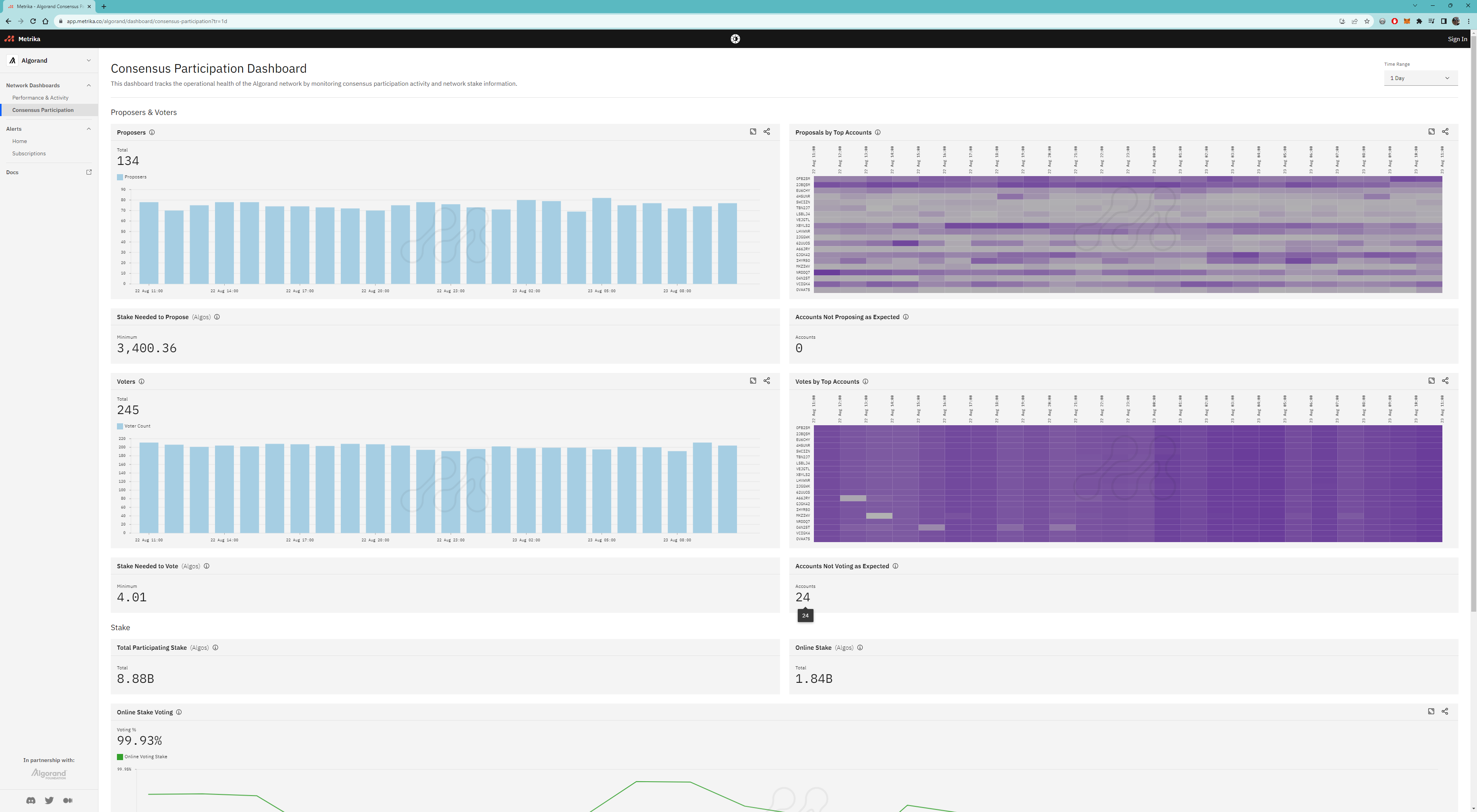
This part is done already for example by metrika

https://app.metrika.co/algorand/dashboard/consensus-participation?tr=1d

  • Accounts Not Proposing as Expected
  • Accounts Not Voting as Expected

Also Folks claim to do it, so I tried to ask if they can be so kind and open source their solution

ibu

Creating incentives for consensus will likely bring a lot more ALGO online to participate. If a chunk of that ALGO is participating through Liquid Governance, some of that might go offline in the time between quarters. However, it seems unlikely that the participation in consensus would decrease to lower than the current level, meaning the likely bare minimum is that, at points, the security will drop to the level it’s at now. As you’ve suggested to not change the system, do you consider the current level of participation to be secure enough already?

Without changing the system at all, the chain’s security status will remain stagnant for the forseeable future, and that might be an issue.

Rambutan
↩ in reply to benedettobio

The main takeaway, from this entire thread… (If I understood this thread correctly)

Algorand Inc and foundation are working together to create a reward system for participating in general Consensus at the protocol level.

Once this system hits main net, correct me if I am wrong, then we don’t have to use any dapps to participate in consensus right?

Participating in consensus should be something that occurs and gets done independent of any Dapps, apps, companies, firms, etc.

Using a third party App (for algorand consensus) renders the whole concept and idea of General Consensus useless.

Why don’t we just wait 9 months or a bit longer for it to get implemented on the protocol level? This would make the most sense.

What’s the rush? What train are we catching?

Rambutan
↩ in reply to ibu

The main takeaway, from this entire thread… (If I understood this thread correctly)

Algorand Inc and foundation are working together to create a reward system for participating in general Consensus at the protocol level.

Once this system hits main net, correct me if I am wrong, then we don’t have to use any dapps to participate in consensus right?

Participating in consensus should be something that occurs and gets done independent of any Dapps, apps, companies, firms, etc.

Using a third party App (for algorand consensus) renders the whole concept and idea of General Consensus useless.

Why don’t we just wait 9 months or a bit longer for it to get implemented on the protocol level? This would make the most sense.

What’s the rush? What train are we catching?

trekianov

I personally think that this proposal, besides pointing in the right direction, that is trying to address the current issue of low online stake, has already succeeded in one goal: understanding if this is a major concern for the community, and the answer is definitely yes. Is it a perfect solution? Of course it’s not, the protocol level should be the way, but this implies a delicate intervention that takes time and effort that currently is not predictable (probably beyond a 6 months horizon). In my opinion this agile mid-term solution has the size (1M) that can be right enough to encourage Governors to step into Consensus and therefore gauging the actual adoption that can be obtained through these kind of incentives, which shall be extended to all classes of Governors once the solidity of the approach is thoroughly tested during its first iteration.

scholtz
↩ in reply to Rambutan

not correct…

DApps must have support to allow to submit tx to make the dapp address or escrows controlled by the dapp in the online state… So DApps who did not implement this will not be able to make their stake online, and any incentives in 9 months when AF will incentivize online stake will not be received by them

At the moment only Folks, and maybe Gard protocol allows in their smart contracts the keyreg transaction which tells blockchain that for this number of round i set my account balance to online state and the specific algod server will protect for me the blockchain

i would like to see the question to incentivize concensus on the global level now in the GP8, but if heads of AF will not allow this, i will be happy to see some incentive taken at least from the DeFi budget and moved for this purpose…

i believe that any algo which is in online state is much better than algo in offline state… lets start 10B algos online iniciative :slight_smile: … there is no reason why person should have his account in offline mode (if he can set for free the public algod node he trusts)

lobo
↩ in reply to trekianov

as soon as more money can be made VCs will come in imho, BC especially loves to farm rewards

anon
↩ in reply to ibu

Such conclusions should be drawn with extreme caution. A completely valid case can be made that the new incentives will drive existing node runners to move their non-DeFi stake to (your) DeFi platform, subjecting an even larger portion of the online stake to these predictable fluctuations that endanger the security of the network. There even exist substantial precedents supporting this argument from when the Governance rewards shifted from vanilla to DeFi and the DeFi platforms did not yet support participation in consensus.

j.v.ii

My view is that as a community we’re not getting very much out of the Governance rewards program. Current programming squanders both time and financial resources (42 million ALGO each quarter). Allocating a significant amount of ALGO purely dedicated toward answering a handful of questions every quarter, some of which are repeated on a quarterly basis - we ought to strive for input in the most efficient way possible and more than a handful of issues every three months.

For example, wouldn’t the concept of Measure 5 be most efficient were we to simply use a sliding scale and have the community select their desired defi rewards once and simply take the weighted average of the setting, rather than ask it across multiple quarters in pursuit of the same ideal allocation, thus burning through far more than 42m ALGO? So, it can feel like it’s just wasting both time and ALGO this way.

Why can’t running a one-click node be a prerequisite to earning your quarterly governance rewards right now, not in six months or 12 months etc. I hate to be a wet blanket, but it just feels like we’re squandering various forms of resources. I’d love to see more of a sense of urgency.

BunsanMuchi

Doing this in the allotted time frame is simply not possible.

Then let’s do it the right way, create an approach for the general Algorand community, create a proper wrapped asset standard for consensus participation and push for its adoption within the general DeFi ecosystem. If this is something we seriously want to do, then we have to coordinate a talk with the Foundation and see how we build this, who builds this and how it fits in our general DeFi ecosystem. From a strong base-layer like this we can build innovative approaches to consensus participation, not from simply giving out rewards and hoping for the best.

Feels like that sometimes, even though I know it’s not the intention.

Then don’t offload it to just DeFi because you end up with a middle of the road solution. It either won’t attract enough consensus to be significant or if it does it becomes an attack vector. That’s bad design and we shouldn’t encourage it.

I suppose the rush is that we’re in essence dependant on the Foundation for consensus at the moment. But again, they know and are working on it, Inc knows and are working on it, we should open up the conversation with them and come up with an ecosystem-wide solution before we start incentives. We’re putting the cart before the horse.

That’s exactly my problem with the proposal. There’s nothing more permanent than a temporary solution. If this measure is moderately successful, then better ones won’t be given the time of day, or alternatively we’ll have standard-fracturing and a loss on UX (this is without opening the aforementioned REAL security concerns with it) and if it’s not we just pissed away 1M Algos on an experiment (mind you, half of what was allotted to our XGov program). What’s worse is that if we see a moderate response to it, we might get the brilliant idea of pushing this program even further in which case it will cause a serious problem to our base-layer.

Again, I’m only so passionate about this because I see it as a clearly flawed system that should NOT be supported in anyway. I understand that all the parties involved have Algorand’s success as their main objective, and that the intentions are noble, but this is a mistake and I can’t be more against it.

Gary2
↩ in reply to lobo

Node runners can add both their wallet and their escrow account. So when they redeem galgo the Algo will be in their wallet and the same amount of Algo will be participating.

BunsanMuchi

But redemption has to occur on a future block, by the user posting a tx, so consensus will dip immediately. In extremis this generates an attack vector.

lobo
↩ in reply to trekianov

so you as the “Head of Market Analytics and Research” at AF are ok with a proposal that literally is:

“should we give 1M ALGOs to FF so they can give it out to gALGO minters on top of the defi boost? and not giving other dapps even a chance to participate in this due to the time constraints + potential technical/centralization issues”

GhostOfMcAfee

Just jumping in to beat this dead horse. It’s a hard no from me for all three proposals.

-Measure 5: DeFi governance is already so heavily incentivized that we get people over leveraging on Folks. This wrecks borrow rates in the short term and makes people reliant on the AF to act like our mommies and save us from irrational over leveraging. The only reason to up the rewards is to pay for the DeFi consensus bonus, which I object to for reasons that many others have stated.

Measures 6 & 7: Like others, I am against these proposals. Consensus incentives should be paid for the act of participating in consensus, not because you participate through a particular platform. There is no reason I have seen to limit this to DeFi participants other than a weird fetish for driving Algos into DeFi to pump our TVL numbers. IMO, matters of decentralization/network security should not be dictated by things like TVL growth. This is especially true given that only one platform would seem to offer this.

trekianov
↩ in reply to lobo

It’s not like you said, please read carefully the Measure: it’s open to every project that meets the requirements. Even AMM could participate in this program with the liquidity in Algo present in the pool, for example. The requirements, in their first iteration, are the ability to efficiently monitor Consensus participation. p.s. Together with Adriana, I am currently also in charge of the Governance :slight_smile:

lobo

That’s the thing, the wording technically says it’s open to everyone but that’s practically not the case.

DEXs have one account that holds all the assets of one liquidity pool. So if you put this account online (which is probably not possible as the current SCs won’t allow this) on which node does it go online? Does the dapp have to run a node per liquidity pool and we have to trust them? Doesn’t sound really feasible to me

Jacopo

While I agree that’s important for consensus that more Algo is staked online and incentives are a good way to funnel participation, I don’t think that this measure cuts it. There should be a fair period of trial for more dApps to propose a PoC, test it and then proceed with the allocation, while in the meantime consensus incentivization should be done by boosting the normal governance, maybe adding a feature for consensus tracking where nodes that stop validating lose the boosted rewards. For Folks Finance I think that % of boost is a bit too much for the amount of time advantage they are given. Right now normal node runners are already put at a “lower level” vs defi governance stakers and with this the risk/reward would just make it too much attractive resulting in more stake moved to the FF escrow system. It should be at that point a MUST that node runners follow this practice:

as otherwise we can imagine that not only the additional runners stake would drop, but also the stake from previous node runners moved to FF would behave the same way and result in a security deficit.

To make this proposal acceptable the measure should lower the reward amount to DeFi and add a measure to boost traditional governance with consensus rewards for node runners.
Once the trial period is over and enough alternatives are provided to reach a decent amount of decentralization then more rewards can be added.

P.S. My opinion is that we should also take delegation into consideration since node running requires a certain attention to how the node operates and even with larger rewards the result obtained might not be the desired one. DeFi participation drove a good amount of participants into DeFi, but not as many new users from outside the chain, just like approaching a new chain higher rewards don’t bring as much behavioral change as an easier approach. I’d go as far to say that delegation might improve %stake online more than higher rewards. A restaurant gets more costumers if it’s built in high traffic zones instead of being hard to reach but gives out big discounts on meals.

edited
trekianov

I think we are seeing the same topic but from two different angles, so no one is right or wrong. The current online stake is dramatically low, if the urgency is to bring as much as possible online stake in the shortest time, this Measure can address it, with the possible side effect that some projects, which are not prepared for this integration, could temporarily lag behind: I am sorry for this but I truly believe that devoting rewards to incentivize consensus is currently one of the best possible uses.

trekianov

The proposal by @Gary2 is actually an interesting one that can address the issue: what do you think? p.s. We are here to discuss and find the best solution, not to defend apriori the first iteration, whose real added value is to have sparked a fruitful discussion like this about Consensus incentivization.

Jacopo
↩ in reply to trekianov

incentivization of consensus is the key problem to solve, so let’s not blend it in with the “provide liquidity” problem. Consensus stake can be incentivized through traditional governance.
DeFi/ FF node runners are already incentivized by the fact that they can earn double the rewards through gAlgo vs the trad gov node runners

Jacopo

the one problem here is:
< if we add rewards to trad governance the rewards won’t be as attractive as DeFi rewards>
So if the intention is to drive users into consensus with rewards they won’t take the smaller rewards if they get more by just minting gAlgo…but if the goal is to make the most people participate then delegation HAS to be taken into consideration, one click nodes don’t address the physical problem, not everyone has a mini pc they can operate and know how to set up, also they probably won’t even understand how the whole process works and the security implications. Thinking that most of the stake is in the hands of users who understand this much about Algorand can be understandable now that the adopters are few, but long term if the stake has to spread to everyday users we can’t expect them to know all this stuff or operate them without creating a security issue.
I understand that this decision is almost forced towards FF and it makes sense to go that way, but the way it was presented without allowing for more opportunities to compete with that is forcing the decision.

scholtz
↩ in reply to trekianov

My suggestion is. Let Algorand Foundation allocate 1M algos for consensus incentivization for next quarter.

100k Algos will be given to public nodes where people can create their participation keys for free… In fair system… each node gets 1 point for each minute online. if node is not updated to latest version of algod, it will not get any point. if node is producing false blocks it gets blacklisted in current period. Payout period will be one hour, where all points are calculated and hour distribution is distributed to all nodes in proportion of their points.

900k Algos will be given to users who make their stake online. If node they selected is online they will get each minute 1 point for 1 algo they stake. Payout period will be one hour, where all points are calculated and hour distribution is distributed to all nodes in proportion of their points.

This system includes also the Folks escrow online accounts.

@trekianov, @JohnWoods, or @Adri … i can create this system open source, in two working days for free if you are interested to use it

edited
scholtz

What needs to happen so that we can put incentivization of any online account as measure 8 of GP8?

Jacopo

overall it’s important to pass a measure to incentivize consensus, considering the important subject at hand I think that it wouldn’t be too unwise to delay the voting for this one.
@trekianov I’d suggest (and I think it would be greatly appreciated by the community) if this measure could be turned to a bounty system, have builders from the community come up with ad hoc solution. Then incentivize the ones that are delivering a solution. Folks would already have one ready. Other platforms and projects will be incentivized to deliver a new working product.
Also give more time to the community to come up with solutions to reward traditional runners outside of DeFi

scholtz

Sure, i would like to see the hackathon for this one…

I was winner at these hacks:

GovId Hack, EUVsVirus, Encode Algorand Hackathon, Swiss blockchain hackathon, Bitcoin bankathon, Encode DAO hack, Algo Hackjam, Algorand Greenhouse Hack III, Mega ace hack, and recently ETH Prague Hack

I am probably the only participant who won eth hackathon with algorand project :slight_smile:

I would love to get badge from “10 billion online algos hack” …

lobo

@benedettobio couldnt attend the space unfortunately but apparently you dont know how your own protocol works so heres why your answer to the “participation stakes vanishes problem” is wrong:

after the period ends FF gathers all the ALGOs to allow redeeming which means at this point all the nodes loose potentially their whole online stake. even if they register their normal wallet that wont help since they need to manually redeem their gALGO to get their ALGOs back to increase their online stake again. so even in this case there will be a sudden drop in online stake

@trekianov tagging so you know that this isnt a solution at all

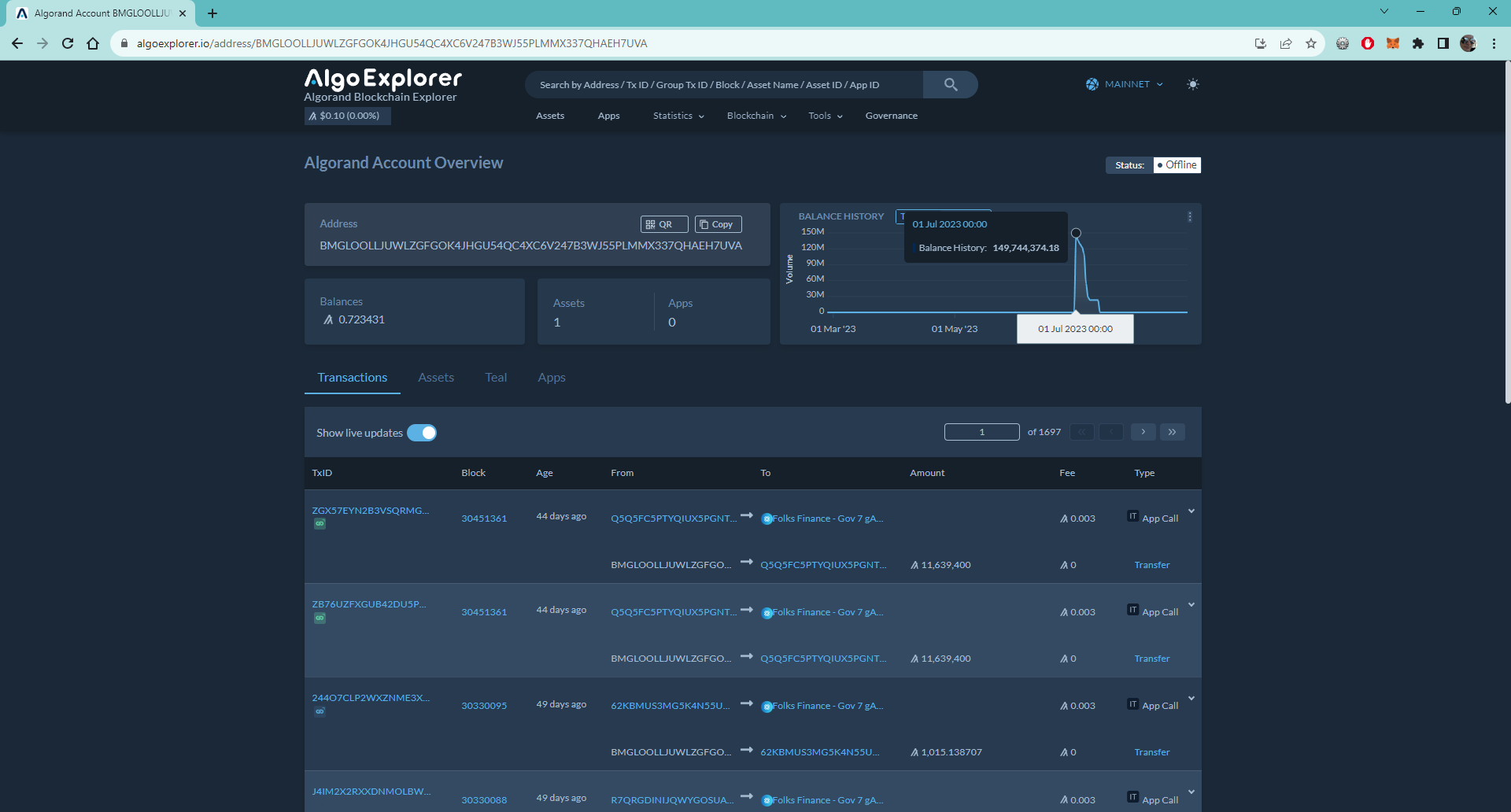
heres such a group tx where FF gathers the ALGOs and apparently opt this escrow account out of the g7 app and then opt it in to the g8 app. at this point that account has like no voting power anymore:

https://algoexplorer.io/tx/group/F0glh%2BEKjPriRW%2BanmoxM0MX92RKs2cDtzBzkk4fTKk%3D

and in general i would have expected you to argue against some of the problems brought up in here instead of just saying that some community members are against it and then marketing this forum to add comments in favor of that measure. at the very least this should have been your job @trekianov imo as more of a neutral person working at AF

edited
makman
↩ in reply to BunsanMuchi

I currently run a node that hosts both the participation keys for my regular account and my folks escrow account. The stake in my regular account is currently 0 since the algo was moved to my escrow account, which is fine - the regular account simply does not end up being selected to vote or generate blocks.

Af the time I burn my galgo, the algo is returned to my regular acount. That move does not impact consensus because the algo is simply shiifted from one online account to another. Both before and after the redemption, both accounts remain online.

I’m not sure where the vulnerability is occuring with such a setup?

makman

Thanks. Would folks taking that central pool online themselves resolve the issue in your view?

Secondly, could the amount suddenly removed ever leave the network with less online than if they didn’t incentivize in the first place? If not, wouldn’t the network still remain more secure overall, even with a temporary drop?

davidw
↩ in reply to trekianov

Hi Trekianov

As a representative of AF I assume your priority is to preserve the integrity and security of the protocol at all times, as number 1 priority… This proposal is clearly late notice outside of defi committee and has not been given sufficient time for other defi builders to prepare for (with exception of FF and possibly gard).

Given the nature of the galgo-algo redemption mechanism I have yet to hear a clear explanation about how the added risk from this predictable cyclical event can be properly mitigated.? With the profit motive of incentives, it is logical to assume existing non incentivized consensus participants will reorg to benefit from the defi 1m which as you admit will be clustered initially around FF at least for 1 or 2 cycles due to their headstart. For that reason alone it defeats its stated purpose and may increase consensus risks for the protocol at specific times above the status quo.

Please be patient and do this properly for future gov cycle supported by more defi options which don’t all share galgo-algo redemption timing implications.

On a personal Ievel I really appreciate what folks finance has done to bring attention to consensus and I think a reduced amount could be risked on defi specific rewards, maybe max 250k. But much preferred would be alternative distribution mechanisms across all participants in interim before the protocol level enhancements arrive. Please let @scholtz and others prove what they can do quickly and let others review as FOSS, under a Hackathon incentive…

For anyone reading all these comments from the most active builders in the space like @d13co , @BunsanMuchi, @Swaggelwander , @scholtz (outside of FF/gard) and @lobo as a leading defi advocate. all are in agreement on the issues (late notice) and potential risks with this proposal.

Nb. @Adri , @trekianov - Collaboration is really great between AF and active teams, when it looks like collusion… it’s not so great, neither is knee jerk proposals. Please note I think this is only how it looks and I’m certain it has been well intentioned.

The only antidote to that on a truly decentralised platform is 100% transparency and proper due notice.

Can the AF committees (incl defi) publish all their meeting notes as matter of course? Simple audio recordings posted onto AF website within 48hours would prevent these situations and save lost times due to necessity of giving due notice on proposals so people are not wrong footed… We all are feeling impatient but security is paramount. As it stands i do expect this to synchronize the loss of algo in online participation at predictable points in time. Until that is properly mitigated/resolved/explained it must be delayed or much less proposed to be put into the defi consensus particpation pot ( eg. <250k).

Regards

David W

scholtz
↩ in reply to lobo

The real question is, if this can be used as attack vector on algorand blockchain…

Can FF make that account online? At the moment its offline.

Can attacker target their server farm and put that single server who protects 150M algos down?

If we go with global 10B algos online initiative the 150M algos will not play significant role there…

Trqv

Oof been in the highlands for a week and this topic exploded.

+1 support for node incentives through the targeted DeFi scheme as outlined in the updated measures.

Personally going to spin up a second node in hopes that it passes.

All hail John Allan woods

Happy feedbacking fam :call_me_hand:

edited
lobo
↩ in reply to scholtz

honestly hope they cant as then i would have to ask what control thy have over those ALGOs in that account, kinda scared about the answer to this

edited
Maial.algo

I vote in favor of 500k allocated to node runners. Waiting for this to become protocol-level

omniwarp

From what I’ve read here, my understanding is that the more successful the proposal is, the bigger the security drop. So even if this proposal works great, it creates an equally great problem because the stake will dump at a known time. Even in the optimistic case where we returned to the exact prior levels, it’s not good to have drops like this. Moreover, what happens in 2024 Q1, Q2, Q3…? Is this really a sustainable way to get people to participate or will we create a pump and dump in security?

I think consensus participation incentive structure is an integral part of the network protocol and should thus be handled by INC. We don’t have to try and tinker with these just because Folks added rewards and slightly more stake came online.

Adri

*** UPDATE 28 August ***
Thank you all for your feedback. Your deliberation has highlighted the need for further discussion on this topic. We will not proceed with measures 5, 6 and 7 this quarter.

trekianov

I want to thank everyone who participated in the (constructive part of the) discussion and I would like to stress that the decision to not proceed in this quarter must be seen in a positive light: the Community has demonstrated enormous interest in addressing this issue and therefore it’s necessary to have a more detailed discussion about the actual implementation and its consequences on the security of the network. At the same time, I feel the need to ask everyone to discuss, even fiercely, the ideas but abstain from transforming them into a personal issue: let’s put aside our egos, we are here to build something together.

lobo

Really appreciate the decision to not rush it and instead trying to work on points that were brought up!

It is important to continue such a discussion now openly instead of it going back to a committee imo so we don’t end up with the same problem next period. This should be the general approach: get early feedback and try to work on the measures together.

And to comment on the last point: while my opinion was always backed by reasons (at least i hope i could make that clear) I know that some of my comments were directly directed towards FF. As long as we can a real discussion where we both acknowledge the points of the other party, balance pros and cons, I definitely don’t want to continue it this way. On top, part of this was due to the short time we had to make our points clear where I personally felt the need to address points more aggressively and I honestly just became pretty emotional because I just want the absolute best for Algorand.

ssuracl

People have been wanting consensus rewards for a long time. Governors should be able to vote on it.

Alice_Sh

it’s vital to emphasize the preeminent significance of upholding Algorand’s security. The ongoing fluctuations in market dynamics have inadvertently magnified the susceptibility of the blockchain to adversarial actions, thereby underscoring the imperative nature of its protection. The adverse aftermath of a successful attack not only endangers invested capital but also engenders the potential for widespread job dislocation.

awesomecrypto

As FYI, there is another idea/suggestion for participation node rewards here. To be clear, that shouldn’t necessarily block or impact this measure for GP8, but it is good to be considered for future decisions.

Idea:
The rewards (Say all or portion of fees + any extra Algos the foundation adds) go to a single participation node through a lottery (in parallel or combined with the committee selection) in each round, independent of its Algo stake size . Basically, receiving rewards works like an actual lottery and the only required qualification is running a participation node. In other words the rewards are given based on allocated hardware/network resources.

scholtz

and this would lead for node runners to form pool coalitions so and distribute the rewards to coalition members :slight_smile:

btw, how do you define the node runner? at the moment it is the account which is online not the node…

i think we really need to teach everyone that online account does not need to mean that you have to run the software… Lets make 10B algos online… for this we need to change this mindset

regarding the idependent thing of stake size… i can split 1000 algo account to 1000 1 algo account… i can make it online in one node… do you think i should have higher chance to win the lottery?

btw i agree that this lottery solution might be easier to implement and it might have also better legislative and accountings impacts

edited
lobo
↩ in reply to awesomecrypto

sounds like people will be incentivized to bring as many accounts online as possible which doesnt sound like a good idea imo. if you add a minimum stake to it, depending on the amount, it would just mean that whales can play this game

awesomecrypto
↩ in reply to lobo

There is a cost to running a node and given that it is a lottery you would not start spending a lot of money running tens of nodes with the hope that the future payments will cover the costs.

awesomecrypto

The goal is to reward one node not accounts, which should be clear from the rationale. The only question is whether that’s possible or not. In the worst case it could be semi-manual similar to gov rewards not embedded in the protocol.

scholtz

At the moment you can track either online public node (by monitoring the swagger i sent you) or you can track list of accounts and its stakes…

Note that the public node requires proxy app to allow use of cpu sensitive “partition key creation”. This is not officially done by Algorand atm, and there is no official way to create partition keys from web on nodes run by algokit or official docker images. (To my knowledge… perhaps something has changed meanwhile)

There is no way at the moment to say which nodes are validating which accounts as far as i know.

Technically those nodes holds the private keys for signing the block proposal messages, so it should be possible, but i am not sure right now if they can sign arbitrary data so that you can registrer your node to some database to link node with account… Nodes does not have any identifier to my knowledge nor they use some account, so it might be good to change protocol if we want to these things properly.

Btw, in my opinion it would be great if we generate account for each node, and this node would identify in the network with his public key…