This forum is a read-only archive. Posting, replying and signing in are disabled.

Open-Sourcing AVM Email: Joining Encrypted Communications with Defi: 3524536010

Atsoc1993

Category: Other
Ask: 150,000 Algo

Value Proposition

  • Already open-sourced and repository submitted to Electric Capital with MIT License

  • 5 PUYA smart contracts for the first decentralized, non-ephemeral, bidirectional, encrypted communications and staking pool service live since October 2025

  • PUYA smart contract pipeline for platform usage, including on-chain registry, staking pool factory, buy-back-and-burn tokenomics or commission-system on email / server purchases.

  • One of the first on-chain implementations at scale of any encryption utility on AVM

What is AVM Email?

AVM Email is a fully decentralized, on-chain, encrypted communication system — our encryption implementation was guided from previous CTO. Although there has been a variation of attempts at on-chain encryption. We are the only encrypted communications dApp on Algorand that checks all of the below:

  • Bidirectional Encryption, encrypt and decrypt sent and received messages between you and another individual on-chain.

  • Email servers provide buyback & burn token functionality, or fallback to a commission based system at user discretion

  • Has a designated workflow for encryption key derivation and does not require arbitrary transactions to be signed

  • Create staking pools for your owned servers

  • Live for the past 6 months

  • Smart contract pipeline

  • Community of 100+

  • DeFi integrations

  • Fully open-sourced

In combination with our on-chain registry, non-ephemeral keys are core to our usecase as communications can be easily retrieved and read by both intended parties. There is no sharing of data or databases storing unencrypted content — only the senders and receivers in any conversation can decrypt communications.

Users can earn commissions on referrals to their email servers eg; @algolinks.avm @asastats.avm @ethereum.avm, etc. when users create email names. Alternatively, server owners can forego these commissions and opt into triggering buyback & burn events for any token of their choice instead; these settings are configurable at any time.

Server owners can create staking pools through their servers to incentive users to purchase email names under their server, and of course any email owner can communicate with another email owner of their choice.

Is Application Live: Yes

Application Is Open-sourced: Yes

Contracts

  • AVM Email Registry / Factory
  • Email Listings Contract
  • Server Contract
  • Email Contract
  • Spam Email Contract

Team

  • Leo Costa

  • Allan Diamante

  • Ulrik Diamante

Previous Works

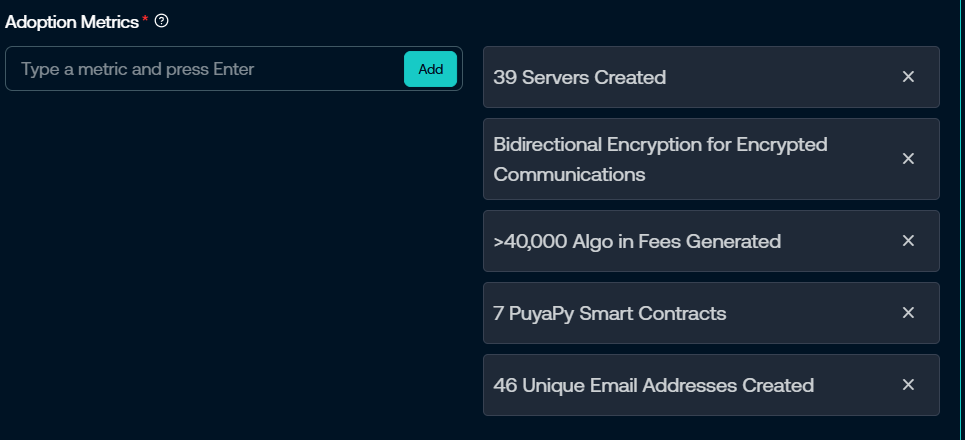
Adoption Metrics

  • 39 Servers Created

  • 46 Unique Email Addresses Created

  • Greater than 40,000 Algo in Fees Generated

  • 7 Puyapy Smart Contracts

  • Bidirectional Encryption for Encrypted Communications

Additional Info

Website for AVM Email: https://avm.email/
Repository for AVM Email: GitHub - atsoc1993/AVM-email: On-chain Encrypted Communications and Decentralized Finance on the Algorand Virtual Machine · GitHub


edited
uhudo

Thank you for splitting the proposal into multiple parts.
Could you elaborate more on the usage of the AVM Email? How much does the community of 100+ users use the email service and related DeFi integrations? Where is the community located?
Would you also mind specifying in more precisely since when is the service live (i.e. since 2025 is 1 year span)?

Based on past controversies regarding related proposals, I would prefer the work were open-sourced in advance rather than only after approval. This would enable xGovs to better assess the benefits of the delivered work.

edited
Atsoc1993

Of course, no problem.

The launch date was 10/27/2025, so we are nearing 6 months live.

There have been 29 generated servers in total, fees generated from the platform are forwarded to over 100 users in the affiliate Algo.fun platform. Each server can earn commissions to server creator or buyback and burn tokens; we have more details about all functionality under our FAQ section (Question mark symbol at the top right of any page on AVM.email )

We have not seen anyone utilize the server staking pool services as of yet, but that logic is there and functional.

As a reminder we had launched at a time where general sentiment was not great in the community, as we can see by the >50% inactivity rate across the xGov community as a whole alone and, sadly, the general price action. We are still here chugging along— hopefully as sentiment recovers and we get better traction we can see these things change.

Our discord is not the most active, but can be found here: AVM Email

There are 49 users in the discord.

Similar to a comment I left on the other forum thread regarding open-sourcing beforehand as a preference — we actually don’t mind doing this for AVM Email. We would personally prefer not to as there are others trying to implement something similar, however those implementations have been lackluster and generic, likely vibe-coded as I have seen, and missing key components that make UX significantly more friendly, alongside many other optimizations eg; simple transactions with note fields as opposed to intricate smart contract pipelines for communications.

Again, similar to the other thread’s comment. We are not familiar with what occurred in the past with xGov, but we don’t feel that by pursuing the conditional open-source pathway should cause us to fail to meet TnC. It should not be an option otherwise — if we were brand new to the community or notoriously known for vibe coding I would understand, but we are well-known and have contributed to projects in the past like Rxelms that should hopefully warrant some discretion in our favor to not open-source preemptively.

edited
uhudo

Regarding usage, the fees you speak of here, are these the 20k ALGO you refer to in your other proposal? Or how much fees did they generate and how much traffic have these servers seen?

You are mentioning others are implementing something similar. Could you name them? Do you have any info about their use, so that xGovs could assess better if there is demand for such a product?

Regarding controversies, I was referring to your past proposals - AF watcher, where the value was promoted to be in its execution, consistency, maintenance and contributions to the ecosystem, while the watcher was offline for a substantial time after the proposal was approved; as well as w.r.t. the last proposal, which served as a basis for this one, was flagged by the xGov Council as non-compliant with the program’s T&Cs. The proposal was also rejected by the majority of xGovs.

IMO, without open-sourcing in advance, it is highly unlikely there will be a different result this time. W.r.t. the efficiency of the ecosystem, it would be beneficial that the proposal would be resubmitted only if it were materially improved.

Atsoc1993

Note that we were referring to $20,000 in Algo relative to the price of Algo observed at a previous point of time.

20,000 Algo more or less was generated from this AVM email platform — the remainder came from other sources, mainly the AF Watcher proposal.

I commented on a reddit post where someone used ephemeral keys, they seem to have had no content on their reddit or their GitHub aside from their own implementation of an MVP similar to AVM Email in terms of theoretical approach, but not quite at our level of implementation, which I found strange.

Regardless, that application is not in production to my knowledge and is not smart-contract based, they use note fields exclusively via outer transactions, where as we have a fully built, in-production, smart contract pipeline and infrastructure.

They also have no metrics to share either, so that is something important to take note of; seems to be vibe-coded as well, and their encryption method was not bidirectional. They claimed that it was adjusted to be bidirectional, but they mentioned they used non-ephemeral keys, this is a contradiction and just makes no sense.

There have been replies to that subreddit post but they do not seem to be active anymore, this was about 2 months ago if I remember correctly, I believe they lost interest once they saw a platform had already had a complete version of what they were working towards, but of course I cannot speak for them, their sudden appearance or respective disappearance, but we commonly see grifts pop-up and go that do things like this often. They copy-paste existing implementations of something onto different chains and change the banners, use bare minimum chain-specific integrations and try to seek something from it. I do not have a link to their implementation but it can be searched for on the subreddit if that is in your interest.

Regarding the comment based on past controversies, I will comment my response as you commented there similarly as well:

Regarding the AF Watcher, which I am not too fond to see coming up again — the watcher going offline was out of my control, and out of my observance. I still stand by the fact that no one reached out to me to let me know it was offline — the X API free tier was deprecated, and I have since then not only converted to the pay-per-use subscription plan as a courtesy but have also upgraded the watcher to monitor and tweet new proposals as well as daily proposal summaries since then.

We also began working on and provided a discord alternative immediately, but only 3 or 4 people used it — I would appreciate if these things were taken into consideration, and not used as a reason to force us to open-source unconditionally if we want to pursue funding, as I don’t see others having this restriction applied to them mandatorily.

I would also ask that you note you asked for material improvement here as well, correct me if I’m wrong but I believe you were referencing content from the other proposal and that would not apply to this fully built platform.

edited
Atsoc1993

~ @uhudo I discussed with team and the consensus is we just open-source the Gainify contracts, Algofun Shares System, and AVM Email contracts — they are minimally documented and will contain no test files, frontend codebase, or any other supplementary files. We understand the risk of blindly accepting proposal TnC for conditional open-sourcing right now and feel its the least we could do to make your lives easier. We have uploaded Gainify contracts so far, we will add AVM Email & Algofun Shares System by tomorrow.

Edit: All contracts added 04/06/2026 10PM EST

atsoc1993/xGov-Proposals-Contracts: The Contracts for the Algo.fun Shares System, AVM Email, and Gainify Staking

edited
uhudo

About the formalities, the currently shared repo still does not meet T&Cs.
An open-source license is missing and the repo hasn’t been added to Electric Capital.
I also think joining again all proposals in the same repo adds back the confusion about the proposals.
Just sharing the contracts without the accompanying tests and documentation, i.e. a partial proposal, IMO still doesn’t meet T&Cs (while I know some other xGov Council members are more lenient on these points than me).

I’d advise you to focus first only on this proposal. Check how some other proposals that approved were presented and documented, e.g. PCG Random Number Generator.

Atsoc1993

Ok — we will place Algofun Shares System & Gainify proposals on hold — then for AVM Email, fully open-source, add license, document, and add repo to Electric capital. ~~

uhudo

Great. I think this has the highest possibility of succeeding.

I’d just advise organizing the repo a bit more, e.g. by adding an overall README, in particular as test, setup and contract files are all joined in the same folder. Also, if you have any tests that assert the functionality rather than just to demo the use, would be helpful.

Consider also rewriting the proposal itself based on this whole discussion.

Atsoc1993

Yes, we will tidy up the repo ASAP — the proposal has different text than this forum post and I’ll make that match as well.

Thank you for your patience in all of this @uhudo and anyone else keeping track in the background, we didn’t make keeping up with us easy and that didn’t deter you from continuing to help us.

Atsoc1993

Just as an update we’ve reorganized the repo, just thinking of some “non-execution” tests we could add, it’s not too straight forward but maybe for the offchain logic. We’re also working on a nice readme that lays out the key logic / flow behind AVM Email, which I think will be most important

uhudo

The repo is now closer to what I’d expect but please double check it as the README does not correspond to the actual folders.
Once everything is aligned, consider merging it in main for clarity.

Regarding the proposal itself, I’ve noticed you increased the ask from 125k ALGO to 200k ALGO.
I’m wondering what prompted the increased ask?

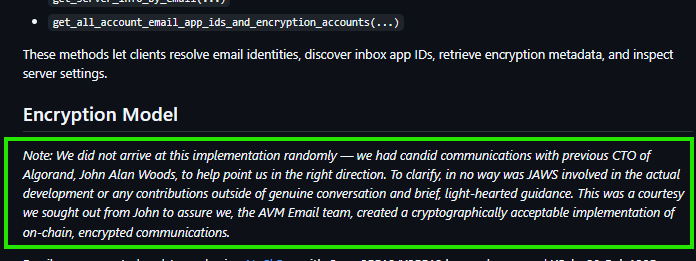
Your also mentioning the product was guided from previous CTO. Does this refer to JAW?
If so, to what degree was he involved? Why is he not listed as part of the team?

As part of the metrics, I’d put the number of servers created, on-chain users, emails sent, fees generated, etc. Not just “community”.

Atsoc1993

Good evening @uhudo —

  1. We made the readme more descriptive and accurate, I think you’ll like this version — main is now the default with all the updates we made: atsoc1993/AVM-email: On-chain Encrypted Communications and Decentralized Finance on the Algorand Virtual Machine

You’ll notice new/enhanced sections for:

  • Folder Structure
  • What AVM Email is
  • Contract System Overview
  • AVM Email Flow (Server creation, email creation, sending emails, receiving emails, allow lists/junk mail
  • Naming Model
  • Encryption Model (deterministic encryption account methods, salt usage, how storage works for all this information, etc.)
  • Tokenomics, Fees & Commissions (server registration, initial email purchases, buyback + liquidity / burn behavior, marketplace fees)
  • Marketplace Flow
  • Server Configuration
  • Private Staking Pools (Requires owning an email under a specific server to be whitelisted)
  • Some core utilities / helpers
  • Prereqs
  • Contract compilation instructions
  • Running integration scripts for email & staking demos
  • General pytests
  1. Regarding increased ask — we spoke amongst the team and there was a consensus that we increase the ask amount. We weighed out the amount of work that was done, compared to other [valid] xGov proposals that were submitted and approved, and noted that we did not decide on an ask amount together when the proposals were split and the ask amount had not been criticized yet by the team. We do feel its a fair ask — although I understand it can be speculative.

  2. Regarding the JAWS reference, we added a note in the readme under the Encryption Model section regarding this as well, but I will paste a snippet here:

  1. I’m not sure if you’ve seen the adoption metrics on the xGov Platform for our proposal, but I’ve updated them here on the forum to match them — if you don’t mind, ironically, we do not have a notable figure for total emails sent, but I was able to get the number of unique email addresses. I have included a script for finding both of these new metrics in the repository under scripts/email:

Adoption Metrics

  • 39 Servers Created
  • 46 Unique Email Addresses Created
  • Greater than 40,000 Algo in Fees Generated
  • 7 Puyapy Smart Contracts
  • Bidirectional Encryption for Encrypted Communications

edited
uhudo

Thank you for incorporating the suggestions. I think the current proposal quality is overall improved.

That said, as the ask has now been increased, i.e. almost dubbled to 200k ALGO (while the past proposal requested 300k ALGO for three products), I am skeptical it is justified as neither the delivered work nor the traction has materially improved since then, thus IMO approving the increased ask would set a bad precedent for the xGov program.

Comparing the ask size of different proposals is difficult. E.g. the PCG random number generator library requested only 32k ALGO for implementation in 4 languages and with traction of being used in multiple products, including in Tardly NLL with 0.6M ALGO staked.

Hope to hear the thoughts of other xGovs too.

edited
Atsoc1993

Thank you for all your help again @uhudo

It absolutely is a spectrum of work/asks on the xGov platform. I can only speculate that the PCG random number generator proposal was truly a humble ask from a seasoned developer we were lucky to have on the DevRel team.

I would greatly appreciate feedback from other xGov council members as well, if there’s anything we can iterate on outside of the closed-product that would make them more confident about approving the state of the presented work we would happily pursue it.

I guess these will be my last words here unless there are any other comments. Of course we cannot do anything about the lack of users / adoption of our platform, in an ideal world this would not be the case, and maybe there were things we could have done differently. But we feel the concept was executed well, the documentation is clear and descriptive, and the product was carefully crafted and open-sourced ahead of time.

We are here for any other requests, and we apologize for the confusing path to get to this point where we had a conjoined monstrosity, followed by 3 separate proposals. We discarded the other 2 proposals until they materially improve — but we feel this proposal is in a good place, and hope that sentiment is shared.

Thank you all again for the efforts already made so far and any to be made in reviewing this proposal.

edited
simonb

So this proposal has come a long way and it deffinitelly shows willingness to adjsut/accomodate feedback.

The traction and user growth is somethign entire algorand is struggling with so lower number of users doesn’t neccessarily mean there is no demand for such product.

Personally i’m supporting this proposal, as the functionality is unique and it has value. However i also feel the ask is on the higher end of the spectrum, but it’s ultimately up to xgovs.

emg110

The proposal is good, the willingness to meet standards and collaboration is very nice , just if the ask was a little bit more modest, it would have been what I fully support. as of a frank suggestion, I would love to see this proposal’s ask in 100-120 and not more. if you adjust that It will become 100% fit in every sense. Currently, the ask ratio to effort is not justifiable IMHO.

Allan

I would like to start by thanking you for the comments and asking that my responses be interpreted in the least hostile way possible. My goal here is simply to clarify a few points and respond based on aspects I may not have fully understood from the arguments presented.

Regarding the adjustment in the proposal value: it was made both based on analyzing other projects and on the need to restructure our own scope. Unlike some of the examples mentioned, our project involves not only smart contracts but also a responsive frontend, which significantly increases both complexity and effort.

Initially, when we presented a broader proposal (including Algofun, Gainify, and AVM Email), there was an intention to make the overall package more cost-effective. However, we agreed with the feedback that the scope was too broad and not well defined. As a result, we decided to focus on the main product (AVM Email), better define the scope, and also add a testing layer covering all operations. With this change, the implicit “bundle discount” no longer applies, which directly impacts the final cost.Regarding the concerns about the increased ask, I believe many of the arguments presented have been somewhat superficial. We all know that pricing a software product is complex and subjective. So far, only uhudo has provided a more structured argument explaining their perspective. While I don’t fully agree with the comparison made, I do appreciate the effort to provide a clear rationale.

For example, a random number generator library supporting four languages was mentioned. However, this is more about variations/dialects within ecosystems like Python and TypeScript, rather than four entirely distinct languages. Additionally, comparing a library/feature with a complete product (SaaS + smart contracts + interface) does not seem equivalent.

Another important point is that the impact of a library supporting multiple languages is very different from that of a SaaS product. Adoption for a library may increase with additional language support, but this does not apply in the same way to a product. For example, it is unlikely that someone would stop using a SaaS simply because it was built with Vue instead of React.

I would like to reiterate the point: if you believe the requested amount is too high, please explain it with a clear basis (if possible), ideally using proposals that are more comparable to ours.

Atsoc1993

Although I know the proposal is near a polling phase and I was not expecting a comment from Allan, I consistently check on this thread. I would humbly ask to hear out Allan’s thoughts here, as he does have some reasonable points. The most impactful of them I feel is that building the front-end on his and Ulrik’s side was no easy feat either— a reminder of the complexity we faced in putting AVM Email together, and the original “bundled” proposal we had for the 3 separate platforms.

There were a lot of intricacies in balancing the different kinds of accounts and content history, as well as encrypting/decrypting content—not only from a smart contract perspective (7 contracts specifically, as we mention) but also from a front-end perspective. Rendering everything, from the interfaces for preparing and sending emails to the option of crawling through email history with the least user friction possible, was incredibly tedious.

We essentially built and delivered a fully decentralized and end-to-end encrypted emailing platform on Algorand, we had no example implementations to build off of and had significant blockers along the way as the entire blockchain itself does not traditionally support encryption foundationally.

We threw in a commission system, tokenomics, and “private” (server-gated) staking pools on top of that just to spice things up. There are very few developers exploring this category of work, even fewer that are not AF employees, either implementing or standardizing these encryption methods. As far as I know we are the first to fully build out something like this that is not just conceptual.

As always we are grateful for everyone’s contributions in reviewing our proposal.

edited
iGetAlgo
↩ in reply to Atsoc1993

You guys keep asking for funding through pity and its sad.

“This was really hard” “It took a lot of time”

I always find it crazy how disconnected old school devs are from the actual world and their understanding for how people interpret things…

joe-p

I want to share my thoughts on the crpyto involved here.

My main concern with basically anything that stores encrypted information on-chain is forward secrecy. This is especially true for a protocol that is only using ECC cryptography. All of this private data will eventually become exposed in a PQ world.

To help with forward secrecy, modern messaging apps typically use key ratcheting. The most popular implementation is Signal’s double ratchet. There’s also the more recent MLS, which is an attempt to standardize a scalable ratcheting protocol for group messaging.

Even if you were to adopt PQ signatures you still are susceptible to key leaks and losing all forward secrecy. You could implement ratcheting, but it scalability becomes even worse with PQ schemes.

With this context, my main questions would be “who are the users and are they okay with this weakened security model?” The term “weakened” is relative to off-chain messaging apps that preserve forward secrecy. This also begs the question of whether or not the users are even fully aware of the security model.

I think the main problem that is trying to be solved here is “I know this persons Algorand address and I want to communicate with them in private.” If that is the case, then I think this can be solved by having a one-time communication on-chain to establish an off-chain communication channel (for example, sharing a signal handle). The value of storing each message publicly and indefinitely (by archival nodes) is not clear to me, thus I’m not convinced the weaker security is justifiable.

Atsoc1993

Yes but then the app is no longer decentralized, because off-chain communications are now, although still encrypted, stored off-chain by some entity.

I have never been a fan of centralized services, especially with data encrypted or not, because access to that data is at the discretion of the host.

Just as a note we have never advertised as being PQ-proof, but I understand the PQ concerns as this is a popular topic on Algorand.

I believe the forward-secrecy is a trade-off to ephemeral keys I know we discussed at one-point in time. But we decided on a route where history can be accessed at any time by the two users communicating. Again this can be facilitated off chain but goes back to my centralization concern.

Additionally, I would be interested in hearing your thoughts on the SEALs implementation, which is what I was signaling in the discord, although of course I appreciate your feedback here as well! And we’d be happy to iterate in the future — although I believe this feedback requires pulling a lot of features.

Late Edit: If there was a genuine interest we would be happy to explore a shift in the usecase implementation after this proposal. But it would be nice to have some assurance that this is desired, we were also discussing going mobile the other day, but it would be nice to have a discussion about the exact implementation and plan appropriately if DevRel would be willing to provide some guidance. But I will add that I’m not a fan of a sort of registry mapping to a signal handle, it feels like low-hanging fruit.

edited
joe-p

Yes but then the app is no longer decentralized, because off-chain communications are now, although still encrypted, stored off-chain by some entity.

I have never been a fan of centralized services, especially with data encrypted or not, because access to that data is at the discretion of the host.

I’m curious about how you feel about how AVM Email is positioned against something like Matrix, where you don’t need to rely on a third party and have E2EE with key ratcheting via Olm. As an end-user it’s not clear what using AVM Email gives me over setting up my own Matrix server. With Matrix I don’t have to worry about all my messages being public. In both cases I need to setup infrastructure to avoid reliance on third parties.

To be clear, I’m not saying there definitely isn’t value here, but I’m saying that value of the product isn’t really clear to me based on the proposal and README. Maybe I’m wrong and users don’t really care about security that much, but I think the users that would care about decentralization would also care about security.

Just as a note we have never advertised as being PQ-proof, but I understand the PQ concerns as this is a popular topic on Algorand.

Yeah that’s fair but it’s kinda what I’m getting at. Not being PQ-secure right now has a LOT of implications because this data is on a public blockchain. If the messages weren’t on chain current-day PQ security would not be as important. Every single message for AVM Email will be indefinitely accessible by every single malicious PQ actor. This is something that I think should be clearly communicated to the users.

Again I don’t think this invalidates all the hard work done here. For some use cases where you don’t need forward secrecy (for example making a private offer on an asset in someones account) I think this makes sense. What gives me pause is the fact that this proposed as a general purpose private message solution where all the security nuances are not mentioned. Perhaps something more targeted for specific use cases where the security model was more narrow would be less concerning to me.

Additionally, I would be interested in hearing your thoughts on the SEALs implementation, which is what I was signaling in the discord, although of course I appreciate your feedback here as well! And we’d be happy to iterate in the future — although I believe this feedback requires pulling a lot of features.

I like some of the cypto decisions they made. Particularly using HPKE. HPKE is nice because it gives flexibility for the underlying KEM. For example, you could have a protocol that uses X25519 today but then switch to X-Wing (or whatever the finalized version is named) for PQ security. You just need to ensure the Algorithm ID (as per RFC 9180 Section 7) is included with messages, then clients can handle the messages with a standard HPKE library. It also fits in nice with MLS, which is compitble with PQ schemes but it’s just very hard to scale.

The trade-off with your approach is that you can derive keys from signatures, which gives compatibility with things like ledger or KMS that may not natively support DH. This is definitely a strong selling point from an Algorand user’s POV.

Otherwise I have basically the same concerns for SEAL as I outlined here, with the additional concerns over the practically of scaling PQ schemes on-chain.

Atsoc1993

No worries! I’m grateful we had someone of your caliber and experience provide us feedback =)

I think the general friction of set-up alone would be enough, not accounting for the fact that even I did not have this on my radar until you mentioned it.

indefinitely accessible by every single malicious PQ actor. This is something that I think should be clearly communicated to the users.

I mean, theoretically every platform should have a disclaimer that they are not PQ proof (99% of all platforms even outside of Algorand and blockchain itself), it’s just not a smart marketing move — but for our usecase it should be disclosed — that’s fair, and I’ll pass this over to @Allan to add, I appreciate you bringing this to our attention.

edited
joe-p

I think the general friction of set-up alone would be enough, not accounting for the fact that even I did not have this on my radar until you mentioned it.

Yeah that’s fair, I imagine nodekit/FUNC make it a lot easier to setup an Algorand node versus a matrix server.

Matrix is pretty cool! It’s a decentralized chat protocol with federation so anyone can setup a server and talk to anyone else on another server. It’s basically becoming the replacement for IRC. Many FOSS projects are using it for their primary chat channel. Mozilla, Fedora, KDE, GNOME, neovim, etc.

I mean, theoretically every platform should have a disclaimer that they are not PQ proof (99% of all platforms even outside of Algorand and blockchain itself), it’s just not a smart marketing move — but for our usecase it should be disclosed — that’s fair, and I’ll pass this over to @Allan to add, I appreciate you bringing this to our attention.

Yeah I appreciate there’s a lot of nuance here and it’s not an easy thing to communicate. I think the main difference is that you are marketing as a privacy solution but being on a public blockchain has massive privacy implications. Also worth mentioning Signal has used PQXDH to prevent harvest now; decrypt later quantum attacks since 2023 and Matrix (and Google RCS) has been working on MLS integration https://arewemlsyet.com/ (which is not directly PQ, but its a good step towards PQ)

Atsoc1993

Absolutely.

Question: Would it be appropriate to spin a Matrix up on other’s behalf somehow — like autonomously as an integration? Eg; Per 2+ users

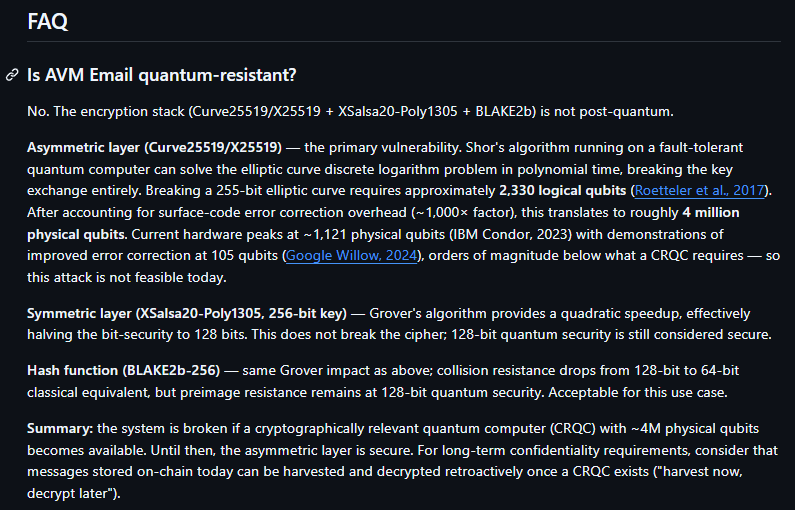
Also Allan will comment shortly with a snippet of the new PQ disclaimer in FAQ

edited
Allan
↩ in reply to Atsoc1993

I have a background in Computer Science, though I admit that the topic of quantum cryptography extends somewhat beyond my area of expertise. I added an FAQ and looked into references from some articles that I considered relevant both to inform and to provide context that, although post-quantum computing represents a potential threat, it is not yet imminent in the current landscape. I understand that the ideal scenario would be the absence of this risk entirely and the assurance that such data could never be decrypted in the future.

edited
Atsoc1993

Let’s add it to the “Frequently Asked Questions” section on the website as well as the Repo you showed here @Allan

joe-p
↩ in reply to Atsoc1993

The ideal solution is you just let users choose whichever server they want to use. You could make a server for them and create their account (and have them change their password), but I think it makes much more sense to just let both users decide which server they want to use (could be their own, could be a popular one like matrix, could be one you setup, etc.).

The main problem is that it doesn’t really matter if its imminent. There is simply no way to protect ECC-encrypted data once its on the chain. The HN;DL attack starts today. This is why the type of data that is being stored is critical. For example, if it’s my hand in poker, no big deal because that information won’t matter over a short time horizon. I don’t care if everyone can read that in a few years. PII on the other hand may be much more sensitive information that I don’t ever want to leak.

Presumably the users of AVM Email use it because they don’t trust centralized servers to handle their data correctly. Putting ECC-encypted data on-chain, however, is definitely mishandling the data if it is sensitive.

Allan

I fully understand the point you raised, and I do think it’s a very valid one.
What concerns me more is that this analysis comes from a single perspective of use. And even though it’s a strong perspective (which I acknowledge), it ends up overlooking several other scenarios where email plays an important role.
It doesn’t have to be seen only as a personal or sensitive communication channel. It can function as a purely informational medium, a newsletter hub, a two-factor authentication component, or even as an integration layer within a stack of services built around the user of that email address.
In other words, reducing the project to a single use case ends up ignoring the flexibility it can have across different contexts.