This forum is a read-only archive. Posting, replying and signing in are disabled.

xGov 165: Proposal to build NFT Bridge between Algorand and EVM based networks

FoundryKev

Hey all, you can find below our proposal 165 for an NFT bridge between Algorand and the various EVM based networks. Looking forward to hear your feedback, comments, and questions.

xGov 165: Proposal to build NFT Bridge between Algorand and EVM based networks

Edit:

Abstract

Messina.one intends to build an Ethereum <> Algorand NFT bridge by leveraging its existing expertise in the bridging space. Messina believes that enabling native bridging of NFTs between networks helps to grow the domain by opening up various opportunities for creators on Algorand.
Messina already built and deployed an NFT bridge between Polygon and Cronos and will benefit from the experience and existing in-house technology. Messina also developed a new NFT standard that ensures exclusivity of NFTs and allows for only one unique NFT to ever be alive on chain at the same time.
The bridge would allow seamless transfer of NFTs between Algorand and all EVM based chains including, but not limited to, Polygon, Ethereum, Base, Optimism, Arbitrum, and Avalanche.

Team

The Messina.one team consists of several experienced professionals across the various web3 domains such as development, product management, marketing, and community.

Jonathan Kay, CEO
A seasoned entrepreneur with a background in decentralised applications, operational support, and transformative ventures.

Mike Knott, CTO
An industry expert with accomplishments in transformative change across a number of technology disciplines.

Derine Loke, Product Manager
A motivated and results-driven product manager leading cross-functional teams with a zeal in building innovative web3 solutions.

Kevin Vernooij, Partnerships & Community
A passionate community builder who spent over a decade in enterprise customer management before taking his expertise into the web3 space.

Chester, Tech Lead
Deep knowledge and skill in Web3 development. Proven expertise in guiding teams in creating advanced blockchain applications and smart contracts.

Experience with Algorand

Messina.one deployed the first native token bridge on Algorand to connect the network with various other ecosystems. Messina also launched its Algorand Governance Liquid Staking solution with mALGO in September 2023.
On top of the products delivered by Messina.one, the same team is also the driving force behind Algo Foundry. Algo Foundry on boarded numerous developers to Algorand through its academic interface programs and developer courses, in addition to building products like AlgoSafe.
The team of Messina.one has been involved with the Algorand ecosystem since its inception and worked closely with the Algorand Foundation on various projects.
From top to bottom, the team has close relationships with the Algorand community on all levels and led the way through numerous partnerships with many leading Algorand players and founders.

Present Proposal

Phases
1 - Requirement Analysis & Product Design
Define project objectives and gather stakeholder needs and create the blueprint and architecture for the bridge.
Estimated Duration: 1-2 weeks

2 - Development, Integration, and Testing:
Design, code, and program the solution. Combine various components and conduct rigorous tests for functionality.
Estimated Duration: 4-6 weeks

3 - Security Audit:
Work with a reputable auditor for a thorough review of compliance and security.
Estimated Duration: 2-4 weeks

4 - Deployment & Launch:
Implement the project into a live environment and launch the bridge.
Estimated Duration: 1-2 weeks

Total Estimated Duration: 10-12 Weeks
Estimated Requirement: 300000 ALGO

*All durations are strictly estimated and may vary.

Benefits for the community

By connecting the EVM and AVM (Algorand) NFT ecosystems, Messina.one is enabling further cross chain integration and community growth in the NFT domain. It will give NFT communities in the Algorand space easy access to a greater audience and creators the opportunity to leverage their creative talent to bring new users into the Algorand ecosystem from EVM chains.
At the same time it allows NFT projects on EVM chains to explore the superior Algorand network at a lower cost and without spending big resources to launch an entire collection, and instead bridge parts of existing collections to test the waters first.
Through these benefits it brings more buyers, more traders, and more capital into the Algorand NFT landscape, adding more diversity and creating an altogether more attractive ecosystem for all NFT stakeholders alike.

edited
Richflairstv

Hello Kev,

A couple questions, Algofoundry and Messina are owned by the same people? Are there others under this brand that should be included?

You have already built a bridge to polygon and cronos, which is great. Do you have any metrics or campaign efforts that have seen demand or show promise for future bridges for NFTs?

Adri

Can you edit your post to include all the proposal info here? The idea of this forum is helping people who are not familiar with github to evaluate your proposal.

FoundryKev
↩ in reply to Richflairstv

Hi! That’s right. Messina I’d say is a spinoff brand of Algo Foundry, as you can also see on the Messina website when you scroll to the far bottom - it will say Powered by Algo Foundry.

Parts of the dev and marketing team also work with AlgoRai, which you could say came through the Algo Foundry studio, but has a different owner and product team.

The Polygon and Cronos bridge was built in collaboration with an NFT Game on Cronos called D.G. Pals who were seeking to go cross chain with existing NFTs. I’d need to get back to you about metrics.

When we announced the launch of that bridge, we had a lot of comments and requests from the community about wanting one for Algorand. Building a bridge is costly though and expecting a stand a lone NFT project, which is often a single individual or a small group at most and not externally funded or profit driven, to carry those expenses is probably unrealistic. Hence this proposal.

We haven’t spoken with any NFT projects or creators specifically about concrete plans to go cross chain, but we have seen the rise of interest in cross chain activities among the community for both tokens as well as NFTs.

Richflairstv

I like the idea of more bridging and crosschain opportunities. Do you know if this is built what the overhead would be to keep from being shelved if market conditions are not good in the next 6-8 months?

FoundryKev

I’ll check the official response and post tomorrow - but unofficially, 2022-23 was a pretty terrible year and bear market and the token bridge wasn’t shelved :slight_smile: so I’m sure it’ll be okay. But let me confirm and get a proper answer.

algoistheway

Thanks for this overview! This seems like an exciting opportunity for our Algorand NFT community. I too am interested in the stats for the Polygon and Cronos bridge.

Additionally, would you please expound on the stakeholder engagement process? Two weeka could be a good timeline with the riggt proceas. Thanks in advance for your response. Cheers!

FoundryKev
↩ in reply to Richflairstv

So our overhead is relatively low at the moment, and a new NFT bridge won’t add much to it. The cost is mostly a capital expense and not an operational expense. We also have quite a robust runway. So bad market conditions shouldn’t affect the availability of Messina products much.

lobo

Why would people bridge their NFTs? Do you have any numbers on how much NFT bridges are used at all? I dont see people using it really.

FoundryKev

I assume you’ve read our proposal and went through what we believe are the benefits to the community. But in case not.

Why would individual people bridge their stand alone NFTs? I don’t see that either unless they simply prefer to hold an asset on a chain of their choice. That’s possible of course. Maybe you see a cool NFT project you like on … BASE - but you don’t want to separate your NFT holdings between chains so you bridge it across to Algorand to consolidate it in one place.

Why would creators bridge parts of their collections or apply a multi chain philosophy without locking a collection in the vacuum of a single network, I definitely see that. The USP of an NFT bridge is more for creators and NFT projects, than it is for individual holders or collectors.

I’d refer you to that section in the proposal as I’d just be repeating what’s already written there.

lobo

tbf there is not a lot in that proposal besides the classic “if you wanna test out algorand maybe bridge some assets over” :smiley:

Dont see how individual users will use it. It has to be the creator who wants to go multichain and has an easy way to do so via your bridge. Holder benefits are tied to the NFT for example so the creator would have to put in work to give someone these benefits even if they bridge their NFTs over. Also I dont see a lot of NFT projects really trying to go multichain tho and I feel like it could be a dead bridge because of that. Do you know how many NFT projects tried using portalbridge to go multichain for example?

FoundryKev

I mean, sometimes that’s all it takes. Plenty of tokens going the same route. We submitted this proposal because there was an ask and interest from the community in building it for Algorand after we had announced the bridge for Polygon and Cronos. We see value in the bridge for NFT projects and creators both ways, which will strengthen the ecosystem as a whole. Instead of creating and minting an entirely new collection, existing collections can be moved across and a presence can be created step by step on other chains. But yes, there needs to be an effort from the creator space to make it a success. Tools to do this right now are scarce and cumbersome, Messina will make it fast and seamless with it’s own NFT standard that allows for just 1 NFT to ever be alive on chain (mint and burn).

There is a clear interest in cross chain activity and many agree multi chain is the way to go to grow. Look at the reaction on the Algorand / Hedera partnership. It’s better to have the tools in place for when that boom happens, than waiting for the boom and coming to the conclusion the infrastructure isn’t ready yet.

leaf

For example, if someone bridges a BAYC to algorand. You can then list it on algorand nft marketplace.
Would there be any data for buyers to see? like would they know the ranking, purchase history etc?

Could be a problem for nft marketplace to handle fake cross-chain NFTs imo.

DragMZ

Hi, what are the open source deliverables here? Thanks!

DragMZ

Thanks, what do you mean by a build? Does it include any analysis/design documents and/or security audit contracts or is it just some of the software source code?

FoundryKev
↩ in reply to leaf

Good questions! The meta data is copied along to the new NFT on the new chain, in this scenario Algorand - so that would bring along anything that’s in the metadata, like accessory info, rarity data, ranking and so on. Purchase history is usually not recorded on the meta data. But our minting process will create a proof of authenticity tag in the metadata which will include a reference to the original NFT that is locked on the mother chain. So through that tag, people can find the original and see purchase history there. Hope that helps!

leaf
↩ in reply to FoundryKev

Thank you, thats very cool! Just to be clear, when someone mints an ARC19 updateable metadata NFT on Algorand, and then bridges the NFT over to Eth. One can edit the metadata on algorand chain, and effectively update the traits showing up on Eth as well. The proof of authenticity can keep up with updates? This could be a nice way to update and edit NFTs from other chain all on Algorand with low txns cost.

Stitch
↩ in reply to FoundryKev

Hi Kev

Couple of questions… interested in the method of bridging

You say it’s a new NFT standard and there’s mint and burn… does this mean an Algorand NFT bridging to a new chain would be burnt - thus losing it’s provenance? And if it were to be bridged back, it would be reminted with an entirely new ASA ID?

When assets are bridged from the EVM to Algorand - are they created under a shared creator account?

If they lose the ASA ID and lose the creator account - how would a creator/collection manage this? It feels closer to a migration ↔ migration solution.

Unless im understanding wrong?

FoundryKev

Right so I have not explained it correctly actually. The original NFT, minted by the creator from the creator address on the native chain, will always continue to exist but will be locked on the bridge when it’s moved across to another chain. A new version of it will then be minted on the new chain where the meta data is copied across and a proof of authenticity tag will be included to refer back to the locked original. This new version on the new chain can then be treated or traded as usual backed by the locked original.

The new NFT can also be moved between chains, but it won’t be locked like the original and cannot be recovered. Only 1 copy will ever be in existence in addition to the original. So the first bridge, is lock and mint. Any subsequent 2nd or 3rd bridge is burn and mint. If the owner of the copy would want to move back to the original chain, you can do so and the copy is then burned and the original unlocked.

The creator account question I need to check with the devs if that’s a unique Messina creator account, or if there is some other solution where there is different creator accounts. My assumption is there will be 1 unique creator account operated by the bridge.

I don’t fully understand your question about losing the ASA ID and creator account.

FoundryKev
↩ in reply to leaf

Thanks for the inputs! Every time the NFT is moved to another network, the meta data will be copied.
However, the original will always be locked on the birth chain, so if you move back to that original, it will unlock the original without the changes you may have done to the metadata on another chain.

Stitch
↩ in reply to FoundryKev

Cheers! My question about ASA ID was related to the mint and burn NFT standard mentioned - it sounded like through this standard you’d have to burn the original to bridge as “only one unique NFT to ever be alive on chain at the same time” - then if bridged back a new NFT would be created (assumingly under a Messina controlled account and with a new ASA ID). But it sounds like it’s actually a case where the original is just locked in an escrow.

The creator account question is really related to the usefulness of a global bridge solution like this. If a creator decided they wanted to bridge say 50% of their assets to try a new eco - there’s almost zero incentive for them to do so if they don’t have ownership of the creator account/bridged assets on the new chain - and resulting royalties etc. It sounds like they wouldn’t? Or is there a solution that considers this? Say can a creator make the destination account that all bridged assets from a specified collection are minted to? Without a system like that it would make it almost exclusively a user bridge - and historically they’ve had very little adoption.

Typically creators build custom migration solutions for this reason

simonb

I like the idea. Few questions:

  • How are you different from https://bridge.xp.network/
  • which algorand NFT standards will you support, does that include multimints and fractionals
  • how are royalties going to be handled on the “target” chain
  • how are collections / creators handled

There is a lot of stuff that portal bridge(wormhole) and xpnetwork both do right in this regard, asnd as some pointed out before me, royalties and the creator rights are a big deal in NFT space. there is very little point in bridning a NFT to eth or vice-versa, if it won’t be treated as part of the XYZ collection.there.

FoundryKev
↩ in reply to Stitch

You’re right. That should have said “one copy” is ever alive on chain. The original will continue to exist and can always be returned to by whoever owns the copy that contains the proof of authenticity.

Royalties are dealt with differently across ecosystems and marketplaces individually. Opensea for example removed the embedded royalty process if I’m correct and now using tips, MagicEden is using some sort of royalty registry where you register the receiver address, and EXA market is using a more traditional method of baked in royalties during the minting process.

When you’re dealing with a bridge across up to a dozen networks and even more marketplaces across those ecosystems, it’s hard to take into account every opinion about royalties. Some would say royalties are a must, some would say a buyer is a buyer and royalties are no more than a friendly gesture. Some will have opinions in between.

The incentive to bring collections into other ecosystems I’d say is project growth and expanding your community to new holders without launching an entirely new collection, which is then stuck on that new network and you can’t mixup your collections or create cross over activity between holders on different ecosystems. The main incentive for a creator would be mobility of NFTs and therefor access to a bigger audience.

Do you have any references for any of these custom build migration solutions? I’m curious to learn how a creator may have build a multi chain mobile NFT collection across various networks, while also considering this royalty and creator account stuff. If someone has managed to create that already, then let’s definitely promote and amplify that instead.

FoundryKev
↩ in reply to simonb

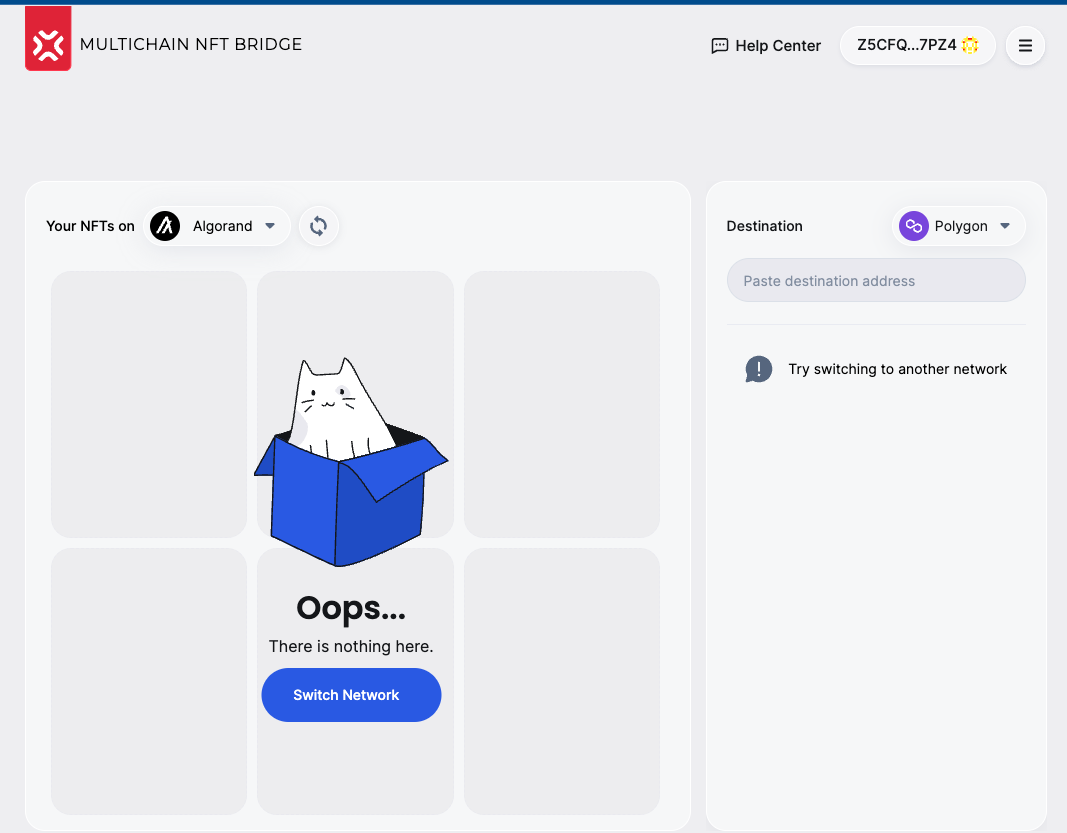
I actually got excited when I first saw this Bridge XP, and if it would work - depending on how their methods are - our bridge wouldn’t be a whole lot different. I tried to use it for Algorand and Polygon though and only got as far as this - and this wallet is full of NFTs. So I am not sure if it works.

Regarding royalties, I’d refer you to my response to Stitch. It depends on how the marketplace deals with it. Baked in royalties that tie to the creator address are not carried over. I can ask the devs to think about it, but I don’t really see a way of dealing with that at first thought.

How collections / creators are handled I don’t entirely know what you’re referring to. Do you mean like how a multi chain collection is registered and showcased on a marketplace of some sort? My simple response would be that it depends on the methods and process of registration of collections of said marketplace.

Stitch
↩ in reply to FoundryKev

With regard to royalties im not sure opinion on them really matters, but how a bridged NFT behaves…

If you end up with NFTs that are not able to be verified by marketplaces, royalties (enforced or not) that are lost and sent to escrows and NFTs that don’t have any access to project utilities (on Algorand normally gated by creator wallets and/or a fixed database of ASA ID’s) you end up with very little use case/appeal for this kind of application.

Custom migrations have worked better - DeGods/y00ts being the main success story migrated from SOL to ETH/Poly (then Poly → ETH :smiley: ). Tinyhorses have a custom solution to manage their project across Algo/XRP (you can burn/remint as much as you like between both chains). Gorcians built a migration solution to migrate from Algorand to Polygon - it worked as intended, altho project seems abandoned since…

The difference with these custom migration solutions is the creator keeps ownership/control of the accounts on both side of the bridge - which means they can enable utility from one chain to another, can verify project with marketplaces, receive royalties depending on marketplace policy etc…

An open ended bridge anywhere solution hasn’t found a market fit that I’ve seen - as they basically undo the properties that grant NFT ownership any benefits.

FoundryKev

The royalties I’ll be honest, I am not too concerned with. Personally I have the, maybe unpopular opinion, that once a sale has taken place, the creator has earned their share. Secondary sales after that are on the open market and between the seller and the buyer.

Project benefits though I think is a better point. I agree when benefits like access to ecosystem features or airdrops are automatically tied to the creator address, this could be a problem when the creator address is the bridge account. I do think the creator, who would also be the one doing the bridging in this scenario, can probably figure it out based on asset IDs. But let me put this question to the devs and see what they think.

When you say they migrated, what was the method of migration in these cases? Lock and mint, burn and mint, what was the user interface like?

Either way, we need inputs like yours and other people that have been in the NFT creator space a long time and know what they need and what would work for them. So thanks for showing up!

Stitch

Migration was slick and easy to use. y00ts especially as all the signing could be done from Phantom wallet. All migrations I’ve used are burn/mint. There’s no ‘original’ and ‘wrapped’ version.

There’s a reason they don’t use off the shelf tools like NFT bridges that I’ve already outlined.

Stitch

ME/Opensea worked with y00ts to preserve trade history

Gorcians just started over

FoundryKev

Alright, so that’d be a one way, one time migration then more than a mobile bridge where you can go back and forth. I can’t immediately think of a reason to move back and forth other than secondary market activity and people moving somewhere else with their newly acquired NFTs, removing as many mobility barriers for digital assets as possible.

So I sympathise on the need for a creator to have control of the creator address to manage the collection, benefits, royalties if you may, and so on. In the current technical roadmap, the creator address on the EVM side would be the same for all mints, and on the AVM side the same story.
I admit I can see that becoming messy if any scaling were to take place and multiple collections start to bridge through the same creator address. We’ll give this some thought!

edited
Stitch

Exactly, and good luck with that secondary market activity with your unverifiable NFT that is either completely hidden in marketplaces or bulked together with hundreds of other bridged NFTs from random collections. After hyped new drops, daily/weekly secondary volume charts are king for discoverability… all gone with bridged NFTs - the increased liquidity/users you thought existed becomes completely inaccessible.

If you can come up with a solution that allows a creator to customise the bridge to be either one-way or two-way, and have owned creator accounts on both sides with the escrow SC in-between… then you start to get a useable tool.

Keep in mind tho that most would gravitate to chains with more users and such a tool could well shrink the Algo NFT eco instead of growing it

Reasons to migrate here are speed/fees: most applicable to gaming NFT market I would think.

Consolidating collections to a single wallet makes little sense to me: I’m a collector on multiple chains and have never felt like the need to take on bridge risk just to hold on a single chain as I’d invariably lose access to those communities and have to bridge back to trade anyway.

leaf

Will a smart contract be able to track sales on another chain just from stateproof and handle royalties lol? that would solve the creator account problem on the other chain. A NFT minter on algorand where it manages these NFTs on another chain sounds pretty cool for a creator.

FoundryKev

Hi! You can do that already through our Messina.one token bridge. If there are any tokens you’re interested in bridging and think would do well on Algorand, let us know on Twitter or Telegram.

GhostOfMcAfee

My apologies if this has been lost in the shuffle, but is there a way to make it so that an EVM creator address is somehow tied to the asset upon bridging? Would your proposal include that ability? I think it is important to include provenance when it comes to bridged NFTs.

FoundryKev

Hi! This sort of happens through the proof of authenticity tag which is added to the metadata that includes data such as purchase history that is not part of the original metadata and it includes a reference to the original NFT on the mother chain. So through this tag, you can find the creator data also.